Sunday, February 10, 2008

a quick trip to chile!

i had a nice, though exhausting, short trip to chile!

the ocean water was so cold that i didnt swim the entire 8 months i was in chile last year.... but this warm summertime sunday, we played in the waves!


it was good to see again my british sister that i met chile! ;)


i took a bus trip into the grape-vine-lined valley, to the small town of vicuna...


... where i explored the bug museum!


la serena always provides entertaining night life!


the chilean cuisine provided particularly delightful adventures this trip!


redshift and the distance to distant galaxies

this weekend i gave a public talk entitled a long time ago, in galaxies far, far away. it was great fun to prepare and present a talk with pretty pictures after giving so many technical talks lately! based on the responses i received, i thought i would share a popular segment with everyone here!


in order to talk about galaxies far, far away, you have to know how far away the galaxies are! it turns out that determining the distance to astronomical objects is not a trivial matter! for very distant galaxies, the best way to determine their distance is by looking at their spectra in order to determine their "look-back time" or their "redshift."

to do this, we point a telescope at a galaxy, collect the photons of light coming from the stars in that galaxy, and then send those photons through a complicated prism system, in order to see the galaxy's rainbow!


the different colors of the rainbow correspond to different wavelengths of light.


each galaxy has a unique rainbow fingerprint ("spectrum"), although some general properties are universal. the simple rainbow fingerprint below shows a nearby galaxy that has several lines, produced by hydrogen, in its spectrum. the existence of these lines and the relative spacing between them are well understood by physics and quantum mechanics.


since light has a finite speed that it travels (the speed of light is 300,000 km/sec or 670,000,000 mph!), it takes light from a distant galaxy some amount of time to travel through space to us! when we determine how long the light has been traveling thru space, we know how far away the galaxy was when it released the photons of light that eventually landed on our lucky telescope! this time is called the galaxy's "look-back time" and goes from very small up to 13.7 billion years (the age of the universe).

sounds simple enough, but how can we determine this??

the key piece of information is that the universe is expanding!! as the light from a galaxy innocently travels thru space for a couple billion years, space itself is expanding! as the light wave travels, space expands and the wavelength of light gets stretched out with space!


the original wavelength of a photon of light when it left the galaxy, is stretched out as it travels thru space so that it is a longer wavelength by the time it reaches us and lands on our telescope mirror. each of the lines from hydrogen are shifted to longer wavelengths!


we compare the spectrum of a distant galaxy to a very nearby one to see how far a particular line has shifted. the farther the shift, the farther away the galaxy, the earlier in the history of the universe the light was produced inside the galaxy! from the amount of shift of a line in a galaxy's spectrum, we get the galaxy's redshift which is a number between zero and something very large (greater than 100). note that what i've described is the galaxy's "cosmological redshift" (as opposed to a doppler redshift).

mathematically, the redshift, z, is equal to the ratio of the wavelength of light that we observe to the emitted wavelength of light as it was when it left the home galaxy, minus one.


a galaxy with a redshift of one (z=1), emitted the light we observe about 8 billion years ago, when the universe was about 6 billion years old!


here's an example of a real two-dimensional galaxy spectrum, showing the intensity of various lines of hydrogen in addition to oxygen and sulfur.

Saturday, February 9, 2008

Thursday, February 7, 2008

upside down orion!

i'm thrilled to be under southern skies again!

in general, when i walk outside of a roofed-structure at night, i look up immediately to see what stars and planets are out, in order to get acquainted with my relative time and location... just 4 days ago, i eagerly awaited the southern summer sun to set so i could look up to see orion upside down (!) and the southern cross above my head… reminding me how far around the other side of the earth i’ve come for this job interview!


i survived my interview, but i have to say it was the most intense one i've had! wow.... i was relieved when it ended, but of course i circled all my responses over and over in my head afterwards, wondering about their "correctness." i tried to be as honest as i could be without getting bogged down with worries about what the "right" answer was they might be expecting. i think i succeeded at this point, but their detailed questions have given me interesting things to ponder for the last couple days!

i leave this evening to head back to the northern hemisphere. i'm excited to discuss the universe a long time ago, in galaxies far, far away!

Saturday, February 2, 2008

darwinian valentine's day

did anyone get up early enough to see the conjunction of venus and jupiter? i almost did, but not quite. let me know if you got any good pictures!

this afternoon, i'm leaving on a jetplane for the spanish-speaking wonderland... chile! i'm extremely excited to be heading back to my home of most of 2007!! the main purpose of the trip is for a job interview (think good thoughts for me!), but i also plan to visit old friends, drive to the mystical valley, drink some pisco sours, eat an empanada or four, hopefully listen to fantastic folk music, and lounge a bit on the beach!


i might not be able to post much while traveling, so i leave you with a challenge... enter the darwin valentine's day card contest being held by the skepchicks!!! i think this is a hilarious idea, and i'm feeling inspired to try to come up with something even half as clever as the one they share...


good luck!

space flight: challenges always re-enter

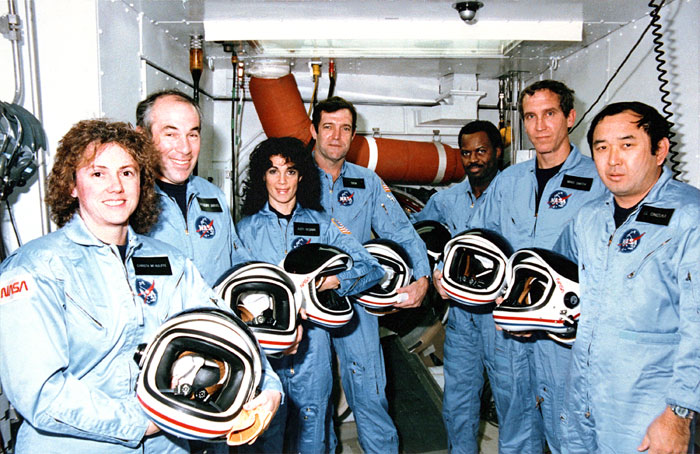
this week we're reminded to learn from our mistakes... by not forgetting them! three major NASA-related events that have helped shape our image of space exploration, all occured in various years during this week. for a more developed summary, see professor astronomy's blog. i'll just mention the two events that i remember from personal experience.

1) on January 28, 1986, the shuttle Challenger exploded. i was young at the time, but i have a very vivid memory of the moment. my class was privileged to watch the launch live and we were all very excited! i sat on the floor, next to my best friend jessica, looking up at the TV. the image of the liftoff and the arc made by the smoke in the air is very vivid in my mind. then the line grew into an unexplainably big puff ball while white streaks shot out to the sides.


the explosion seemed surreal and confusing. my young mind's first thought was "that's odd. i don't think that was supposed to happen." it was ultimately the reaction of the teachers in the room that made me understand the seriousness of the situation. i remember deciding at that moment that i did NOT want to be an astronaut!


2) On February 1, 2003 i was in west texas observing at the mcdonald observatory. i was there for an 8-night observing run on the 2.7m telescope and became excited when i heard the shuttle columbia would pass over texas on its way to landing in florida! depending on the shuttle's final descent path, i would be able to see it crossing the sky, low to the north, early in the morning. i followed NASA's liftoff webpage all night to track columbia in its orbit, in anticipation of seeing the shuttle! while i finished up some morning calibration exposures, i stood out on the catwalk that surrounds the telescope.... looking off to the north.

NASA estimated that the shuttle would pass by between 7:30 and 8am (central time, of course), so i watched from about 7:30 until 8:15am (it was february and cold on the mountain top!). The sun had risen by 8am and since the shuttle would have crossed the sky very low on the horizon, i suspected that i would not see it at all. so i finished the night's observing a little disappointed having not seen the shuttle. i closed down the telescope, walked across the road to my dorm room and went straight to sleep.

it wasnt until i woke up around 4pm that i found all the other astronomers gathered around the TV watching CNN. i was surprised, to say the least, when i heard the news that columbia had broken apart during re-entry! most of the visiting astronomers and observatory staff there were very emotional about the event. this created a somber atmosphere as we discussed the effect of the 3000 degree heat generated during re-entry and our speculations as to what could have happened. as the shock slowly wore off and the reality set in, i reflected on my thoughts that early morning as i waited to see the shuttle.

i think professor astronomy sums them up, and provides excellent insight into these events... so i will leave you with a quote from his blog:

It is important to remember these people and accidents. These men and women willingly put their lives at risk to explore space, bravery that deserves recognition. But also, each of these accidents may have been preventable. A string of human errors and cultural issues led to each accident. These errors are much easier to see in retrospect than they were ahead of time, and so we should be careful in assigning blame to freely. Yet we can and must learn from these mistakes to protect future lives; to ignore these lessons would be an unforgivable failure.

Finally, we should all recognize that more lives will be lost in the future. Space travel is extraordinarily dangerous. As private companies also begin to open space to civilians, we must accept that there will be accidents and lives lost, and most of these will probably be due to human error. Let's just hope that those errors are due to exploration and humankind's pushing of the envelope, and not due to our failure to learn from our history.

when imagination becomes reality

here is an amazing project where Yeon Doo Jung, a korean photographer, takes drawings by children and turns them into reality by staging real photoshoots! that must be such a cool feeling as a kid to have so much effort going into creating your personal design! see more at wonderland 2005...


i found this via neat-o-rama

Friday, February 1, 2008

carnival o space - #39

this week's collection of astronomy musings has been collected at sean welton's visual astronomy.

around christmas, many people asked me about what kind of telescope they should buy for their backyard sky watching. assuming the successful purchase of a telescope, i refer you to sean's excellent list of ten essential astronomy accessories. i find especially useful: a good chair, star charts, a red flashlight, warm clothes and various eye pieces. one thing that doesnt make his top ten, but i definitely enjoy when possible, is a tasty beverage kept warm or cold in a good thermos! enjoy!