Showing posts with label astrophotography. Show all posts

Monday, January 25, 2016

Five things we know about the universe that will make you feel very small

Here is an article I contributed to ABC Science, originally posted here.


Five things we know about the universe that will make you feel very small.

One thing we know about the universe is that it's really big. Another is that thinking about it and trying to understand it will make your brain hurt.

Astronomer Amanda Bauer takes us through her top five mind-expanding things we know (or don't know) about the universe.

1. There is no edge of the universe
PHOTO: Full-sky map of the oldest light in the universe (NASA/WMAP Science Team)
There is one edge we know of - our horizon, which is the limit of how far we can see.

Imagine sailing on a boat on the ocean and seeing a horizon in the distance, past which you know there is more Earth, but you just can't see it. We've measured the universe to be flat (as opposed to curved like Earth or saddle-shaped), but our horizon exists because of the finite speed of light.

Beyond that visible horizon, we think the universe just keeps going in the same way - forever.

We have no reason to believe there is an edge. But we also have no way of measuring this infinity because we physically cannot see it.


2. Dark matter and dark energy make up 95 per cent of the universe

PHOTO: A composite image showing the galaxy cluster 1E 0657-56, better known as the bullet cluster. Gravitational lensing was used to locate the dark matter (shown as blue patches) in these two colliding galaxies. The pink colour shows gas blown apart by the collision. (NASA/Chandra X-Ray Observatory)

Only 5 per cent of the universe is made of ordinary material like planets, stars, cars, and coffee. This "normal matter" is made mostly of protons, neutrons, and electrons.

Another 24 per cent is an exotic material that interacts through gravity, but produces no light, making it invisible to us. We call this "dark matter".

While dark matter only interacts with normal matter very weakly, particle physicists have plausible candidates for what dark matter is.

Hopefully particle accelerators like the Large Hadron Collider will provide more insight for scientists very soon.

That brings us to the final 71 per cent of the stuff in the universe, which is a truly bizarre type of matter. Perhaps it's not matter at all, but a property of the universe itself. We call this mysterious stuff "dark energy".

What we do know is that dark energy has a gravitationally repulsive effect that is causing the expansion of the universe to speed up. But we don't understand how this acceleration is happening.


3. There is no centre of the universe

PHOTO: In a way, we're all at the centre of our own universe. (NASA/Ames/JPL-Caltech)
The universe has been expanding ever since the Big Bang 13.8 billion years ago.

But the Big Bang should not be imagined as a normal explosion in space. Rather, the Big Bang is an explosion of space itself, so that every point in space expands equally away from every other point in space. There is no centre to the expansion.

From our galaxy we measure that all galaxies are moving away from us, and the farther the galaxy, the faster away it is moving.

The interesting thing is that if you zoomed off to any other galaxy in the universe, you would measure the exact same effect - all other galaxies would be moving away from you.

In this way, you could argue that you are the centre of the universe. But then, so is everyone else.


4. Far-away galaxies offer a glimpse into the past

PHOTO: At 3 million light years from Earth, the Triangulum galaxy is even further away than Andromeda, so gives us a glimpse even further back in time. (NASA)
When we look at distant galaxies, we are actually looking at a snapshot of the past.

Some galaxies are located so far away their light takes billions of years to reach us, even travelling at the speed of light. The images we collect through our telescopes tell us what the galaxies looked like billions of years ago, when the light left the galaxy.

Andromeda is the nearest spiral galaxy to our Milky Way. It floats at a distance of 2.5 million light-years, so the views we capture of Andromeda show us what it looked liked 2.5 million years ago. And that's the closest spiral galaxy.

The farthest galaxy we have detected is 13 billion light years away. This means we are looking at galaxy light as it was only 2 billion years after the Big Bang.

We will never capture light from the future though, only the distant past.


5. The future will be dominated by black holes

PHOTO: Pretty much all galaxies have a supermassive black hole at their centre. This one, a spiral galaxy known as NGC 4258, also has two unusual spiral arms that glow in X-ray, shown in purple. (ASA/CXC/JPL-Caltech/STScI/NSF/NRAO/VLA)
We are currently in the Stelliferous Era - meaning the universe has a lot of stars. This era began a few hundred million years after the Big Bang when the very first stars formed.

Now, almost 13.7 billion years later, new stars continue to form, although the number of new stars forming each year is dropping.

Eventually, new stars will stop forming and all stars will slowly burn out. But in that very distant future, supermassive black holes will still thrive.

It's believed that nearly every galaxy in the universe has a supermassive black hole at its centre, which means that eventually hundreds of billions of supermassive black holes will be spread throughout our ever-expanding universe.

Over trillions and trillions and trillions, and many more trillions, of years these black holes will slowly evaporate through Hawking Radiation.

The leftover elementary particles will be left to zoom through a vast, cold space with nothing much around to bump into.

Sounds very empty.

Friday, December 25, 2015

special full moon on christmas day

today's full moon is the first on christmas day in 38 years.  the year was 1977 - when Star Wars Episode IV was released!

via NASA

without any spoilers - i really enjoyed the new star wars, the force awakens, released this holiday season.  i enjoyed most of the new characters they introduced, including Rey, who is a major character.  but how pathetic that she's not included by several retailers?   DO BETTER HUMANS!

From Jamie Ford on twitter

anyway, happy holidays, everyone!

Monday, August 10, 2015

A 2dF night at the Anglo-Australian Telescope

A new video from AAO!

"A 2dF night at the AAT" assembles 14 time-lapse sequences taken at the 4-metre Anglo-Australian Telescope (AAT) located at Siding Spring Observatory NSW, Australia. This time-lapse video shows not only how the Two Degree Field (2dF) instrument works but also how the AAT and the telescope dome move in tandem, and the beauty of the Southern Sky in spring and summer.   
The video is 2min 50sec long and combines more than 4000 frames obtained using a CANON EOS 600D with a 10-20mm wide-angle lens. All sequences were taken during September and November 2011 by astronomer Dr Ángel R. López-Sánchez while he was working as the 2dF support astronomer for the AAT. The music is the song “Blue Raider” from Composer Cesc Villà's album “Epic Soul Factory”

Sunday, July 19, 2015

2015 David Malin Award Winners

Here is the first batch of winning astrophotos from the annual David Malin Awards contest.  These are absolutely stunning captures from non-professional astronomers around australia!

Overall Winner: "Stellar Riches" by Troy Casswell


Deep sky winner: "The Fighting Dragons of Ara" by Andrew Campbell

Nightscape winner: "Aurora Treescape" by James Garlick

Solar system winner: "Solar Crown" by Peter Ward

Sunday, June 28, 2015

kalaya - beautiful australian night sky timelapse

the australian night sky never disappoints, especially when viewed from far out into the outback.  a talented australian astrophotographer, greg priestley, was able to capture the milky way and the "emu" rising above uluru and kata tjuta in may 2014.

kalaya is the aboriginal word for emu.

beautiful work!

Kalaya - David Malin Awards from Greg Priestley on Vimeo.

Monday, June 22, 2015

planetary pair: venus & jupiter approaching!

venus is incredibly bright in the evening sky right now, and if you get out and LOOK UP, you won't miss the other bright object right by it - the planet jupiter!  they will keep getting closer and closer to each other over the next week and a half, culminating in what will appear to be a very bright double star system on july 1st.

it's quite a beautiful sight - make sure you enjoy it!  read more by tanya munro at the conversation.

here was the view from Brno, Czech Republic as photographed by Pavel Gabzdyl.

Photo by Pavel Gabzdyl

the view it turned around from the southern hemisphere!  this shot was taken by chris wyatt in australia.
Photo by chris wyatt

Monday, April 20, 2015

astro anecdotes

there are all sorts of astronomy folklore stories passed down through generations of astronomers.

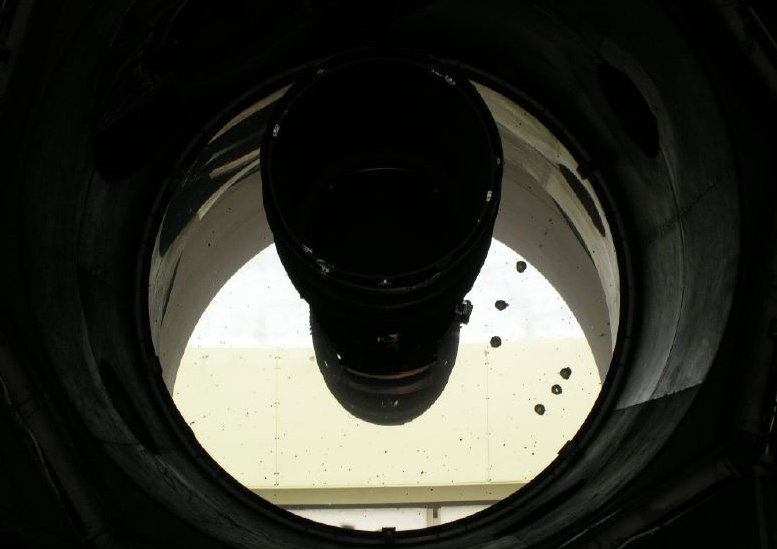
did you know that the 107'' telescope at McDonald observatory has bullet holes in the primary mirror?

Six bullet holes in the primary mirror of the 2.7m telescope at McDonald Observatory.
Photo credit: McDonald Observatory.

I used to observe with that telescope all the time during my PhD and it was always fun to walk down the solid tube to see the "damage" up close.   the six holes only block 1% of the light and were filed smooth and painted black to stop any reflected light from invading the observations!

there is a blog now dedicated to recording all these stories i keep hearing over a beer at the pub - and many more i havent yet heard in person!

you can read them all here: astro anecdotes.

Sunday, March 22, 2015

total solar eclipse - svalbard

did you see the total solar eclipse on march 20th, 2015?

my friend geoff sims was up to capture him consistently amazing photos of the events from Svalbard.


and one from 35,000 feet, collaboration with Glenn Schneider.


i'd like to see a thorough movie of his experiences and eclipse photos.  here's a preview of that possibility.  support their kickstarter if you want to see it to!


i missed it unfortunately, but i absolutely have plans to be in the US on August 21st, 2017 ;)

Wednesday, March 18, 2015

aurora australis

last night the skies over a lot of australia and new zealand glowed - the aurora australis.  this photo was captured in perth, western australia by colin legg.


you can also see the milky way shooting across the sky and the large magellanic cloud - a small irregular galaxy smudged just at the top of the red glowing gas.

the southern hemisphere night sky is so lovely.

Friday, February 20, 2015

Observing Galaxies with SAMI

I've been out at Siding Spring Observatory for the last week observing galaxies for the SAMI survey with the 4-metre Angle-Australian Telescope (AAT).  Here's the story. 

arrive at siding spring observatory and hope to see crisp blue skies above the telescope dome.


check the instrument hardware


plug the optical fibres into SAMI field plates.  each of the silver ones will look at individual galaxies. the orange ones look at sky. 


hope that you get to go for a ride with SAMI at prime focus (spot the astronomer!)


take a walk around the catwalk to enjoy the view of the warrumbungles and check the sky


get comfortable in the control room, where you will spend most of you waking hours for the next many nights. (there are a lot of monitors around!)


check the software to make sure it works (SAMI uses python mostly)


check software that talks to the instrument (SAMI) on the telescope


take some calibration frames and look at the raw data to check that it looks ok.


once the sky is dark and the stars are shining in the all-sky camera, focus the telescope and start collecting photons!


enjoy seeing those squiggles in SAMI raw data - gas in a distant galaxy! Each horizontal line is a single spectrum ("rainbow fingerprint") from a different place across the face of a galaxy. The very bright white streaks are cosmic rays, while the vertical dotted lines are glowing gas in Earth's atmosphere. squiggles show gas doppler shifted as it swirls around the center of the galaxy far, far away.


a quick reduction of SAMI galaxy data! each bundle on the right covers a single galaxy and has 61 individual optical fibres looking at a different spots across each galaxy. the left shows a quick reduction of the spectra collected from the light in each fiber. the squiggly lines show gas emission in the galaxy (hydrogen, nitrogen and silicon here). a single exposure points at 13 galaxies for a total of 800 spectra!


replug the fibres in the SAMI field plate in the spooky light of the middle of the night.


start to get goofy in the wee hours of morning by noticing you blend in with the couch.


and again the next night, unintentionally!


take a walk around the mountain during the days to get some sun and enjoy the views!


adding it all up, this observing run was 5 nights long, during which we collected new data for 84 galaxies!  that means we have 5,124 individual spectra.  woohoo!

the SAMI run continues for another five nights, but my shift is finished and i drive back to sydney tomorrow.  time to get back on a day schedule. 

Wednesday, February 18, 2015

timelapse of the sun

An AMAZING timelapse video of our Sun, our star, made of 5 years worth of high resolution images from NASA’s Solar Dynamics Observatory. Wow!

Wednesday, January 7, 2015

Astronomy in the Park - Sydney

if any sydneysiders read this ...

I'll be participating in Astronomy in the Park this Friday at Centennial Park in Sydney. I'm giving a talk around 8pm and then the star-gazing begins! Let me know if you're interested - I can give you a ticket discount code.

sign up HERE.


Hubble turns 25

This April 24th marks the 25th anniversary of the launch of the Hubble Space Telescope!?!   hard to believe the old girl has lasted this long and continues to be used by astronomers to produce some AMAZING science and images.


Friday, January 2, 2015

jupiter in a blue sky

have you ever spotted jupiter during the daylight hours?   i have not, but philip cruden has, and captured this great photo that even shows one of the galilean moons!


Tuesday, November 18, 2014

bouncing on a comet.

humans landed a robot on a comet last week for the first time.  yeehaw! a collaboration of scientists and engineers from 20 countries made this happen through the european space agency.

the rosetta spacecraft traveled through the solar system for 10 years, getting gravity assists from earth a few times and mars before reaching its destination: Comet 67P/Churyumov-Gerasimenko.

space craft selfie with its solar panel and comet 67P

the philae lander drifitng away from rosetta on its way to comet 67P

the philae lander spotting its landing site

unfortunately, philae did not stick the landing and drifted and bounced twice across the surface. scientists werent exactly sure where philea drifted to at first, but this morning released this compilation of images from Rosetta's camera OSIRIS. WOW! at the time, Rosetta was 15.5 km from the comet's surface. the images have a resolution of 28 cm/pixel and the enlarged insets are 17 x 17 m.

Credit: ESA
this is what philea saw upon settling still.  captions by emily lakdawalla.


philea now rests still, in hibernation.  it landed in a spot that doesnt have enough sunlight to supply energy to its working solar panel.  luckily, the little robot managed to collect all the data it was designed to collect during its short initial lifespan, AND it successfully sent all the data back to earth.
it's an exciting time for all those scientists.  i hope they got some sleep after a few days of incredible activity.  lots of science to do now.... i cant wait to hear what they find!

for your entertainment, watch the event as is played out through randall munroe's live-comic-blogging!  relive the experience here:  xkcd1446.org


Monday, October 20, 2014

watching comet siding spring approach mars

i work with a very interesting doer-of-all-astronomy-tech-things steve lee (of "Steve and the Stars" fame).  over the last couple nights, as comet siding spring has rushed towards mars at 56 km/s, steve has been taking images using two of his own telescopes that live near siding spring observatory in new south wales, australia.

the distant astronomical objects i study in the universe do not really change or move noticeably in the time that i've been studying them (or even over a human lifetime).  so i find it very exciting to be able to watch a comet zoom across a field of view over the period of 24 hours!

here are two images of comet siding spring, mars, and milky way dust taken 24 hours apart using the same setup (90mm refractor + Canon 6D, 7x1min exposures summed), but cropped slightly differently. you can clearly see the motions of both the comet and mars again the background stars and dust contours of the milky way galaxy.

Comet Siding Spring, Mars, and Milky Way dust taken 18 Oct 2014 by Steve Lee
Comet Siding Spring, Mars, and Milky Way dust taken 19 Oct 2014 by Steve Lee 

now for a different comparison - here is an image of the same region of sky, but captured through a different telescope setup and exposure detail (31cm f/5 Newtonian + Canon 6D,  single 2 minute exposure).

Comet Siding Spring, Mars, and Milky Way dust taken 19 Oct 2014 by Steve Lee
cool stuff.

Sunday, October 19, 2014

comet siding spring and mars

Comet C/2013 A1 (Siding Spring) will pass within 139,500 km (86,000 miles) of the surface of Mars at 5:51 tomorrow morning (Monday 20 Oct, Sydney time - or 19 October at 18:51 UTC).  This means Comet Siding Spring will pass 10 times closer to Mars than any (recorded) comet has flown by Earth!  But it will be traveling at 50 km/s which is too fast to be captured by Mars's gravitational pull.

Comet Siding Spring was discovered by Rob NcNaught at Siding Spring Observatory in New South Wales on 3 January 2013.  Last night Steve Lee took this beautiful image of Comet Siding Spring and Mars against the dusty backdrop of the Milky Way using a 90mm refractor and Canon 6D camera, from a location VERY CLOSE to siding spring observatory!

Comet Siding Spring, Mars, and Milky Way dust (Photo by Steve Lee (AAO))
 
The comet is still composed of the pristine material the solar system was made from, which will give insights into the formation of planets!

more info about the comet from Dr bruce betts:


For a list of ways to view the comet (if you dont have your own telescope or are covered in clouds), see The Planetary Society blog by the great Emily Lakdawalla here

Thursday, October 16, 2014

steve and the stars

i'm SO EXCITED to finally get to reveal this short film "steve and the stars" to everyone. i worked with the bluebottle group to produce it for the AAO. i think it captures the excitement and wonder, that cosmic vertigo that comes when thinking about our place in this unfathomably huge universe of ours. so lucky to be able to do this as my job!


the official blurb and behind-the-scenes shots while filming in july 2014!

Ever wonder what it's like to stay up all night using a world class 4-metre telescope?

In celebration of 40 years of discovery with the AAT, the AAO has made a short film, Steve and the Stars. 
The star of the show is Head Telescope Operator, Steve Lee, who has worked at the AAT for almost its entire 40 years of operation. 
Steve guides this video tour of working with the AAT, exploring how observational techniques have changed from the 1970s to today's digital age, and the AAT’s exciting future pursuing more world-class discoveries.

The live footage was shot and edited in July 2014 by Bluebottle Films with time-lapse material by AAO's Angel Lopez-Sanchez.

just hanging with the tarantula nebula and the large magellanic cloud :)

danielle and james from bluebottle films.  great to work with them!


Never tire of sunrises on siding spring observatory

with david malin, one of the stars of the show!