bad news, the hubble mission has been postponed until next spring :(
in short, no data is being sent from hubble to earth. NASA thinks they can put together a quick fix while astronauts train to accomplish the news tasks scheduled for the spring mission. a lot of training is needed for the simplest tasks, even for these amazingly capable space walkers! hopefully we'll be able to receive data again in a few weeks, and repair many things in addition to adding new instruments in the spring.
lots of people reporting on this so i'll direct you to other places for more details info:
NASA
dynamics of cats
julianne at cosmic variance
bad astronomy
NY Times
Tuesday, September 30, 2008


Monday, September 29, 2008
vinyl sound waves
its unfortunate to think how much is created and preserved with current technology, which will probably not be available at some point in the near future as technologies change. the print on old books fades, the floppy disk with my high school english writing project is unreadable, unless i buy a record player i cannot accept the wonderful gift of micheals jackson's bad on vinyl from my mother, all the cassette tapes i collected in college of live shows by various bands are now gone, etc...
here's an art installation by jean shin that nicely summarizes the point.

it's called "sound waves" and was highlighted in a NY Times article. the artist melted old vinyl records and "the resulting structure speaks to the inevitable waves of technology that render each successive generation of recordable media obsolete."
here's an art installation by jean shin that nicely summarizes the point.

it's called "sound waves" and was highlighted in a NY Times article. the artist melted old vinyl records and "the resulting structure speaks to the inevitable waves of technology that render each successive generation of recordable media obsolete."
space welcomes the chinese taikonauts
china has become the third country to develop an independent space program to put its "taikonauts" in space (the others being the US and russia). you can watch a video showing the first chinese space walk, which is interesting. something i noticed in the video is that the chinese space mission control center seemed a little... tight, didnt it?
here's NASA's mission control center in houston:

here's the russian mission control center:

and here's the chinese one they show in the video!?

is it just me? they seem rather tighly squeezed into those rows! or is this not the real control center?
here's NASA's mission control center in houston:
here's the russian mission control center:
and here's the chinese one they show in the video!?

is it just me? they seem rather tighly squeezed into those rows! or is this not the real control center?
Sunday, September 28, 2008
writing about the LHC
chris wilson at slate wrote a great article called: atomic prose - Why can't science journalists just tell it like it is when it comes to particle physics? he eloquently describes the challenges faced by journalists while covering the workings of the large hadron collider (LHC), and ultimately, how they have failed.
some excerpts i particularly enjoyed:
he also shares yet another gem from richard feynman's impeccable ability to describe complicated phenomena...
some excerpts i particularly enjoyed:
No one ever said writing about particle physics was easy—the field of quantum mechanics shares a kind of proverbial inscrutability with rocket science, and nonscientists are understandably reluctant to dig in. But the best way to meet that challenge is to address it head-on, with clear analogies and straightforward language. The puzzles of the subatomic world—and specifically, the quest for the Higgs boson, a particle theorized to endow all others with mass—are interesting and entertaining in their own right; dressing them up in florid language only adds another layer of confusion between the author and the reader.
...
On the whole, the best writing about physics for a general audience seems to come from physicists, not journalists. This isn't due to the fact that physicists understand the subject matter better—if anything, people who spend all day in the lab are often the worst at explaining the big picture. Rather, they're better at writing about physics because they don't try so hard to make you care. They don't believe their readers must be seduced with colorful wordplay or end-of-the-world melodramas. Journalists writing popular treatments of subatomic physics could take a lesson from the scientists: Tell it straight and have a little faith that the subject matter itself—a major advance in our understanding of the cosmos—can generate its own wonder and excitement.
he also shares yet another gem from richard feynman's impeccable ability to describe complicated phenomena...
Feynman was fond of comparing the process of exploring the atom to smashing two pocket watches together and then trying to figure out how they worked by examining the debris—an analogy that neatly captures how particle physics is a distinctly forensic exercise.
Saturday, September 27, 2008
carnival of space - 72
this week's carnival of space is hosted at twisted physics - unravelling our strange universe.
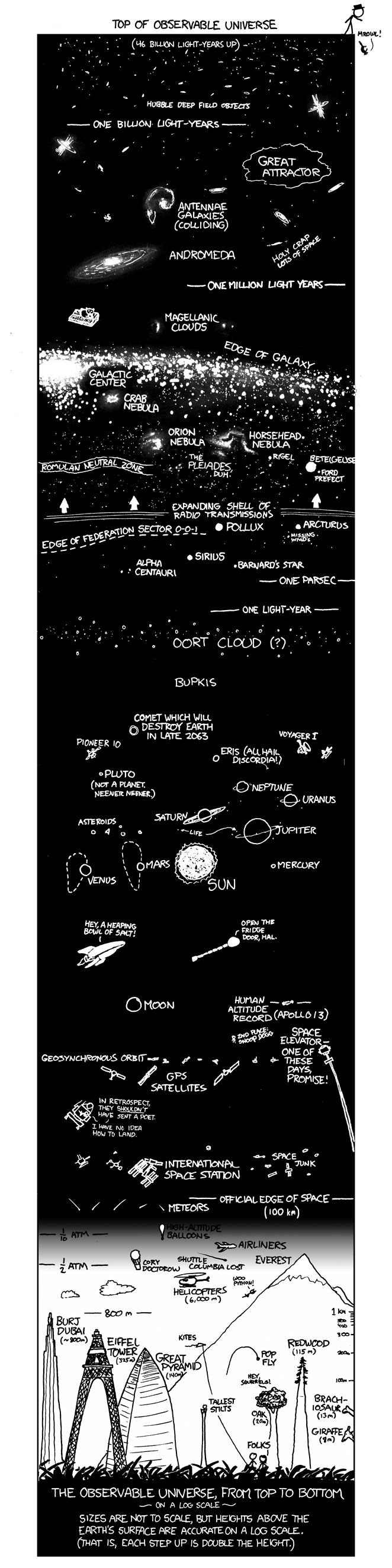
i contributed an entry showing the relative sizes of objects in our solar system and other well-studied stars.
i contributed an entry showing the relative sizes of objects in our solar system and other well-studied stars.
Friday, September 26, 2008
this doorway is no more

this doorway is no more! it has ceased to be! it has expired.
this is an ex-doorway!!
seen in oxford, england.
Thursday, September 25, 2008
shuttle to hubble delayed
complications resulting from hurricane ike has delayed the target launch date for space shuttle atlantis' STS-125 mission to work on the hubble space telescope. now we can forward to october 14, 2008 at 10:19 p.m EDT.
in light of the atlantis launch delay, the shuttle endeavour's STS-126 supply mission to the International Space Station has also been delayed a few days. now they will try to lauch endeavor on november 16 at 7:07 p.m. EST.
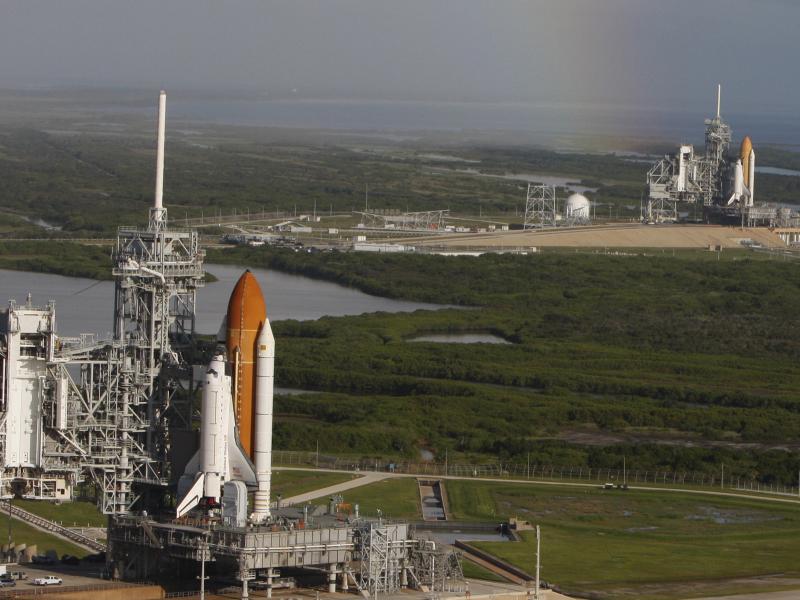
you can read a bit more from nancy universe today, who also found the wonderful picture above, released by NASA, showing both shuttles on the launch pad: Atlantis and Endeavour on pads 39 A and B.
in light of the atlantis launch delay, the shuttle endeavour's STS-126 supply mission to the International Space Station has also been delayed a few days. now they will try to lauch endeavor on november 16 at 7:07 p.m. EST.
you can read a bit more from nancy universe today, who also found the wonderful picture above, released by NASA, showing both shuttles on the launch pad: Atlantis and Endeavour on pads 39 A and B.
pin hole cameras
seeing these creepy pinhole cameras at boy of blue indistries reminded me of a cool post by julianne at cosmic variance a while ago describing the
effects of pin hole cameras found naturally in every day life. dont know if i'd like to use the skull-version of the ancient pin hole camera, but it looks cool and is functional!


"a 4”x5” camera made from Aluminium, Titanium, Brass, Silver, Gem Stones and a 150 year old skull of a 13 year old girl. Light and time enters at the third eye, exposing the film in the middle of the skull."

effects of pin hole cameras found naturally in every day life. dont know if i'd like to use the skull-version of the ancient pin hole camera, but it looks cool and is functional!


"a 4”x5” camera made from Aluminium, Titanium, Brass, Silver, Gem Stones and a 150 year old skull of a 13 year old girl. Light and time enters at the third eye, exposing the film in the middle of the skull."

Wednesday, September 24, 2008
LHC - down for the count
...at least until the spring of 2009, anyway.
considered by most to be the most complicated piece of technology ever created by human kind, it's no wonder that a couple technical glitches finally suspended operations at the large hadron collider. as a press release from CERN revealed yesterday, a large helium leak and a faulty electrical connection have stopped scientists ability to slam proton beams together at amazingly high speeds! well, they actually hadnt started the collision phase yet, but now they wont be able to try again until at least next spring, while they fix the present malfunctions!

the image above is a small hint at things to come. it shows "the debris of particles picked up in the detector's calorimeters and muon chambers after the beam was steered into the collimator (tungsten block) at point 5." cool!
considered by most to be the most complicated piece of technology ever created by human kind, it's no wonder that a couple technical glitches finally suspended operations at the large hadron collider. as a press release from CERN revealed yesterday, a large helium leak and a faulty electrical connection have stopped scientists ability to slam proton beams together at amazingly high speeds! well, they actually hadnt started the collision phase yet, but now they wont be able to try again until at least next spring, while they fix the present malfunctions!

the image above is a small hint at things to come. it shows "the debris of particles picked up in the detector's calorimeters and muon chambers after the beam was steered into the collimator (tungsten block) at point 5." cool!
Tuesday, September 23, 2008
relative sizes
i never get tired of visual effects used to showcase the relative sizes of planets and stars.
the music is Rubber Bullet by stakka and K Tee. i found the video from digg via neat-o-rama.
if you like this, check out the powers of ten video by the eames, played to the galaxy song by monty python: HERE.
or see how hurricanes relate to spiral galaxies and brain cells relate to large scale structure in the universe!
the music is Rubber Bullet by stakka and K Tee. i found the video from digg via neat-o-rama.
if you like this, check out the powers of ten video by the eames, played to the galaxy song by monty python: HERE.
or see how hurricanes relate to spiral galaxies and brain cells relate to large scale structure in the universe!
Monday, September 22, 2008
claire de lune - bossa nova
laurindo almeida not only transcribes my favorite piece, claire de lune, into a beautiful guitar piece, but he also adds some bossa nova flair! i'm extremely impressed by both of these skills!
i loved playing this piece so much when i first learned it, that i wrote a little report on the history of the song and claude debussy for my high school french class. i even recorded myself playing the song and played it for the class as i gave my broken-french report. the thing that aggravated me the most was that the teacher took points off my grade because the title "claire de lune" was wrong. she claimed it should be "claire de la lune." from a grammar perspective, i understood her point, but i argued that i wasnt about to change the name of a song given to it by the french composer! she didnt agree, i didnt change the name, and my grade was marked down. i was livid... and apparently i'm still a little perturbed by her. oh well. i still love the song!
thanks for the heads-up from the jackass penguin show.
i loved playing this piece so much when i first learned it, that i wrote a little report on the history of the song and claude debussy for my high school french class. i even recorded myself playing the song and played it for the class as i gave my broken-french report. the thing that aggravated me the most was that the teacher took points off my grade because the title "claire de lune" was wrong. she claimed it should be "claire de la lune." from a grammar perspective, i understood her point, but i argued that i wasnt about to change the name of a song given to it by the french composer! she didnt agree, i didnt change the name, and my grade was marked down. i was livid... and apparently i'm still a little perturbed by her. oh well. i still love the song!
thanks for the heads-up from the jackass penguin show.
Saturday, September 20, 2008
carnival of space - 71
for your space reading pleasure, check out the 71st installment of the carnival of space at .astronomy (clever name for a blog!).
Friday, September 19, 2008
LHC == Halo
as readers of the blog have informed me, they've changed the public name of the large hadron collider to "halo". the new name is fine, although its unfortunately lacking onomatopoeia. oh well.
i thought the suggestion of "The One Ring" was pretty funny. any other ideas?
i thought the suggestion of "The One Ring" was pretty funny. any other ideas?
Thursday, September 18, 2008
the bottle to bang - small pie collider - LHC
here are two very interesting and very different descriptions for how the large hadron collider (LHC) works.
the first is the "small pie collider" from an enthusiastic "mad scientist" who gets major points for creativity! (although the analogy doesnt relate all that well to the LCH, in my opinion.)
the second is an excellent visualization video called "the bottle to bang," created by chris mann at CERN.
the first is the "small pie collider" from an enthusiastic "mad scientist" who gets major points for creativity! (although the analogy doesnt relate all that well to the LCH, in my opinion.)
the second is an excellent visualization video called "the bottle to bang," created by chris mann at CERN.
NASA student ambassador - IYA 2009
as part of NASA's participation in the international year of astronomy (IYA 2009), applications are being accepted until sept. 29, 2008 to be a student ambassador.
good luck all!! let us know the results!
The NASA International Year of Astronomy Student Ambassadors Program is designed to encourage undergraduate and graduate students to participate in NASA's IYA activities and to help generate excitement about NASA scientific discoveries in astrophysics, planetary science and solar physics within their local communities and beyond. These students will serve as role models to others in the community.
Up to 52 students will be selected for a one-year award of up to $2,700. Students will receive a $2,000 stipend and up to $700 for reimbursement of materials, supplies, and travel expenses for the execution of their activities.
Two NASA IYA Ambassadors will be selected to participate in the IYA Opening Ceremony in Paris, France, January 2009 and each will received a travel allowance of up to $5000. Only undergraduate students are eligible for this component.
Participate in activities that align with the NASA IYA goals “to offer an engaging astronomy experience to every person in the country, nurture existing partnerships, and build new connections to sustain public interested in astronomy” to help generate excitement.
Full details and instructions, including an online application form, are available at http://spacegrant.org/niya/. The National Space Grant Foundation administers this program under a grant from NASA. Applications are due Sept. 29, 2008. Questions about this opportunity should be directed to webmaster@spacegrant.org
good luck all!! let us know the results!
Wednesday, September 17, 2008
milky way and andromeda collision
we all live on a pale blue dot we call earth, which orbits around the sun, along with many other planets, rocks, and dust, to form our solar system. the sun, along with about 400 billion other stars, make up our the milky way galaxy. the milky way galaxy is one of the biggest galaxies inside our gravitationally bound local group of galaxies. there are roughly 45 observed galaxies in our local group. the milky way and the andromeda galaxy (M31 - shown below) are the largest galaxies in our group, while the others are all tiny little asymmetrical things like the clouds of magellan (small and large), the draco dwarf galaxy, the carina dwarf spheroidal galaxy, et cetera, and my new personal favorite: dwingeloo 1 (i just think the name is awesome)!

the milky way and andromeda galaxies dominate our local group. they dance around each other, spinning in circles around their shared gravitational center, while all the small galaxies cluster around the two big ones. slowly, the two massive spiral galaxies will shrink the distance between them, spiraling closer and closer, until they eventually become one galaxy. i say they are moving slowly because it will take them another 4 billion years or so to fully merge, but andromeda approaches the milky way at 300,000 km per hour!!!
our visual intuition of what a galaxy merger looks like is generally not what really happens. you see no massive fireworks that you might assume would occur when those billions of stars smash into each other. the thing is... stars nearly *never* come into violent contact! the distance between individual stars is so huge, that even though both andromeda and the milky way have hundreds of billions of stars each, it will be very unlikely that any two will get close enough to feel each others heat! just think that our sun's nearest stellar neighbor, alpha centauri, is 4 light years away! it takes *light* 4 years to travel to the closest star to our sun. thats *very* far away! even inside of densely packed globular clusters, star dont collide.
so if nothing explodes when galaxies collide, what do mergers look like? here are some examples of simulations that show the eventual merging of andromeda and the milky way. the merger will take place in about 4 billion years, so nothing to fear... don't worry! in fact, if humans were still around as that time approached, it would be fantastic because you could see the andromeda galaxy shining in the sky! you can see it now with the naked eye as a tiny little smudge... if you know where youre looking on a very clear night.
here's a quick video showing how the two massive galaxies will come together. the first time they go near each other, they pass thru each other like ghosts (no fireworks). gravitational forces dominate the interaction, drastically warping each galaxy.
this excerpt from a full program shows the collision in a bit more detail. the video clip describes the sloan digital sky survey during the first 4 minutes (this is where the galaxy zoo gets its millions of galaxies), and then shows visualizations of the milky way - andromeda collision starting around minute 4. they also show what the night sky might look like from earth's surface when the warped milky way disk and the beaming bright andromeda spiral dominate the view!
here's a scientific simulation produced by the N-Body Shop at the university of washington. props to them for displaying their very cool, physically motivated simulations on youtube for all to enjoy! this video shows how the milky way galaxy may have formed, with many small objects coming together under gravity's influence to form one galaxy.

the milky way and andromeda galaxies dominate our local group. they dance around each other, spinning in circles around their shared gravitational center, while all the small galaxies cluster around the two big ones. slowly, the two massive spiral galaxies will shrink the distance between them, spiraling closer and closer, until they eventually become one galaxy. i say they are moving slowly because it will take them another 4 billion years or so to fully merge, but andromeda approaches the milky way at 300,000 km per hour!!!
our visual intuition of what a galaxy merger looks like is generally not what really happens. you see no massive fireworks that you might assume would occur when those billions of stars smash into each other. the thing is... stars nearly *never* come into violent contact! the distance between individual stars is so huge, that even though both andromeda and the milky way have hundreds of billions of stars each, it will be very unlikely that any two will get close enough to feel each others heat! just think that our sun's nearest stellar neighbor, alpha centauri, is 4 light years away! it takes *light* 4 years to travel to the closest star to our sun. thats *very* far away! even inside of densely packed globular clusters, star dont collide.
so if nothing explodes when galaxies collide, what do mergers look like? here are some examples of simulations that show the eventual merging of andromeda and the milky way. the merger will take place in about 4 billion years, so nothing to fear... don't worry! in fact, if humans were still around as that time approached, it would be fantastic because you could see the andromeda galaxy shining in the sky! you can see it now with the naked eye as a tiny little smudge... if you know where youre looking on a very clear night.
here's a quick video showing how the two massive galaxies will come together. the first time they go near each other, they pass thru each other like ghosts (no fireworks). gravitational forces dominate the interaction, drastically warping each galaxy.
this excerpt from a full program shows the collision in a bit more detail. the video clip describes the sloan digital sky survey during the first 4 minutes (this is where the galaxy zoo gets its millions of galaxies), and then shows visualizations of the milky way - andromeda collision starting around minute 4. they also show what the night sky might look like from earth's surface when the warped milky way disk and the beaming bright andromeda spiral dominate the view!
here's a scientific simulation produced by the N-Body Shop at the university of washington. props to them for displaying their very cool, physically motivated simulations on youtube for all to enjoy! this video shows how the milky way galaxy may have formed, with many small objects coming together under gravity's influence to form one galaxy.
Tuesday, September 16, 2008
signs of nottingham
advertising is a funny thing. when i visit foreign countries whose languages i barely speak, adverts remain a bit of a mystery, as i must gather information thru colors, shapes, and product placement. in england, i speak the language relatively well, and have discovered some highly entertaining labels and signs! enjoy!
not everyone takes refuge in maths and physics...

why is this word so freaking difficult to spell?!?

spam stores? off license? what is this store trying to sell me?

i wasnt sure what this little old-fashioned camera sign meant. i looked around for a "scenic view" but didnt really find one. so i figured it was telling me to take a picture of *it*!

they could probably use a bigger sign to advertise their yoga class. this single sheet of paper was posted on the side of a gigantic stone church building!

ah, robin hood....

... your style is legendary. even thru the bus window on a rainy day.

an innocent little poker game sitting in the corner of a pub.
(quid : pounds :: bucks : dollars)
brilliant name!

can i have one non-innocent smoothie, please? (and no banana flavored milk, yuck!)

this might be one of the best-spotted and least-safe-for-work pictures i've ever taken...

i first noticed it from the bus window before the red writing was added and i thought to myself.... that sign is just begging for graffiti! it took about 2 more days before it happened! the sign only stayed up for a day or so, but i managed to get a shot ;)
not everyone takes refuge in maths and physics...

why is this word so freaking difficult to spell?!?

spam stores? off license? what is this store trying to sell me?

i wasnt sure what this little old-fashioned camera sign meant. i looked around for a "scenic view" but didnt really find one. so i figured it was telling me to take a picture of *it*!

they could probably use a bigger sign to advertise their yoga class. this single sheet of paper was posted on the side of a gigantic stone church building!

ah, robin hood....

... your style is legendary. even thru the bus window on a rainy day.

an innocent little poker game sitting in the corner of a pub.
(quid : pounds :: bucks : dollars)
brilliant name!

can i have one non-innocent smoothie, please? (and no banana flavored milk, yuck!)

this might be one of the best-spotted and least-safe-for-work pictures i've ever taken...

i first noticed it from the bus window before the red writing was added and i thought to myself.... that sign is just begging for graffiti! it took about 2 more days before it happened! the sign only stayed up for a day or so, but i managed to get a shot ;)
Monday, September 15, 2008


man pole spam
occasionally i glance thru my spam filters just to make sure everything is working properly and i havent missed any important emails. today i found a spam email with possibly the best title ever:
"super size your man pole now"
just so you know.
"super size your man pole now"
just so you know.
Sunday, September 14, 2008
2008 paralympic photos
there's an incredible series of photo of the 2008 paralympic games at the big picture from boston.com.
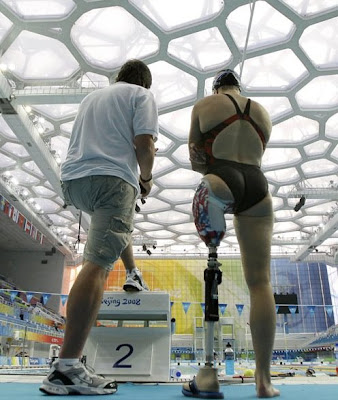
this is melissa stockwell of the USA. she is one of two US veterans competing in the beijing games, who were injured in iraq.

this is melissa stockwell of the USA. she is one of two US veterans competing in the beijing games, who were injured in iraq.
Friday, September 12, 2008
folks near cincinnati, ohio!!
to all my family and friends near cincinnati,
this saturday, september 13, there is an all day, family-friendly event called SCOPE OUT at the cincinnati observatory at Mt. Lookout. if you didnt know that this was the first public observatory in the US, or one of the oldest operational telescopes in the country, then you should definitely go check it out!
the events during the day are free, and you can register for the evening dinner featuring a very exciting keynote speaker... *the* bad astronomer himself, phil plait! here we are in austin last january during the AAS meeting. he's the second from the left....

the events take place from noon - 10:30, with the dinner from 6-8pm. i hope you can go and enjoy this great feature of my home town!
this saturday, september 13, there is an all day, family-friendly event called SCOPE OUT at the cincinnati observatory at Mt. Lookout. if you didnt know that this was the first public observatory in the US, or one of the oldest operational telescopes in the country, then you should definitely go check it out!
the events during the day are free, and you can register for the evening dinner featuring a very exciting keynote speaker... *the* bad astronomer himself, phil plait! here we are in austin last january during the AAS meeting. he's the second from the left....

the events take place from noon - 10:30, with the dinner from 6-8pm. i hope you can go and enjoy this great feature of my home town!
Thursday, September 11, 2008
you just blew my mind. (i know)
stuart at the astronomy blog has found the online logbooks of the LHC scientists! how fantastic that they instantly make these available to the public! most entries don't make any sense to those of us not involved in the action, some show awesome graphs of colorful detections, and one demonstrates that physicists can maintain a sense of humor (despite the underwhelming opposition)!
in other LHC news, part 3 (of 5) is my favorite so far of the LHC series at PhD Comics this week.
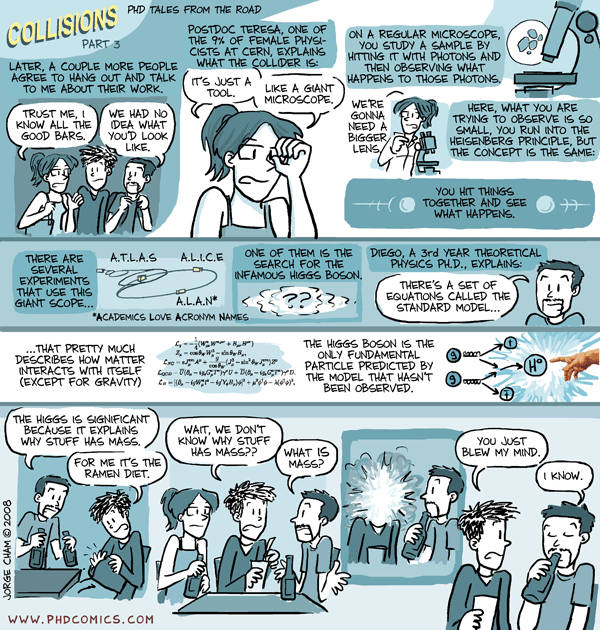
in other LHC news, part 3 (of 5) is my favorite so far of the LHC series at PhD Comics this week.
what teachers make
slam poet extraordinaire, taylor mali, has a message we should all hear:
thanks ze frank for finding and sharing this video... one of the best things i've seen on youtube.
now can we show this to school boards or the legislature or whoever determines teachers's salaries? because teachers are not appreciated enough and DO NOT make nearly enough money for all the crap they have to deal with!
thanks ze frank for finding and sharing this video... one of the best things i've seen on youtube.
now can we show this to school boards or the legislature or whoever determines teachers's salaries? because teachers are not appreciated enough and DO NOT make nearly enough money for all the crap they have to deal with!

refractive macro-photography
an article at scienceray reminds me that i will never tire of refraction in photography.

image by steve took it at flickr

image by scarbody at flickr
image by steve took it at flickr
image by scarbody at flickr
Wednesday, September 10, 2008
Supercollider? I 'ardly know 'er!
i wish i could take credit for the post title, but it comes from the recurring genius of xkcd. if you hold your mouse over the comics, you discover the pseudo-secret punchlines of each comic - which is where i found the title!

the initial stages of the start-up of the large hadron collider (LHC) are going smoothly over in switzerland. this is good news for things to come! you can listen to BBC radio 4 all day as Andrew Caspari sits in the control room to give regular updates.
today they are sending protons into the accelerator for the first time, but they are only sending the proton beams around one direction at a time. they are not actually sending the beams in opposite directions today in order to collide them. that will come at a later date.
cosmic variance is live-blogging the LHC start-up.
PodBlack Cat has up-to-date videos from LHC. exciting!!!
here's a funny video about the LHC by steve punt.
phit plait, the bad astronomer, says his peace about the LHC. again.
PhDcomics has a week-long series about a tour of the LHC from a grad student.
i'm trying to get some work done.
UPDATE!!! the beam of protons has gone all the way around the accelerator in both directions! the LHC has officially been born after over a decade of work. congratulations to all those involved!!
the initial stages of the start-up of the large hadron collider (LHC) are going smoothly over in switzerland. this is good news for things to come! you can listen to BBC radio 4 all day as Andrew Caspari sits in the control room to give regular updates.
today they are sending protons into the accelerator for the first time, but they are only sending the proton beams around one direction at a time. they are not actually sending the beams in opposite directions today in order to collide them. that will come at a later date.
cosmic variance is live-blogging the LHC start-up.
PodBlack Cat has up-to-date videos from LHC. exciting!!!
here's a funny video about the LHC by steve punt.
phit plait, the bad astronomer, says his peace about the LHC. again.
PhDcomics has a week-long series about a tour of the LHC from a grad student.
i'm trying to get some work done.
UPDATE!!! the beam of protons has gone all the way around the accelerator in both directions! the LHC has officially been born after over a decade of work. congratulations to all those involved!!
Monday, September 8, 2008


questions from the weekend
this weekend, i've been asked two questions over and over:
1) is it true that only 5% of all (US) americans have passports?
2) are you scared the earth might end when physicists recreate the big bang on wednesday?
number two is easy to answer: NO!
(and huh? they're not actually recreating the big bang, they're just setting up experiments that produce energies similar to those that occured after the big bang, for tiny itty bity little pieces of time. these types of events occur all the time naturally on earth: cosmic ray events. read more HERE)
as for numero uno, i havent been able to find any solid statistics on how many american citizens have passports, but the average report shows 15% (+/- 10%). this apparently sounds absurd to many british folks, who have dozens of countries so close by that it would seem silly and inconvenient not to have a passport. i dont remember being asked this question when i lived in other parts of the world, but it has been a common theme during my two weeks in the UK!
consider that the average american worker has 2 weeks of vacation a year. this is not a lot of time (and one of the reasons i want to keep working abroad, or stick to the academic lifestyle)! with one of your two weeks, you'll probably visit family around the holidays, and with the other week, you'll go to a beach or a national park or a city in the US. san francisco and florida aren't foreign, but they are far away from the midwest, exotic, and not as intimidating as jumping across an ocean where you most likely dont speak the language.
one week is not a long enough time to travel across an ocean. if youve never been out of your country before, one week is not enough time to get adjusted to the time change, feel comfortable enough to relax, and really experience another culture. with so much diversity inside of one large country, and so little vacation time available, why would the average american need a passport?
i have two large families and only a couple members actually had passports prior to me moving out of the country and convincing them they needed to come visit me!
 image found at flickr by gravitywave.
in all honesty, it's not easy to travel internationally. nearly everyone i've come across in my travels has been wonderfully hospitable, helpful, and friendly. but occasionally i intersect with a person who assumes all americans are hopeless (and/or as crass as our current president). that situation is never fun to deal with.
also, it's difficult to initiate motivation to travel so far away when its so uncommon for your family and friends. my friends growing up went to florida with their families for their week summer vacation, they never considered going to another country! i was fortunate to have two fantastically strong role models in my aunt and older sister! not as many young americans are lucky enough to be so regularly in contact with people who travel internationally. also, i'm lucky enough to have a career that provides me oppotunnities to travel if i want.
in my travels, i've found the perspective gained from leaving my home country to be immeasurable. i've learned to appreciate the amazing convenience of living in the US. with some effort, people truly have the freedom to live the "american dream" and do nearly anything they might want (aside from marrying a person of the same sex, and a few other odd restrictions). what concerns me most is that it's simple to take such freedoms for granted when you never have the opportunity to leave their protection long enough to see the conditions of a place where such freedoms don't exist.
1) is it true that only 5% of all (US) americans have passports?
2) are you scared the earth might end when physicists recreate the big bang on wednesday?
number two is easy to answer: NO!
(and huh? they're not actually recreating the big bang, they're just setting up experiments that produce energies similar to those that occured after the big bang, for tiny itty bity little pieces of time. these types of events occur all the time naturally on earth: cosmic ray events. read more HERE)
as for numero uno, i havent been able to find any solid statistics on how many american citizens have passports, but the average report shows 15% (+/- 10%). this apparently sounds absurd to many british folks, who have dozens of countries so close by that it would seem silly and inconvenient not to have a passport. i dont remember being asked this question when i lived in other parts of the world, but it has been a common theme during my two weeks in the UK!
consider that the average american worker has 2 weeks of vacation a year. this is not a lot of time (and one of the reasons i want to keep working abroad, or stick to the academic lifestyle)! with one of your two weeks, you'll probably visit family around the holidays, and with the other week, you'll go to a beach or a national park or a city in the US. san francisco and florida aren't foreign, but they are far away from the midwest, exotic, and not as intimidating as jumping across an ocean where you most likely dont speak the language.
one week is not a long enough time to travel across an ocean. if youve never been out of your country before, one week is not enough time to get adjusted to the time change, feel comfortable enough to relax, and really experience another culture. with so much diversity inside of one large country, and so little vacation time available, why would the average american need a passport?
i have two large families and only a couple members actually had passports prior to me moving out of the country and convincing them they needed to come visit me!
image found at flickr by gravitywave.in all honesty, it's not easy to travel internationally. nearly everyone i've come across in my travels has been wonderfully hospitable, helpful, and friendly. but occasionally i intersect with a person who assumes all americans are hopeless (and/or as crass as our current president). that situation is never fun to deal with.
also, it's difficult to initiate motivation to travel so far away when its so uncommon for your family and friends. my friends growing up went to florida with their families for their week summer vacation, they never considered going to another country! i was fortunate to have two fantastically strong role models in my aunt and older sister! not as many young americans are lucky enough to be so regularly in contact with people who travel internationally. also, i'm lucky enough to have a career that provides me oppotunnities to travel if i want.
in my travels, i've found the perspective gained from leaving my home country to be immeasurable. i've learned to appreciate the amazing convenience of living in the US. with some effort, people truly have the freedom to live the "american dream" and do nearly anything they might want (aside from marrying a person of the same sex, and a few other odd restrictions). what concerns me most is that it's simple to take such freedoms for granted when you never have the opportunity to leave their protection long enough to see the conditions of a place where such freedoms don't exist.
Sunday, September 7, 2008
peep show - in space
chris lintott shares this video from a project headed by the adler planetarium in chicago. they launched balloons up to 96,000ft to collect data of the atmosphere, and on one flight, a peep tagged along for the ride. enjoy the peep show!
Saturday, September 6, 2008
large hadron collider - the big bad boom!
this wednesday, september 10, 2008, is an exciting day, as the large hadron collider (LHC) at CERN in geneva, switzerland will be run to its full capacity for the first time! some are calling it beam day, while others prefer big bang day. call it what you want, it's certain that people from all around the world are on the edge of their seats in anticipation of the potential results of this experiment! some are so excited, that they've created an LHC rap...
CERN Rap from Will Barras on Vimeo.
the LHC is a huge particle accelerator which will generate beams of protons and collide them into each at great speeds in order to create very high energies, and to see what resulting particles they can detect! protons are particles that fit under the more general heading of hadrons. hadrons are atomic particles made up of smaller particles called quarks. protons are made up of 3 quarks: 2 ‘up’ quarks and 1 ‘down’ quark. protons are advantageous to use for the LHC because they have an electric charge (positive), which allows them to be steered around quite controllably by large magnets! you start with hydrogen atoms (hydrogen is one proton with one electron swooping around it), strip off the electrons so you only have protons left, then accelerate the protons with gigantic magnets and slam them into each other! fun stuff!

we want to look at such high energies, because other places in the universe have really high energies. for example, the centers of stars are incredibly energetic. we can study them pretty well by matching our theories to what light and other particles come out of stars, but we cannot generate similar energies on earth.
the LHC experiment will create energies 7 times higher than any previous experiments on earth, and will attempt to answer deeper questions about the nature of the material we find in the universe. like what is gravity? what happened in the big bang? what happened just after the big bang, but before the cosmic microwave background radiation was emitted? why do some particles have mass, but not all particles? what the heck is dark matter?
and please, please don't worry.... the LHC will NOT destroy the planet!!!
here's a visually pleasing and informative tour of the LHC by dr. brian cox:
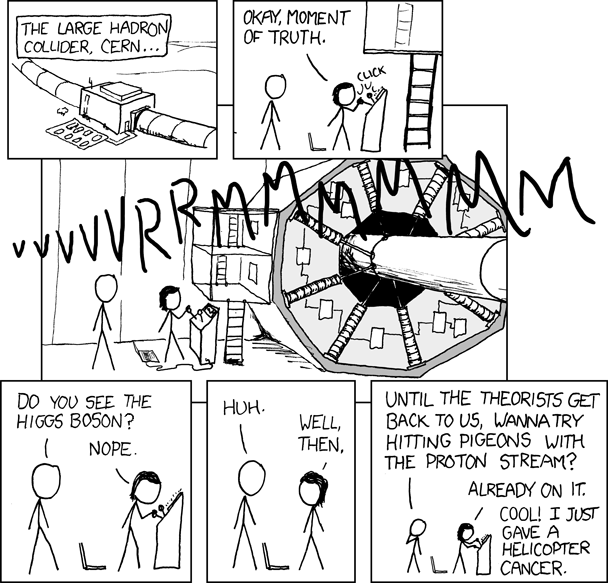
of course xkcd has a great comic about the big day:
you can also check out an interactive game at sciencemuseum.org.uk explaining how the large hadron collider experiment thinks it could detect the higgs boson - HERE.

even with all this exciting attention, dont expect definitive results to cover the front pages of world newspapers within 24 hours of wednesday's experiment. once data is collected, it will take at least a month to analyze and double check all the details. it took many many many years to produce this most complicated machinery, let's have collective patience to allow scientists to properly reduce the data and determine reliable results!!!
UPDATE: for more about the safety and perceived potential hazards of LHC, go HERE and/or read the full analysis from the LHC Safety Assessment Group: HERE.
CERN Rap from Will Barras on Vimeo.
the LHC is a huge particle accelerator which will generate beams of protons and collide them into each at great speeds in order to create very high energies, and to see what resulting particles they can detect! protons are particles that fit under the more general heading of hadrons. hadrons are atomic particles made up of smaller particles called quarks. protons are made up of 3 quarks: 2 ‘up’ quarks and 1 ‘down’ quark. protons are advantageous to use for the LHC because they have an electric charge (positive), which allows them to be steered around quite controllably by large magnets! you start with hydrogen atoms (hydrogen is one proton with one electron swooping around it), strip off the electrons so you only have protons left, then accelerate the protons with gigantic magnets and slam them into each other! fun stuff!

we want to look at such high energies, because other places in the universe have really high energies. for example, the centers of stars are incredibly energetic. we can study them pretty well by matching our theories to what light and other particles come out of stars, but we cannot generate similar energies on earth.
the LHC experiment will create energies 7 times higher than any previous experiments on earth, and will attempt to answer deeper questions about the nature of the material we find in the universe. like what is gravity? what happened in the big bang? what happened just after the big bang, but before the cosmic microwave background radiation was emitted? why do some particles have mass, but not all particles? what the heck is dark matter?
and please, please don't worry.... the LHC will NOT destroy the planet!!!
here's a visually pleasing and informative tour of the LHC by dr. brian cox:
of course xkcd has a great comic about the big day:
you can also check out an interactive game at sciencemuseum.org.uk explaining how the large hadron collider experiment thinks it could detect the higgs boson - HERE.
even with all this exciting attention, dont expect definitive results to cover the front pages of world newspapers within 24 hours of wednesday's experiment. once data is collected, it will take at least a month to analyze and double check all the details. it took many many many years to produce this most complicated machinery, let's have collective patience to allow scientists to properly reduce the data and determine reliable results!!!
UPDATE: for more about the safety and perceived potential hazards of LHC, go HERE and/or read the full analysis from the LHC Safety Assessment Group: HERE.
carnival of space - universe from A to Z
the 69th carnival of space is up at discovery news. irene klotz has cleverly compiled the universe from A to Z.
my suggestions for viewing the september night sky come in at the letter "O":
O is for Observe and some suggestions to blow your mind
my suggestions for viewing the september night sky come in at the letter "O":
O is for Observe and some suggestions to blow your mind
Friday, September 5, 2008
the beckoning of lovely
amy krouse rosenthal initiated a fantastically cool art party among strangers in chicago on 08/08/08 at 8:08 pm. then she made a video for us all to enjoy!

Thursday, September 4, 2008
the riddle of moving to another country
growing up, i absolutely loved riddles, puzzles, and jokes. oh my.
the guesser can ask the riddler yes/no questions until the puzzle is solved:
a man lives on the 14th floor of a building downtown. everyday when he leaves, he rides the elevator down to the ground floor and walks to wherever he is going. when he returns, he takes the elevator to the 8th floor and walks the rest of the way. unless it's raining, then he takes the elevator all the way up to the 14th floor. why?
and so on...
ze frank has created an interactive matchstick version of the first puzzle i really remember solving. my dad introduced it to me one time when he took my sister and i to hear the cincinnati pops orchestra. while we were sitting on the lawn waiting for the performance, he set up this puzzle with some blades of grass.

move two matches to form 4 equal squares, using every match as part of a square in the solution.
i have no idea where he discovered this puzzle or if he even remembers this event. i was occupied and frustrated for a good while, but when i surprised myself by actually solving it, i was hooked for life!
i think my interest in solving puzzles and riddles initiated a curiousity in figuring out how things in the our universe work. i also find that it's an advantage to like such things when traveling around the globe. moving to another country is like a gigantic series of puzzles and riddles (and sometimes jokes that either i dont get, or i'm the only one who understands!).
at least during this move, the language puzzle is more entertaining than frustrating, but there are still constant mysteries to figure out. for instance, what is a person from nottingham called? why do they drive on the left side of the road here, while most of the other countries in the world have chosen to drive on the right? is there really a different and/or proper time to say cheers instead of thank you, or are they completely interchangeable? why is there a mysterious trick to flushing half the toilets i've encountered in this country... and what is it?
there are new puzzles to solve everyday.... and luckily, i thoroughly enjoy nearly all of them (for now)!
the guesser can ask the riddler yes/no questions until the puzzle is solved:
a man lives on the 14th floor of a building downtown. everyday when he leaves, he rides the elevator down to the ground floor and walks to wherever he is going. when he returns, he takes the elevator to the 8th floor and walks the rest of the way. unless it's raining, then he takes the elevator all the way up to the 14th floor. why?
and so on...
ze frank has created an interactive matchstick version of the first puzzle i really remember solving. my dad introduced it to me one time when he took my sister and i to hear the cincinnati pops orchestra. while we were sitting on the lawn waiting for the performance, he set up this puzzle with some blades of grass.

move two matches to form 4 equal squares, using every match as part of a square in the solution.
i have no idea where he discovered this puzzle or if he even remembers this event. i was occupied and frustrated for a good while, but when i surprised myself by actually solving it, i was hooked for life!
i think my interest in solving puzzles and riddles initiated a curiousity in figuring out how things in the our universe work. i also find that it's an advantage to like such things when traveling around the globe. moving to another country is like a gigantic series of puzzles and riddles (and sometimes jokes that either i dont get, or i'm the only one who understands!).
at least during this move, the language puzzle is more entertaining than frustrating, but there are still constant mysteries to figure out. for instance, what is a person from nottingham called? why do they drive on the left side of the road here, while most of the other countries in the world have chosen to drive on the right? is there really a different and/or proper time to say cheers instead of thank you, or are they completely interchangeable? why is there a mysterious trick to flushing half the toilets i've encountered in this country... and what is it?
there are new puzzles to solve everyday.... and luckily, i thoroughly enjoy nearly all of them (for now)!
hubble servicing mission 4
the atlantis space shuttle is preparing to launch on the STS-125 mission to perform the final repairs on the hubble space telescope. it's difficult to describe the impact hubble has had on scientific discovery of the properties of our universe although julianne at cosmic variance is attempting to summarize this, but also on the universal inspiration it has provided human beings. the launch of this mission is set for october 8, 2008.... quickly approaching!

to find out more about the repairs, NASA has a nice video of the hubble telescope servicing mission plan. enjoy!
to find out more about the repairs, NASA has a nice video of the hubble telescope servicing mission plan. enjoy!
Monday, September 1, 2008
spot on!
i received my first piece of mail. not only does it show the first account i signed up for using the title "doctor" (!!!!), but it also demonstrates the entertainingly polite british tone of speech ;)


night sky september 2008
this month provides an early evening of a trio of planets: mercury, venus, and mars. venus is the brightest (magnitude -4) of these three as they all shine in the west, disappearing quickly as the sun goes down. here's the view for the evening of monday, september 1st:

the best viewing will be from southern points on earth like australia, south africa, argentina, and southern chile, but folks at northern latitudes should be able to spot these planets with a bit of care and quickness!
the moon moves up and to the left (12 degrees) in the sky each night. although it is a tiny little crescent sliver right now, it will help you find the trio of our three nearest neighbor planets!

the moon passes very nearby the bright star, antares, on september 7th. viewers in south america might see the moon occult antares (or pass right in front of it).
the moon will pass below a bright jupiter on september 9th.... look south.

on september 11, venus is just 0.3 degrees north of mars.
sky & telescope has created a very cool movie (HERE) showing the western horizon and the motion of the planets since the beginning of august all the way thru the end of september! you'll see saturn at the beginning of august, then it disappears below the horizon, while the other three planets approach each other for their closest pass beginning september 13th and going until september 19th. you can check this movie for the alignment of the plants on any given night this month!
this year's harvest moon, the full moon nearest to the autumnal equinox, occurs on september 15th.
on september 20, the moon is a single degree north of the pleiades (M45) star cluster.
enjoy!
the best viewing will be from southern points on earth like australia, south africa, argentina, and southern chile, but folks at northern latitudes should be able to spot these planets with a bit of care and quickness!
the moon moves up and to the left (12 degrees) in the sky each night. although it is a tiny little crescent sliver right now, it will help you find the trio of our three nearest neighbor planets!
the moon passes very nearby the bright star, antares, on september 7th. viewers in south america might see the moon occult antares (or pass right in front of it).
the moon will pass below a bright jupiter on september 9th.... look south.
on september 11, venus is just 0.3 degrees north of mars.
sky & telescope has created a very cool movie (HERE) showing the western horizon and the motion of the planets since the beginning of august all the way thru the end of september! you'll see saturn at the beginning of august, then it disappears below the horizon, while the other three planets approach each other for their closest pass beginning september 13th and going until september 19th. you can check this movie for the alignment of the plants on any given night this month!
this year's harvest moon, the full moon nearest to the autumnal equinox, occurs on september 15th.
on september 20, the moon is a single degree north of the pleiades (M45) star cluster.
enjoy!
Subscribe to:
Posts (Atom)