Showing posts sorted by relevance for query super science. Sort by date Show all posts

Sunday, May 20, 2012

astounding stories of super science

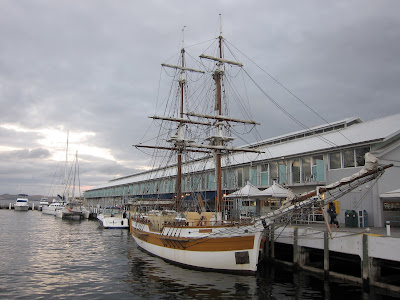
a few weeks ago, we held the inaugural "astounding stories of super science" symposium in hobart, tasmania, the australian island-state off the south east coast.  a nice venue for a meeting!


under the super science initiative, the australian government funded a one-off program sponsoring 100 young research fellows across three branches of science: space and astronomy, marine and climate, future industries.  as far as i can tell, this initiative is unique among countries around the world and i feel very lucky to take part!  

the research topics among the space science and astronomy super science fellows cover a wide range of topics, from observing the most distant galaxies in the universe, to measuring the shape of earth's surface.   because of this diversity, some of us supers decided it would be a good idea to get together, meet, share our research with each other, network, see a new place in the world, and generally enjoy our science and our fantastic titles! 

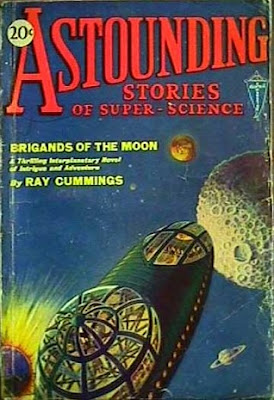
while organizing the symposium, we discovered an old science fiction magazine from the 1930s called astounding stories of super science, and our inspiration was found! 


twenty-three super science fellows from astronomy and space science attended the symposium, along with a smattering of other astronomers from around australia.  

Natasha Hurley-Walker discussing the murchison widefield array
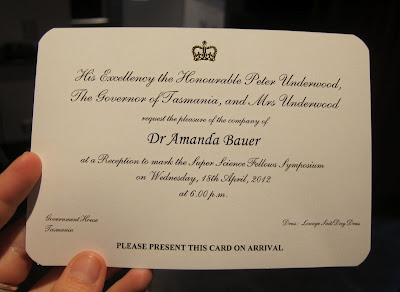
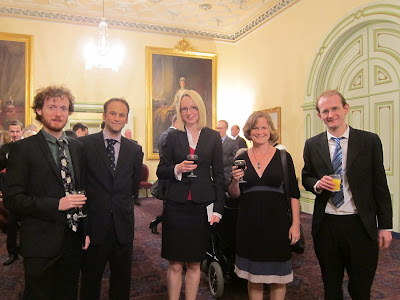
the symposium was officially opened by His Excellency The Honourable Peter Underwood AC, Governor of Tasmania (yes, the full title is required), who invited us to and evening at the government house!


it was a fancy event and we queued to be properly introduced to the governor one by one as we entered the estate.


he graciously and enthusiastically talked to each of us in turn.  when i commented to him that i thoroughly enjoyed the title of super science fellow and had a cape to go with the persona, he smiled and replied that he was disappointed i didnt wear it for the occasion!   i said i thought it would have been a bit inappropriate for his soiree and he just laughed out loud without responding further.  damn, damn.  i missed an opportunity there! 


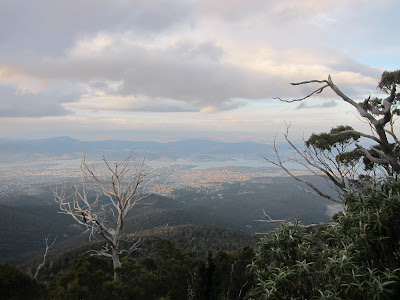
 one afternoon several of us walked to the peak of mount wellington to enjoy the view over hobart.


and, of course, a couple of us attended the conference dinner sporting full on, super regalia!  


good times ;)

Wednesday, May 1, 2013

announcement: new job

big news: i've accepted a new job!

i'm thrilled to announce that i'll be staying in sydney for at least several more years, officially splitting my time as a research astronomer and the head of a new outreach office at the australian astronomical observatory (AAO)!

i'm very excited about the possibilities in this new role.  i look forward to continuing to investigate the unknown aspects of the universe that intrigue me most, while helping my colleagues translate their research for general audiences, and creating exciting events for us all to enjoy together.  there are scientists who don't enjoy talking to about their research to the public or students or politicians or the media, and that's ok, but i find myself completely energized by it. 

i've recognised over the last several years that my motivation and passion for astronomy is not just communicating research to seasoned scientists around the world.  i also want to inspire people to harness their inherent curiosity about the world around them by sharing the thrill of scientific discovery.  luckily, my super science fellowship and current employers at AAO have been incredibly supportive of this desire. 

the challenge i have faced in my recent search for the next satisfying stage in my career is that science communication is not a largely supported component of a scientist's professional responsibility.  the academic realm demands high publication rates in professional journals, the successful acquisition of (more and more) external funding, and maybe teaching or other departmental work.  positions are few and the competition is fierce.

researchers are expected to give back to their community through science communication, visiting schools, giving public talks, etc., and the US's national science foundation even requires an outreach component in grant applications, but these outreach activities are rarely acknowledged, measured or valued as more than an "added bonus" by potential employers. 

in order to commit to outreach activities on a large scale, a scientist often has to "drop out" of research roles, which i apprehensively suspected i might have to do this year.   there are desperately few positions available that officially combine research and outreach (there were exactly two world-wide that i found in astronomy in the last 6 months).  i see this as a shame.  aside from the experience, passion, and deep understanding of the science being communicated by an active researcher, lasting value comes from visibly encouraging researchers to interact more with the public.

in addition to having well-prepared teachers in classrooms to teach occasional astronomy lessons to students, a memorable experience meeting an active scientist, looking through a telescope or participating in a public event with family can have an incredible impact, as i hear over and over from people of all ages around the world.

a recent US sequester has pressured NASA to critically evaluate all public outreach and education programs.   as far as i understand, all NASA's outreach activities are currently suspended, but the extent of full cancellations are yet to be determined.  this is such bad news.   and this situation added an extra challenge for me this job round because i was originally hoping to move closer to my family in the US (to be fair, "closer" is anywhere that is not australia!).  lucky for me, i will be able to see my family regularly, and thankfully, i have their full support, but you can see how these career decisions only become more difficult with time, and the entire field suffers the consequences.

i'm proud to hold this new position because i think it has the potential to set a positive example for the professional astronomical community by demonstrating the added value of a position involving both public outreach and scientific research.  props to the AAO for creating such a position!

At the Stories from Siding Spring Observatory photo exhibition opening

astronomy provokes the potential of human imagination.   we can share beautiful astronomical images and science discovery stories to inspire people of all ages to harness their inherent curiosity about the cosmos and our place in it.  i will do my best to share this with as many people as possible. 

but sadly, my time as an official super scientist will come to an end later this year.  i feel like i've made the most of it though, sciencing with other supers and wearing my cape  whenever appropriate (or almost appropriate?).  i still have a ton of business cards so i might save them to give them out to anyone i might especially want to impress.  ;)

so, aside from the fact that i'm not actually going to be the science correspondent on the daily show, this is as close to a dream job as i can imagine getting.   thanks for your support, everyone!

Wednesday, July 6, 2011

australian national astronomy meeting

i'm currently in adelaide attending the astronomical society of australia's annual scientific meeting. i was flatterend several months ago to be asked to give an invited talk at this meeting, which means i have 30 minutes to talk instead of the typical 15 minutes that most speakers get.

this talk has been in the back of my mind since i accepted the invitation. i was asked to talk about "galaxy evolution" and really wanted to give a broad background to the topic for the benefit of the diverse range of attendees, and also show some of my recent results over the last couple years, and since joining the australian astronomical community as a super science fellow.

i'm pleased to report that i'm proud with the how the talk was received and i think many of you might be amused to know that during the introduction... i put on my bright red "super science fellow" cape and thanked the australian government and the AAO for giving me such a fabulous title :) haha! i figured if i was going to do it, i should really go for it, so i even threw my fist in the air to strike a real super hero pose!! it was the first time that i received spontaneous applause while giving a professional astronomy talk!

since i didnt warn anyone i was going to perform such shenanigans, and since i took the cape off quickly as i wanted people to actually listen to my talk and take me seriously, i dont think anyone got a photo of the event :( oh well - what a thrill!

here are some other bits of news...

  • the decision as to where the SKA telescope will be built (australia or africa) will be made on 29 February 2012.
  • the 1000 groups that submitted proposals during the first call to use ALMA will hear back in september 2011.
  • yesterday at this meeting, sarah brough presented conclusions and realizations from the women in astronomy workshop to the ENTIRE AUSTRALIAN ASTRONOMY COMMUNITY! i think that is fantastic. 
  • there is a new forum for astronomy PhD students (and postdocs, etc... really) with the clever title: astroPhD
  • CAASTRO (ARC Centre of Excellence for All-sky Astrophysics) will advertise 35 postdoc positions over the next couple years. they are organizing wide-field astronomical capabilities of next-generation telescopes and the HUGE data sets they will provide. CAASTRO has a noteworthy policy: they offer all positions with a part-time option to help support parenting and other real life situations. excellent!
  • the suburu telescope in hawaii is currently shut down after an unfortunate coolant leak occurred above the telescope, spilling coolant (ethylene glycol) on the primary mirror, other optics, and surrounding areas.

hopefully i'll get back into my regular blogging schedule soon, but if you want to read about the lastest astronomical developments, follow along on the twitter hashtag: #asa11

Wednesday, April 28, 2010

science ninja

the other night i had a science ninja dream that i can only describe by showing you this picture of my toothpaste.


i wish more products were labeled so informatively. in fact, while brushing my teeth, i usually read this list over and over and think to myself "if only the components of the universe were so easily stated, their origins identified, and their purposes described!"

so in my dream i figured out how i could make such a list for the universe: by becoming a science ninja!! one of the more bizarre premises of quantum theory is that the act of watching something changes the reality of the situation: the observer affects the observed reality. but what if the observer is a ninja?!?!

obviously a science ninja could observe the universe without affecting it, my dreaming self surmised!

so in my dream, i dressed myself as a science ninja (i'll leave you to imagine that...) and sped off into the distant crevices of the universe to create my toothpaste list. as a science ninja, i was also clearly not hampered by the bothersome passage of time or slow travel speed, so i zoomed to any location i wished... and watched.


my first stop was to sit at the outskirts of a galaxy with an active nucleus and watch the life cycles of its central supermassive black hole! i had a special science ninja device which allowed me to jump back in time to when the galaxy was forming. i watched as really massive stars formed quickly, turned into black holes because they were too big to do anything else, and sank towards each other in a gravitational dance (yes, i had special science ninja glasses that allowed me to "see" black holes). they quickly collided to form a single, central massive black hole which then happily reacted with gas left over from the explosions of nearby former-stars that werent quite big enough to become black holes, and therefore supernova-d. soon, jets shot out of opposite sides of the black hole in long, narrow streams, only to putter out a bit later.

these are my leftover memories of a dream that was obviously more vivid and twisted, and not limited to my waking life intuition of how the universe could work.

i remember in my dream excitedly scribbling down a long list of "ingredients" which minimally included: dark matter, super massive black holes, life, worm holes (that was a fun dream-ride!), photons, and electrons. i wish i could remember the "where it comes from" and "what it does" columns of my dream list :(

anyway, it was a fun dream. thanks for the inspiration, toothpaste!

Sunday, November 10, 2013

outreach officer

this week i officially start my new job with the AAO, splitting my time as a research astronomer and head of our new outreach office!

i'm very excited to begin this new position and to have a new office!


although i'm sad to lose my official title as a super science fellow :(   in honor of my time as a super, here are some interesting modifications of classic art pieces to include superheroes!


and from an entertaining, but slightly sad series of oil paintings about an aging superhero, by andreas englund:


but seriously, once super, always super.   i'm keeping the cape!  

and i'm really thrilled about the new office!   it has a big window with views of trees and sky and birds and weather!  it has been too long since i've had a nice view of the outside world from my indoor office.


ps. i've been sharing photos on here recently that i've previously posted on instagram.

Monday, July 19, 2010

Super Scientist

i'm pleased to announce that after the unexpected shock of being flung into the job market a few months ago, i have accepted a "super science fellowship" to work with the folks at the australian astronomical observatory near sydney, australia! woo hoo! (i'd say "yeehaw" but i dont think thats the proper phrase to use!)

primarily, i will be using data from the extensive multi-wavelength GAMA survey to look at the star formation history of the universe and to see how star formation in galaxies behaves as a function of stellar mass, morphology, and environment, as well as continuing some ongoing projects that i find interesting.

i'll be moving down under around november this year and fully welcome any tips about moving to australia or suggestions about cool neighborhoods to live in around sydney. i'm not really looking forward to another round of moving across the world and dealing with visa issues, etc... but i am certainly looking forward to exploring a new continent and mashing up my english accent even more than it already is!

someone suggested that australia is a mix of english and texan culture, which is an intriguing statement. i hope it combines the outdoorsy adventurousness and tasty beverage aspects, and not the conservative, judgmental, moaning-about-the-weather parts.

i feel like with the fantastic title of super scientist, i should be entitled to wear some sort of super hero outfit, but apparently capes are not advised ;(

Monday, October 15, 2012

fresh science national final

i made it to the national finals for an australian competition called fresh science, which are taking place this week in melbourne!

the fresh science program selects one dozen early career researchers from all branches of science, gives us loads of science communication training and feedback, throws us in front audiences from students to politicians to journalists, and works with us to prepare official press releases during the finals week (look out for mine this thursday!).


some highlights from information obtained today:

newspapers make money from ads and always have.   ads they sell on websites generate a lot less money than in the printed paper, yet less papers are sold.   as a result, the online stories that get click-thrus are the ones that get promoted by producers, ie. stories with good photos and headlines.   so if you want more interesting news and less bullshit kardashian-type stories, stop clicking on the bullshit stories online (please).

regarding presentations:  

memorize opening and closing lines - they make the most impact.  actually, super-practice the intro to give yourself a confident start.

it doesnt matter the length of your presentation, the audience will only take away 3 pieces of info. so choose those wisely and focus on arguing/telling the story of those 3.


we speak at an average rate of 150-180 words per minute, but think at around 700 words/minute.

top tips for regaining audience attention, which will inevitably drift: change your focus every few minutes - vary the tone of your voice, use audience participation, pause, use the power point "B" key to provide a blank screen and bring attention back to you.

AMAZINGLY, only 12% of any audience is paying attention to you at any given moment.   20% is indulging in sexual fantasies, 20% is reminiscing, and the rest is worrying, daydreaming, thinking, etc... 

Wednesday, September 12, 2012

Guest Post: Jacinta Delhaize on Meeting Nobel Laureates

i have the pleasure of working with a very clever astronomy PhD student based in perth, australia, jacinta delhaize.  her research involves using radio telescopes to uncover the mysteries of galaxy evolution.   jacinta was chosen as one of 8 australian physics PhD students who got to attend the annual meeting of nobel laureates in germany in july this year.  i'm thrilled to host this post by jacinta, as she tells a very entertaining and enlightening story of her experience hanging out with winners of science nobel prizes.   enjoy!


The 62nd Lindau Meeting of Nobel Laureates

What happens when you put 27 Nobel Laureates and over 500 young researchers on a small island together for a week? I recently had the chance to find out when I attended the 62nd Meeting of Nobel Laureates in Lindau, Germany.

Lindau is a small Bavarian island on Lake Constance in southern Germany. The locals sometimes refer to the island as ‘Disneyland.’ I can only assume this is because of its beauty, and probably the fact that it is packed with tourists in the summer. Indeed, walking down the cobblestone streets between heavily decorated old European buildings and gazing out across the shimmering lake at the snow-capped Austrian Alps makes you feel like you have stepped into a fairy tale.

Jacinta's chariot awaits ;)

Once a year, hundreds of early-career researchers from around the globe descend on this idyllic town to attend a meeting with some of the world’s most prominent scientists – winners of the Nobel Prize. This year, I was extremely fortunate to be one of the eight Australian students chosen to attend and it was certainly something to remember.

The motto of the Lindau meetings is “Inspire. Educate. Connect.” Over the next five days, this is exactly what we experienced. In 2012 the meeting focused on Physics and there were 27 Nobel Laureates in attendance. Each morning we had lectures by the Laureates, on whatever they chose to talk about. Some spoke about the work they won their prize for, some about the work they are currently doing, and some on a completely different topic. The lectures that I got the most out of were the ones in which the Laureates shared their experiences before and after winning the Nobel Prize, and then gave us some advice for our own lives and careers.

Physics Laureate John Mather. Photo Credit: Rolf Schultes

One of my favourite examples of this was by Dan Shechtman. He won the Nobel Prize in Chemistry last year for his discovery of quasi-crystals. He described how he faced fierce opposition by parts of the scientific community who did not believe in the existence of quasi-crystals, and how he overcame this.

He advised us to “have tenacity. . . like a Rottweiler dog, bite and don’t let go. Believe in yourself.” While this might sound a little aggressive, he delivered it in such a calm, passive manner that I think he was simply saying that if you know you are right, you must not give in.

In the afternoons there were discussion sessions with each of the morning’s speakers, and you could choose which Laureate you most wanted to learn more from. I often found it challenging to choose, but the session that inspired me the most was with Mario Molina who shared the 1995 Nobel Prize in Chemistry for showing that CFCs are harmful to the Earth’s ozone layer. The morning session had focused on climate change and sustainable energy options. Some controversial statements had been made which sparked much discussion among the early-career researchers. So I wanted the opportunity to hear directly from a leading climate scientist.

Jacinta Delhaize and Mario Molina
As a young scientist, I am sometimes asked for my opinion on climate change issues. I am an astronomy student and so while I have no expertise at all on climate science, I do know how extremely unique and precious our planet is. I asked Professor Molina how a non-specialist scientist could respond to such questions. He suggested that the best way would be to explain the scientific process. If you understand and value the way that scientific discoveries are made and verified, then you will trust the overall consensus of experts in the field above the opinion of non-experts. He said that 97% of climate scientists agree that human-induced climate change is occurring. To me, that was a very powerful statement.

There were some other moments during the week that were just plain awesome. The timing of the meeting happened to coincide with the CERN announcement of the discovery of the Higgs-like boson.  We were extremely fortunate to have a panel discussion about the significance of the discovery with CERN staff that afternoon. I remember sitting there and thinking how ridiculously lucky I was to be so involved with the international scientific community while it celebrated what was possibly one of the most triumphant moments in the history of modern physics.

Panel discussion about the Higgs Boson at the Lindau Meeting.

Other fantastic moments definitely included the three lunches with Laureates that myself and the eight other members of the Australian delegation had the opportunity to attend. The first lunch was with John Mather and George Smoot (who characterised the Cosmic Microwave Background) and Brian Schmidt (who shared last year’s Prize for discovering the accelerating expansion of the Universe.)  They entertained us with recollections of the Nobel Banquet with the Swedish Royal Family and how they were terrified of falling over or making a mistake.

The second lunch was with Sir Harry Kroto, the discoverer of ‘buckyballs’ (C60 to chemists). He pressed upon us the importance of communicating your science effectively. He also urged us, particularly as young scientists, to “question everything” - to apply critical thinking in every situation. Our final lunch was with Paul Crutzen, who investigated the causes of ozone depletion along with Mario Molina. We discussed issues surrounding what he calls the ‘anthropocene’ – the era over which human activity has impacted the atmosphere.

These lunches made me appreciate the human aspect of the Laureates. Although we tend to think of them as super heroes, they really are just normal people who strove for excellence and had the good fortune (and talent) of making remarkable discoveries that changed the world. It is for this reason that they really are the very best people to advise and inspire the next generation of scientists, as they are proof of what is attainable.

Australian delegates with Physics Laureates (L to R: Andy Casey, Melissa Ness, Mike Dopita, John Mather, Sarah Beavan, Grace Shepherd, George Smoot, Andrew McCulloch, Brian Schmidt, Minnie Mao, Jacinta Delhaize, Adele Morrison.)

Lastly, I’d like to mention an unexpected theme that arose during the meeting. This was the concept that science and music/art are intertwined and each enhances appreciation of the other. This was first mentioned by our hostess, Countess Bettina Bernadotte as she welcomed members of the Vienna Philharmonic Chamber Orchestra to play during the opening ceremony of the meeting. Later in the week, Peter Gruenberg used his lecture to explain the harmonies of Alpine Folklore music, and treated us to live examples. Laureate Dudley Herschbach likened what he calls ‘chemistry wizardry’ to "Beethoven composing his symphony” and then concluded his lecture by playing a song with the refrain “Experiment; make it your motto day and night.” It was a nice reminder that while we all value the importance of science, there are many other ways to describe the world around us and we should embrace them all. On the last day we had the opportunity to put this in to practice and express ourselves through dance! Here’s a pic of Brian Schmidt getting his groove on with the Countess.

Brian Schmidt and the Countess

Of course, there were many opportunities to mingle with the other early-career researchers at the meeting, all of whom were very enthusiastic, outgoing and open-minded people. We came from all over the world yet our passion for science connected us all. I also particularly enjoyed the various social events in the evenings when we could meet the local people of Lindau. Despite the fact that we had completely overrun their island, they were very welcoming, excited and proud to be hosting us. Thank you for having us and for stuffing us full of delicious pretzels!

So in summary – I thoroughly enjoyed my time at the 62nd Lindau Meeting of Nobel Laureates. I was inspired in so many ways, gained a better education of important issues in science and I now feel well and truly connected to the international scientific community and very proud to be part of it. I definitely recommend it to anyone thinking of applying for next time. My whole-hearted thanks to the Australian Academy of Science, the International Centre for Radio Astronomy Research and all the organisers of the Lindau Meeting of Nobel Laureates for giving me this once-in-a-lifetime opportunity.

all photos provided by jacinta delhaize.  you can follow her on twitter here: @jdelhaize

Thursday, March 22, 2012

an episode on the AstroPodcast

i made it off the mountain one afternoon earlier this week to join allison in the small town of coonabarabran and record an episode of the AstroPodcast!

"This week Dr. Amanda Bauer, Super Science Fellow of the AAO, joins us to talk about her life as an astronomer collecting images of galaxies and trying to find the reason for some of their seemingly strange behaviours."

listen: HERE


this was a lot of fun and i hope to join allison on the AstroPodcast again sometime soon. please let me know if there are any issues you'd like to hear discussed!

Tuesday, July 30, 2013

galaxy fireworks: conference photos

i wanted to share some photos from the galaxy fireworks conference from late june, including my favorite - the conference photo!


Conference Photo (Credit: Angel Lopez-Sanchez)
at the beginning of the conference, i welcomed everyone by recognizing and thanking the local organizing committee, and by sharing the geographic and gender demographics of the conference participants (~50% from outside australia; 40% women).


i like this demonstration of how computer simulations start from the most simple approximation to the most complex (nature):

Slide by Danail Obreschkow
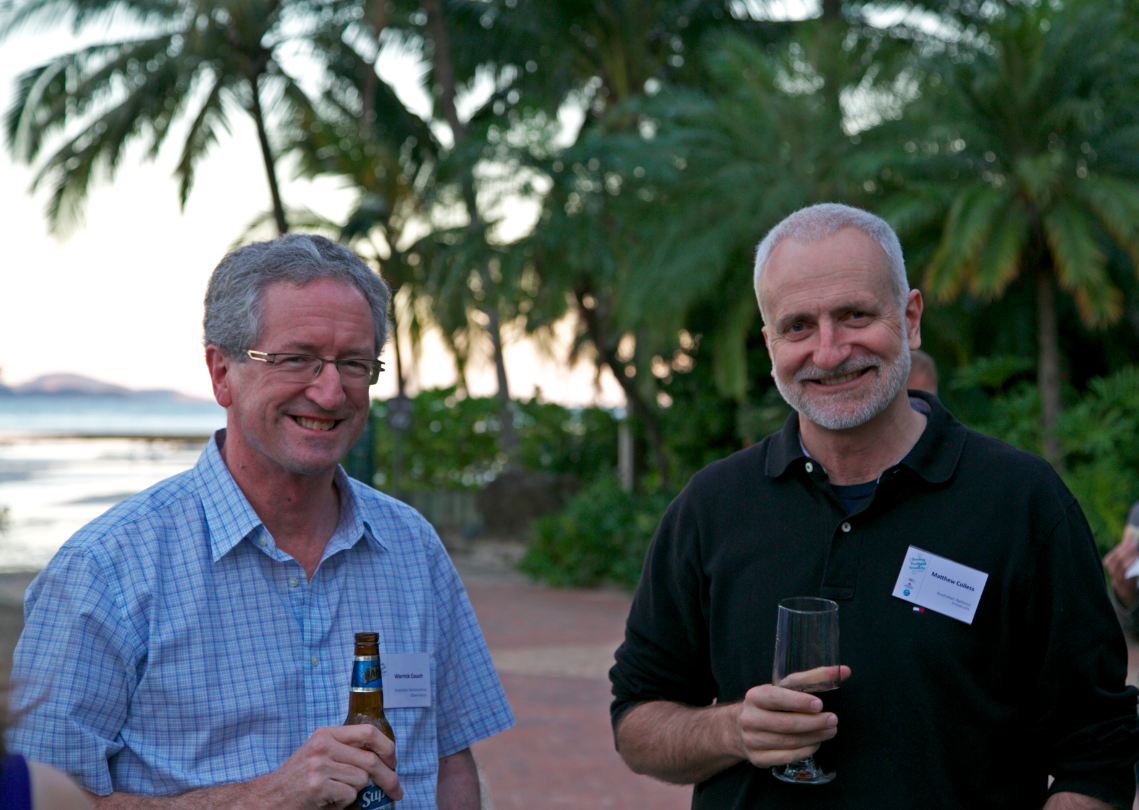
the conference brought together the current (left) and most recent former director of the australian astronomical observatory (AAO).

warrick couch and matthew colless
before the conference dinner, we admired the stars of the southern sky and heard a few stories of australian indigenous astronomy.

astronomers actually looking at stars in the night sky!
the cape made a brief appearance at the conference dinner ;)

super science was discussed
and i'll mention an entertaining moment during the talks - this slide suggesting conference-themed acronyms...

Slide by Stuart Ryder
see more photos from the conference: HERE.

see all previous posts discussing the "feeding, feedback, and fireworks" conference:  HERE.

Wednesday, March 26, 2008

the international space station meets jules verne

i hope some of you got to the see spectacular and rare triple flyby tonight! the european space craft, jules verne, came into view first, rising in the southwest and brightly passing almost overhead. (jules verne was a popular author of the 19th century, who pioneered the science-fiction genre with popular novels like journey to the center of the earth and twenty thousand leagues under the sea).

it was difficult to spot jules verne at first because there were scattered clouds overhead which confused us into thinking all the stars were moving! jules verne was bright at about 1st magnitude, but it was nothing compared to the international space station (ISS), which followed about 5 minutes later. the ISS was negative two magnitudes.... which means super-bright! way brighter than anything else in the night sky other than the moon! the shuttle, endeavor, caught our eyes, as it followed the same path across the sky as the ISS, just 40 degrees or so behind it, not as bright, but still bright indeed! it was so cool to see both of them trailing across the sky in tandem!

i excitedly looked thru binoculars to try to find more details of the bright ISS. I could see the brightest central region reflecting the sun's light, then some extended metallic stuff sticking out to the sides... solar panels!


the ISS has been in orbit around earth since 1998. it constantly moves around the earth at 350-460 km (217-286 miles) above the surface, and moves at 27,700 km/hour! that means it makes nearly 16 orbits everyday!! so why is it so rare that we see the super-bright ISS pass overhead? since the ISS doesnt produce light of its own, we rely on reflected sunlight to see it. the ISS is only illuminated when it passes is in sunlight... which means most of the time that it passes overhead, its daytime which prevents us from seeing it, or it's nighttime, which prevents it from being illuminated. we can see the ISS over our heads when it passes near sunrise or sunset. at sunset, we are just barely in the darkness of earth's shadow, but the ISS, still floating above the surface, still receives and reflects the sun's light! the ISS is soooooo bright because its football-field size reflects a lot of light!

what a fun sight tonight!! thanks to my students who came to the roof with me after our lab class to watch the event :)

Sunday, November 29, 2015

Cloudy with a chance of life: how to find alien life on distant exoplanets

This article was originally published in The Conversation on on 26th November 2015.


Cloudy with a chance of life: 

by Brad Carter, Amanda Bauer, & Jonti Horner

How do you go about hunting for life on another planet elsewhere in our galaxy? A useful starting point is to imagine looking from afar for signs of life on Earth. In a telescope like those we have on Earth, those aliens would likely just see the Earth and sun merged together into a single pale yellow dot.

If they were able to separate the Earth from the sun, they’d still only see a pale blue dot. There would be no way for them to image our planet’s surface and see life roving upon it.

However, those aliens could use spectroscopy, taking Earth’s light and breaking it into its component colours, to figure out what gases make up our atmosphere. Among these gases, they might hope to find a “biomarker”, something unusual and unexpected that could only be explained by the presence of life.

On Earth, the most obvious clue to the presence of life is the abundance of free oxygen in our atmosphere. Why oxygen? Because it is highly reactive and readily combines with other molecules on Earth’s surface and in our oceans. Without the constant resupply coming from life, the free oxygen in the atmosphere would largely disappear.

Biomarkers

But the story isn’t quite that simple. Life has existed on Earth for at least 3.5 billion years. For much of that time, however, oxygen levels were far lower than those seen today.

And oxygen alone is not enough to indicate life; there are many abiological processes that can contribute oxygen to a planet’s atmosphere.

The concentration of oxygen in the Earth’s atmosphere over the last billion years. As a reference, the dashed red line shows the present concentration of 21%.  Wikimedia

For example, ultraviolet light could produce abundant oxygen in the atmosphere of a world covered with water, even if it was devoid of life.

The upshot of this is that a single gas does not a biomarker make. Instead, we must instead look for evidence of a chemical imbalance in a planet’s atmosphere, something that can not be explained by anything other than the presence of life.

Here on Earth, we have one: our atmosphere is not just rich in oxygen, but also contains significant traces of methane. While abundant oxygen or methane could easily be explained on a planet without life, we also know that methane and oxygen react with each other strongly and rapidly.

When you put them together, that reaction will cleanse the atmosphere of whichever is least common. So to maintain the amount of methane in our oxygen-rich atmosphere, you need a huge source of methane, replenishing it against oxygen’s depleting influence. The most likely explanation is life.

Observing exoplanetary atmospheres

If we find an exoplanet sufficiently similar to our own, there are several ways in which we could study its atmosphere to search for biomarkers.

When a planet passes directly between us and its host star, a small fraction of the star’s light will pass through the planet’s atmosphere on its way to Earth. If we could zoom in far enough, we would actually see the planet’s atmosphere as a translucent ring surrounding the dark spot that marks the body of the planet.

How much starlight passes through that ring gives us an indication of the atmosphere’s density and composition. What we get is a “transmission spectrum”, which is an absorption spectrum of the planetary atmosphere, illuminated by the background light of the star.

Our technology has only now become capable of collecting and analysing these spectra for the first time. As a result, our interpretation remains strongly limited by our telescopic capabilities and our burgeoning understanding of planetary atmospheres.

Despite the current challenges, the technique continues to develop with great success. In the past few years, astronomers have discovered a wide variety of different chemical species in the atmospheres of some of the biggest and baddest of the known transiting exoplanets.

Many exoplanets may have no atmosphere at all. NASA/JPL-Caltech

Eclipses

Another approach involves observing a transiting planet and its star as they orbit one another. The goal here is to collect some observations when the planet is visible (but not in transit), and others when it is eclipsed by its star.

With some effort, astronomers can subtract one observation from the other, effectively cancelling the hugely dominant contribution of light from the star. Once that light is removed, what we have left is the day-side spectrum of the planet.

[Star + Planet] - [Star] = [Planet] NASA/JPL-Caltech/R. Hurt (SSC/Caltech)

The future

Astronomers are constantly developing new techniques to glean information about exoplanetary atmospheres. One that shows particular potential, especially for the search for planets like our own, is the use of polarised light.

Most of the light we receive from planets is reflected, originating with the host star. The process of reflection brings with it a subtle benefit - the reflected light gains a degree of polarisation. Different surfaces yield different levels of polarisation, and that polarisation might just hold the key to finding the first oceans beyond the solar system.

By rotating a polarising filter, we can block light of certain polarisation. This is how polarised sunglasses cut the glare from puddles and the ocean on a sunny day.  Wikimedia, CC BY-SA

These methods are still severely constrained by two factors: the relative faintness of the exoplanets, and their proximity to their host star. The ongoing story of exoplanetary science is therefore heavily focused on overcoming these observational challenges.

Further down the line, advances in technology and the next generation of telescopes may allow the light from an Earth-like planet to be seen directly. At that point, the task becomes (slightly) easier, in part because the planet can be observed for far longer, rather than just relying on eclipse/transit observations.

But even then, spectroscopy will be the way to go; the planets will still be just pale blue dots.

What we have seen so far

The exoplanets we have discovered to date are highly inhospitable to life as we know it. None of the planets studied so far would even be habitable to the most extreme of extremophiles.

The planets whose atmospheres we have studied are primarily “hot Jupiters”, giant planets orbiting perilously close to their host stars. As they skim their host’s surface, they whizz around with periods of just a few days, yielding transits and eclipses with every orbit.

Because of the vast amounts of energy they receive from their hosts, many of these “hot Jupiters” are enormous, inflated far beyond the scale of our solar system’s largest planet. That size, that heat and their speed, make them the easiest targets for our observations.

But as our technology has improved, it has also become possible to observe, through painstaking effort, some smaller planets, known as “super-Earths”.

Atmospheres of distant planets…

The hot Jupiter HD189733 has one of the best understood planetary atmospheres beyond the solar system.

Artists impression of the broiling blue marble, HD 189733 b. NASA, ESA, M. Kornmesser

Observations by the Hubble Space Telescope, in 2013, suggest a deep-blue world, with a thick atmosphere of silicate vapour. Other studies have shown its atmosphere to contain significant amounts of water vapour, and carbon dioxide.

Overall, however, it appears to be a hydrogen-rich gas giant like Jupiter, albeit super-heated, with cloud tops exceeding 1,000 degrees. Beneath the cloud turps lies a widespread dust layer, featuring silicate and metallic salt compounds.

The young giant planets in the HR8799 system appear to have hydrogen-rich but complex atmospheres, with compounds such as methane, carbon monoxide and water. They are likely larger, younger, and hotter versions of our own giant planets - with their own unique subtleties.

A direct image of the four planets known to orbit the star HR 8799. Ben Zuckerman

For the super-Earth GJ1214b the lesson is to be careful about making conclusions. Early suggestions that this might be a “water world” or have a cloudless hydrogen atmosphere have since been superseded by models featuring a haze of hydrocarbon compounds (like on Titan), or grains of potassium salt or zinc sulphide.

While the search for Earth-like planets continues using ground- and space-based telescopes, exoplanetary scientists are eagerly awaiting the launch of the James Webb Space Telescope JWST.

That immense telescope, scheduled for launch in around October 2018, could mark the true beginning of the exciting search for distant atmospheric biomarkers and exoplanetary life.
Saturday, December 14, 2013

year in review

xkcd hits it exactly right in the year in review comic.  i still have not managed to see an aurora!


with hidden comment "all in all, i give this year a C-.  there were no aurora visible from my house and that comet evaporated.  they'd better not cancel the 2017 eclipse."  amen to that.  

but for myself, i'd say it has been a fairly good year.   lost the super, but gained an official "science communicator" role.  moved to a new flat that has a garden to play in.  visiting family for a second time. siding spring observatory survived the bush fires.   explored the great barrier reed with my mom.  talked to my nephew's class about astronomy and being a scientist. probably more that i cant recall right now.  

thanks everybody for hanging around :)

Thursday, October 3, 2013

live from siding spring observatory

i'm up at siding spring observatory this week for many events during the upcoming StarFest weekend extravaganza!  this morning, the australian national news program, channel 7 sunrise, broadcast their show from different parts around the observatory!   i featured in a couple segments, talking about the science we can do with our 4 meter AAT telescope and showing some pretty pictures on computers in the control room.

you can watch one quick segment HERE (at least for the next month or so).

overall, it was a very fun experience, but the super early wake up call was not my favourite part of the day!
sunrise over siding spring observatory

here is sam, a PhD student who was up all night observing, talking about the exciting new SAMI instrument and its capabilities.

sam showing off SAMI and the AAT to edwina bartholemew
we did a few scenes outside with the view, a few inside the dome with the big telescope and inside the control room. can you spot the gag that came right at the end of the scene ;) 

behind-the-scenes from the news spot this morning
i found it fascinating to watch the small news crew smoothly organize every scene setup and shot.  they were in control.  an impressive operation!

several AAO staff with the channel 7 sunrise weather team
this is my first trip to siding spring since the fires in january.  its springtime and regrowth is happening all over!   its nice to see.

springtime flourishes at siding spring observatory

the sunrise view from the top of siding spring