here's a nice demonstration of how stars move around the sky to form star trailsby using timelapse photography!
South Celestial Pole from Martin Whipp on Vimeo.
Friday, January 30, 2009


Thursday, January 29, 2009
venus during the day
today (thursday) and tomorrow (friday) provide excellent opportunities to see the bright planet venus during the day - which is one of my favorite astronomical phenomena! the very thin crescent moon sits right next to venus during these two days, making it easier to adjust your eyes to venus's position.
from both hemispheres, the crescent of the moon opens toward venus today, then tomorrow, venus sits on the convex side of the moon.

happy planet hunting!
from both hemispheres, the crescent of the moon opens toward venus today, then tomorrow, venus sits on the convex side of the moon.
happy planet hunting!
motivating manager
the quality of this video isnt that great, but without a doubt, it'll warm your heart.
Wednesday, January 28, 2009
what should hubble look at?
as part of the international year of astronomy festivities, the hubble site has launched a project where we get to choose an astronomical object for the hubble space telescope to observe!
already existing images and descriptions of the possible targets are available at youdecide.hubblesite.org, where you can also vote by March 1st! the choices:
i'm biased in opinion as i study galaxies and think interacting galaxies are incredibly exciting, but i would be happy to see hubble's view of any of the objects listed above.
i will leave you with a great compilation of cosmic collisions previously captured by the hubble space telescope, which now sits as my desktop background:

thanks to the astronomy blog for the tip.
already existing images and descriptions of the possible targets are available at youdecide.hubblesite.org, where you can also vote by March 1st! the choices:
NGC 6634 - star forming region
NGC 6072 - planetary nebula
NGC 5172 - spiral galaxy
NGC 4289 - edge-on spiral galaxy
Arp 274 - interacting galaxies
NGC 40 - planetary nebula
NGC 4289 - edge-on spiral galaxy
Arp 274 - interacting galaxies
NGC 40 - planetary nebula
i'm biased in opinion as i study galaxies and think interacting galaxies are incredibly exciting, but i would be happy to see hubble's view of any of the objects listed above.
i will leave you with a great compilation of cosmic collisions previously captured by the hubble space telescope, which now sits as my desktop background:

thanks to the astronomy blog for the tip.
Tuesday, January 27, 2009
long exposure photographs
we use long exposures to capture the photons flying thru space from very distant objects. its not uncommon to expose for eight hours on a faint galaxy 11 billion light years away just to catch a faint signal!
images created by opening the shutter for a couple minutes reveal amazing phenomena on earth as well! here are a couple examples from an online digital photography school.

20 second exposure by sara heinrichs

114 second exposure by MumbleyJoe

i dont actually know if aigar truhin used a longer exposure to capture these strange light pillars over latvia, but its a cool image anyway!
i love this unforgettable image of picasso...

i cant find the link now, but i read somewhere on the internets that photographer gjon mili visited picasso in 1949 and told him about a technique of creating drawings from light using long exposures. picasso was instantly inspired and used a "light pen" to sketch this bull. brilliant!

images created by opening the shutter for a couple minutes reveal amazing phenomena on earth as well! here are a couple examples from an online digital photography school.

20 second exposure by sara heinrichs

114 second exposure by MumbleyJoe

i dont actually know if aigar truhin used a longer exposure to capture these strange light pillars over latvia, but its a cool image anyway!
i love this unforgettable image of picasso...

i cant find the link now, but i read somewhere on the internets that photographer gjon mili visited picasso in 1949 and told him about a technique of creating drawings from light using long exposures. picasso was instantly inspired and used a "light pen" to sketch this bull. brilliant!

flying bananas!
never thought bananas could be scary, but daniela edburg certainly achieved the effect in this photo!

thanks to bernd missal for the link!

thanks to bernd missal for the link!
Monday, January 26, 2009
tycho crater: 3D!
on the moon, theres a large crater named tycho. it's the big one toward the southwest, with ejecta shooting out in every direction.

here's an amazing three dimensional video of its structure... here. 3D glasses: use 'em if you gottem! (the video is much much better in the high-res version).
the crater's shape is created from the impact of an object falling to the ground and splashing up material all around. you can sort of visualize the process from this excellent video of a water droplet falling into sand.
of course the structure of the sand after the impact quickly fades away, but you can still see the ring of material shot out in every direction and then one lingering mound of stuff right in the middle at the impact location.
here's an amazing three dimensional video of its structure... here. 3D glasses: use 'em if you gottem! (the video is much much better in the high-res version).
the crater's shape is created from the impact of an object falling to the ground and splashing up material all around. you can sort of visualize the process from this excellent video of a water droplet falling into sand.
of course the structure of the sand after the impact quickly fades away, but you can still see the ring of material shot out in every direction and then one lingering mound of stuff right in the middle at the impact location.
Sunday, January 25, 2009
Saturday, January 24, 2009
butt hole road
glad to see the NY times also finds humor in some of the signs of england!

see also:
signs of nottingham
signs of cambridge

see also:
signs of nottingham
signs of cambridge
Thursday, January 22, 2009
signs of cambridge
here are some photos from a quick weekend trip to cambridge, england.

so much pristine grass around the colleges (this one is king's college), but dont dare take a step on it!

this sign outside of trinity college made me laugh. a noticeably large amount of people in this country smoke, so it's not surprising that they state "permission applied for."

apparently people love this stuff!

a typically polite, and very official sign!

worst name. ever.

this is the foundation stone of the cambridge corn exchange, set in 1874 by the then mayor, john death. i've been informed that death as a name is pronounced "dee-ath," but seriously. worst. name. ever.

so much pristine grass around the colleges (this one is king's college), but dont dare take a step on it!

this sign outside of trinity college made me laugh. a noticeably large amount of people in this country smoke, so it's not surprising that they state "permission applied for."

apparently people love this stuff!

a typically polite, and very official sign!

worst name. ever.

this is the foundation stone of the cambridge corn exchange, set in 1874 by the then mayor, john death. i've been informed that death as a name is pronounced "dee-ath," but seriously. worst. name. ever.

Wednesday, January 21, 2009
to read or not to read
many more books exist than could possibly be read by any single human being during a lifetime. i wish that every book i chose to spend time reading turned out to be interesting and beneficial to my being, but that's, unfortunately, not the case. i choose books mostly based on recommendations from family and friends, book reviews, and sifting thru the "classics" that i feel i *should* try to read at some point.
 the guardian is currently featuring a series called 1000 novels everyone must read. i went thru the first installment, the love category, in last weekend's paper. of the novels i had read, i mostly agreed with their inclusion in the list, but not all. i also excitedly added quite a few books to my to-read list!
anyway, even if i dont ever get around to reading all the novels listed, i really enjoyed reading the brief plot descriptions the guardian included in the list. there were many authors i'd heard of and titles i recognized, but i had no idea what the books were about or in what style the authors wrote! an enlightening experience reading that list. enjoy!
 the guardian is currently featuring a series called 1000 novels everyone must read. i went thru the first installment, the love category, in last weekend's paper. of the novels i had read, i mostly agreed with their inclusion in the list, but not all. i also excitedly added quite a few books to my to-read list!
 anyway, even if i dont ever get around to reading all the novels listed, i really enjoyed reading the brief plot descriptions the guardian included in the list. there were many authors i'd heard of and titles i recognized, but i had no idea what the books were about or in what style the authors wrote! an enlightening experience reading that list. enjoy!
Tuesday, January 20, 2009
a gaza story
suleiman baraka is a palestinian astrophysicist working at virgnia tech with NASA. during an interview a couple days ago with democracy now, he shares a devastating account of his family that currently lives in gaza. his 11-year-old son was killed after a bombing, his extended family is still suffering thru the attacks.
there are over 1,100 such stories.
there are over 1,100 such stories.
finally - a new US president!
this happy day is finally here: bush is out, obama is in. i'm extremely excited!! the world has high expectations for obama, which are nearly as high as what he seems to have set for himself! its unrealistic that he will accomplish all the changes he seeks, but i honor his conviction and determination, even if i dont agree with all of his suggestions. i'm ready to enjoy this inaugural day. i'm looking forward to no longer instantly rolling my eyes in disappointment (to say it lightly) every time my president opens his pie hole.
these nice images show the inauguration preparation (from the big picture):

the US capitol building where the official inauguration is taking place today, january 20, 2009, using abraham lincoln's bible.

nasa will participate in the inaugural parade! astronaut michael gernhardt will drive the new lunar electric rover, pictured above, which is current design for a mission to the moon in about 12 years! also participating are the entire crew that flew on space shuttle endeavour in november 2008 on the STS-126 mission.

up to 120,000 passengers an hour can be carried on washington dc's metro system... using these fancy tickets!

and please, someone explain to me the appeal of wax figures!! i just dont get it! they always seem more creepy than anything.
anyway, enjoy the day!!
these nice images show the inauguration preparation (from the big picture):

the US capitol building where the official inauguration is taking place today, january 20, 2009, using abraham lincoln's bible.

nasa will participate in the inaugural parade! astronaut michael gernhardt will drive the new lunar electric rover, pictured above, which is current design for a mission to the moon in about 12 years! also participating are the entire crew that flew on space shuttle endeavour in november 2008 on the STS-126 mission.

up to 120,000 passengers an hour can be carried on washington dc's metro system... using these fancy tickets!

and please, someone explain to me the appeal of wax figures!! i just dont get it! they always seem more creepy than anything.
anyway, enjoy the day!!
dimensions: visualized.
i'm enamored by the graphical perspective presented in this series of videos: dimensions. i've only watched the first two ~10 minute videos so far, but i'm looking forward to sitting thru the rest.
as the name suggests, this series elegantly guides us to visualize 3+ dimensions in creative ways that i havent seen before. enjoy!

as the name suggests, this series elegantly guides us to visualize 3+ dimensions in creative ways that i havent seen before. enjoy!

Monday, January 19, 2009
friends: small and grand
of all the new friendships i've made in nottingham over the last 5 months, i dont have any new tiny friends!? i suspect that several couples i know are on the brink of committing to parenthood, but still, almost none of my new friends have small children! not having any little kids around feels strange since i've always been surrounded by kid cousins or kids of friends. babies are adorable (more so when you dont have to change their diapers!), toddlers are cute while learning to communicate and interact (and when they get wound up, wild, and whiny, i can go home!), and then kids really start to get fun when they use their blossoming imaginations to create games and explain to you how the world works according to their growing understanding!
i like spending time with people of a wide range of ages; they remind me to maintain my innocent curiosity while seeking happiness and wisdom.


hm. how does one meet cool kids to interact with in a new city? volunteer?
i like spending time with people of a wide range of ages; they remind me to maintain my innocent curiosity while seeking happiness and wisdom.


hm. how does one meet cool kids to interact with in a new city? volunteer?
Friday, January 16, 2009
paper abstract mad libs!
i'm not sure how well-known mad libs are, but i loved them as a kid! the name of the game plays on the term ad lib and consists of a very short story with missing words. the missing words are labeled with their type - noun, adjective, verb, etc... one person asks another for random words that satisfy the grammatical requirements, writes the words into the blank lines, and then reads the silly story with funny, random words out loud for everyone to enjoy.
now that you know the history (did you before? i dont know), you'll understand my enjoyment of today's phd comic:

haha!
now that you know the history (did you before? i dont know), you'll understand my enjoyment of today's phd comic:

haha!
poor baby
the hat leads you to believe that this little one is ready to party, but the expression screams of boredom!


Thursday, January 15, 2009
carnival of (collectible) space
this week's carnival of space collection of astronomy-reads is us at collectSPACE. there are several interesting articles to tackle, but one especially caught my interest.... ian musgrave has inspired me to attempt to spot the super bright planet venus during the day!
venus is that amazingly bright object shining in the southwest evening sky right now. i've been watching it, so i have an idea of where it sits as the sun sets. i'll try to go out a little earlier each evening (well, afternoon really, considering the sun is still setting ridiculously early these days) to see is i can spot it. its easiest to see venus during the day when the moon is somewhere nearby as a beacon. at the end of this month (jan 29th and 30th, 2009), the crescent moon will pass very close to venus so we will be able to see them both together during the day - one of my favorite events! (and maybe, just maybe, it wont be raining here in england so i can actually try to spy the daytime alignment!).

this daytime venus photo was taken by peter heinzen during an eclipse in june 2007.
happy venus hunting!
venus is that amazingly bright object shining in the southwest evening sky right now. i've been watching it, so i have an idea of where it sits as the sun sets. i'll try to go out a little earlier each evening (well, afternoon really, considering the sun is still setting ridiculously early these days) to see is i can spot it. its easiest to see venus during the day when the moon is somewhere nearby as a beacon. at the end of this month (jan 29th and 30th, 2009), the crescent moon will pass very close to venus so we will be able to see them both together during the day - one of my favorite events! (and maybe, just maybe, it wont be raining here in england so i can actually try to spy the daytime alignment!).

this daytime venus photo was taken by peter heinzen during an eclipse in june 2007.
happy venus hunting!
comet lulin
comet lulin (C/2227 N3) says a big hello to the sun today as it clears its closest approach to the fiery center of our solar system - its perihelion. this comet is shooting around the sun and starting its journey towards the outskirts of the solar system, passing by the earth on its way at a closest-distance of only 14.5 times farther than the moon on february 24th, 2009. you can currently view comet lulin thru a modest telescope, and jeremy perez shares a quality sketch of his telescopic view:

i love that he made a sketch! its just so romantic and endearing and reminds me of some of the first washes and engravings of the moon created 400 years ago by galileo galilei (his name demands that you say it out loud)...


lulin will reach a peak magnitude of 5-6 in late feb 2009, allowing for naked-eye viewing in clear, dark areas. caffeinatedastronomy.com has a comprehensive collection of links about comet lulin that you can pay attention to, and hopefully i can find some good images to post as comet lulin approaches!

i love that he made a sketch! its just so romantic and endearing and reminds me of some of the first washes and engravings of the moon created 400 years ago by galileo galilei (his name demands that you say it out loud)...


lulin will reach a peak magnitude of 5-6 in late feb 2009, allowing for naked-eye viewing in clear, dark areas. caffeinatedastronomy.com has a comprehensive collection of links about comet lulin that you can pay attention to, and hopefully i can find some good images to post as comet lulin approaches!
Wednesday, January 14, 2009

star stories
there's a nice piece at nobelprize.org describing key results in our understanding of how stars form and die that led to nobel prizes! the article contains several lovely images and short videos and starts with this space poem by nobel laureate in literature, harry martinson...
The galaxy swings round
like a wheel of lighted smoke,
a smoke composed of stars.
It is sunsmoke.
For lack of other words we call it sunsmoke,
Do you see.
I don't feel languages are equal
To what that vision comprehends.
The galaxy swings round
like a wheel of lighted smoke,
a smoke composed of stars.
It is sunsmoke.
For lack of other words we call it sunsmoke,
Do you see.
I don't feel languages are equal
To what that vision comprehends.
Tuesday, January 13, 2009
responsibility project
you might not think something called the responsibility project would be led by an insurance company, but liberty mutual leads the way this time. i really like this short clip pointed out by contando estrelas.
let me know if you find other good videos demonstrating responsibility, however you think that might be defined!
let me know if you find other good videos demonstrating responsibility, however you think that might be defined!
sideways saturn
i guess it depends on which side you think is saturn's front to determine whether its sideways right now. i think in our minds we all visualize saturn's rings as a dominant feature of the sixth planet from the sun, and how can we not when our little space robots take pictures like this for us to enjoy!!

while spacecrafts can zoom around objects to get different views, we are stuck with the perspective provided to the surface of the earth. from our vantage point, saturn's rings dont always appear at such an angle that we can see their extended beauty. saturn slowly rotates with respect to the earth, so that the rings sit at different inclination angles. richard bosman nicely demonstrates our varying views of saturn in this series of images taken over the period of time from 2005 to new years day 2009.
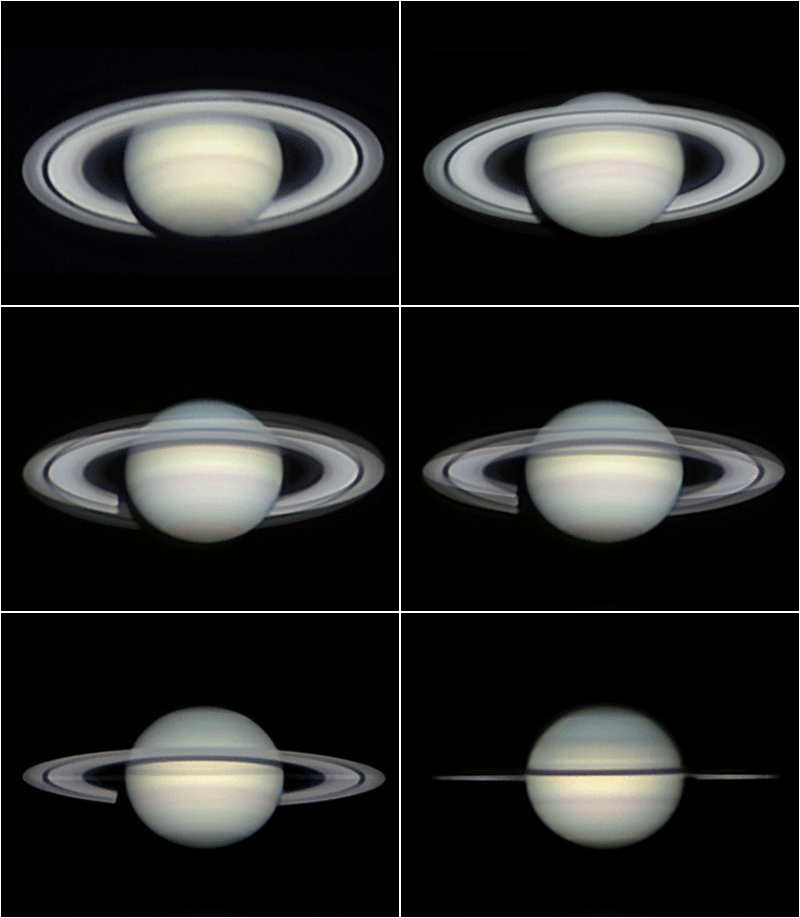
right now, saturn's rings are horizontal to the earth, with the rings very very thin and narrow... a position i think of as "sideways!" if you have the chance, view our ringed neighbor thru a telescope, via a local astronomy society, your own telescope, or a friends. saturn will not be properly viewable from the earth in this orientation again until 2038!
late this evening, 13 january 2009, provides a lovely chance to view saturn, the big, bright moon, and the star, regulus, lined up along the ecliptic.

enjoy the views!

while spacecrafts can zoom around objects to get different views, we are stuck with the perspective provided to the surface of the earth. from our vantage point, saturn's rings dont always appear at such an angle that we can see their extended beauty. saturn slowly rotates with respect to the earth, so that the rings sit at different inclination angles. richard bosman nicely demonstrates our varying views of saturn in this series of images taken over the period of time from 2005 to new years day 2009.
right now, saturn's rings are horizontal to the earth, with the rings very very thin and narrow... a position i think of as "sideways!" if you have the chance, view our ringed neighbor thru a telescope, via a local astronomy society, your own telescope, or a friends. saturn will not be properly viewable from the earth in this orientation again until 2038!
late this evening, 13 january 2009, provides a lovely chance to view saturn, the big, bright moon, and the star, regulus, lined up along the ecliptic.
enjoy the views!
Sunday, January 11, 2009
poster design
this poster advertised the rachmaninov piano concert in 2007 commemmorating the september 11 world trade center events.

the concert is long past now, but i thought the design of the poster was really great! (link)

the concert is long past now, but i thought the design of the poster was really great! (link)
Friday, January 9, 2009
for anyone who eats
if i'm completely honest, creating a tasty new dish can be more satisfying than finding an unfathomably distant galaxy.
my success rate for cooking yummy food drastically increases with the freshness of the ingredients used. i think its true that the only culinary knowledge one really needs when preparing fresh ingredients is... dont over cook them - they taste good on their own! overcooking tends to make vegetables bland, unappetizingly mushy, and less nutritious!
the last year i lived in austin, i had fresh and delicious fruits and vegetables delivered to my front door once a week (as i've mentioned before). i enjoyed cooking regularly for myself and friends in order to eat all the produce in prime condition. i often froze dishes for surprise meals during busy and/or financially challenging weeks down the road.
 when i moved to nottingham, i immediately missed my greenling deliveries, but realized that finding farmers markets and seeking similar home-delivery-of-local-produce services were potentially just a few internet searches away!
searching for recipes online provides an easy way to get ideas for how to store, cook, and combine any surprise items i receive. i still have to go to the store once in a while for yogurt, garlic, ginger, (alcohol,) bananas and/or any special ingredients required for a particular dish, but the convenience, health benefits, and cheap price of home delivery are unbeatable.
these are my personal reasons and methods for gathering food the way i do, but i find that my practices are included within the so-called slow food movement. to learn more about the slow food movement, specifically within the austin, texas community, i recommend this 10 minute video...
essential viewing for austinites, useful for anyone who eats:
"If more of us valued food and cheer and song above hoarded gold, it would be a merrier world." -- J. R. R. Tolkien
my success rate for cooking yummy food drastically increases with the freshness of the ingredients used. i think its true that the only culinary knowledge one really needs when preparing fresh ingredients is... dont over cook them - they taste good on their own! overcooking tends to make vegetables bland, unappetizingly mushy, and less nutritious!
the last year i lived in austin, i had fresh and delicious fruits and vegetables delivered to my front door once a week (as i've mentioned before). i enjoyed cooking regularly for myself and friends in order to eat all the produce in prime condition. i often froze dishes for surprise meals during busy and/or financially challenging weeks down the road.
 when i moved to nottingham, i immediately missed my greenling deliveries, but realized that finding farmers markets and seeking similar home-delivery-of-local-produce services were potentially just a few internet searches away!
 searching for recipes online provides an easy way to get ideas for how to store, cook, and combine any surprise items i receive. i still have to go to the store once in a while for yogurt, garlic, ginger, (alcohol,) bananas and/or any special ingredients required for a particular dish, but the convenience, health benefits, and cheap price of home delivery are unbeatable.
these are my personal reasons and methods for gathering food the way i do, but i find that my practices are included within the so-called slow food movement. to learn more about the slow food movement, specifically within the austin, texas community, i recommend this 10 minute video...
essential viewing for austinites, useful for anyone who eats:
"If more of us valued food and cheer and song above hoarded gold, it would be a merrier world." -- J. R. R. Tolkien
hypermuchfuss
everyone loves clever acronyms, right?
glen petitpas keeps up the entertainingly comprehensive DOOFAAS - Dumb Or Overly Forced Astronomical Acronyms Site! you might notice that my name isnt as simple as it seems; amanda actually stands for - Antarctic Muon And Neutrino Detector Array.
but is it possible for the acronym game to go too far?
sarah askew shared with us on twitter this morning, that one group may have... at least i think the win the acronym game! a paper was released today called "The HYPERMUCHFUSS Campaign -- an undiscovered high velocity population." thats right, a survey referred to as HYPERMUCHFUSS which stands for - HYPER velocity or Massive Unseen Companions of Hot Faint Underluminious Stars Survey!
wow.
glen petitpas keeps up the entertainingly comprehensive DOOFAAS - Dumb Or Overly Forced Astronomical Acronyms Site! you might notice that my name isnt as simple as it seems; amanda actually stands for - Antarctic Muon And Neutrino Detector Array.
but is it possible for the acronym game to go too far?
sarah askew shared with us on twitter this morning, that one group may have... at least i think the win the acronym game! a paper was released today called "The HYPERMUCHFUSS Campaign -- an undiscovered high velocity population." thats right, a survey referred to as HYPERMUCHFUSS which stands for - HYPER velocity or Massive Unseen Companions of Hot Faint Underluminious Stars Survey!
wow.
body puzzle
this is a clever idea:

although i can imagine much naughtier designs and locations on the body for such art...

although i can imagine much naughtier designs and locations on the body for such art...
Thursday, January 8, 2009
star wars matryoshka dolls
i present to you some of the coolest russian stacking dolls (matryoshka dolls) ever!


these cute little creatures were hand-painted by the clever matt brown! he did an impressive job painting the light-sabers to look straight on the curved surface of the dolls.


these cute little creatures were hand-painted by the clever matt brown! he did an impressive job painting the light-sabers to look straight on the curved surface of the dolls.
air traffic visualization
here's a neat visualization of all the air traffic that flies over britain in one day, from the BBC program britain from above. they use GPS data to attain the flight paths. its amazing how many planes pass overhead each day....
Wednesday, January 7, 2009
where is Arp 220?
while peculiar galaxies might not seem as symmetrically pleasing as their spiral counterparts, the events creating their odd structures are quite exciting! the galaxy, arp 220 (the 220th object in halton arp's atlas of peculiar galaxies), represents a well-studied, relatively nearby (250 million light-years away) galaxy, that doesnt appear typical at all!

the hubble space telescope image above shows the optical view of a mashed-up, non-symmetric mess! arp 220 appears as one object, but as you can infer from the wisps of faint starlight curling around the outskirts of the galaxy, something unusual is occurring!
arp 220 is also the brightest object in the local universe, as it shines extremely brightly at both x-ray and infrared wavelengths. here is an image of arp 220 in the infrared, where it radiates 90 percent of its energy, making it a classic example of an ultra-luminous infrared galaxy (ULIRG = "you-lerg"):

so what explains all these crazy characteristics of arp 220? this peculiar galaxy is the result of two separate spiral galaxies colliding together to become one! the wispy tidal tails seen in the optical image are the result of some stars and gas getting flung out of each galaxy during their initial close encounters. other chunks of gas and dust get concentrated into dense clumps during the entire merger process, seen shining brightly in the infrared image. these dense regions of gas, cool enough to form stars - lots of stars! the newly-formed stars shine very brightly, but enough dust surrounds the star-forming gas clouds that the dust absorbs huge amounts of the stellar light and heats up! the dust naturally wants to cool off and does so by releasing light energy in the infrared... thus, we see arp 220 shining very brightly in infrared observations!
at its current rate of star formation, arp 220 will shine brightly in the infrared for about the next 40 million years! this sounds like a long time to our human scales, but its not that long, astronomically speaking. after 40 million years, nearly all the gas in arp 220 will have condensed into shining stars and the resulting galaxy should eventually look like a regular elliptical galaxy.
although arp 220 lives pretty close to our milky way galaxy, it represents potential to study what may have happened to the earliest galaxies that formed in our universe, since early galaxies experienced interactions and mergers with surrounding galaxies quite often!
my fellow graduate students and i used to joke about arp 220 because it seemed to be a favorite galaxy of a particular professor of ours. every time any of us presented results on any aspect of galaxies evolving, this professor would ask "and how would arp 220 fit in with your scenario?" or "where does arp 220 lie in that plot?" he was so predictable with these questions, that we all learned to expect them and prepared ourselves, and each other, for his inevitable comments.
even though we joked about his insistence with this particular galaxy, he taught me a good lesson about the universe - when trying to understand how things occur very far away and long, long ago, its good to take examples of local, well-studied galaxies to see if they can be explained by your new theories. if arp 220, or the milky way, or andromeda, or the magellanic clouds cannot be explained to some degree by your theory, then some aspect of it is not sufficiently comprehensive in its current form.
ironically, i now find that i ask myself quite regularly - "where would arp 220 be in that plot?" and the thought experiment often proves to be useful!

the hubble space telescope image above shows the optical view of a mashed-up, non-symmetric mess! arp 220 appears as one object, but as you can infer from the wisps of faint starlight curling around the outskirts of the galaxy, something unusual is occurring!
arp 220 is also the brightest object in the local universe, as it shines extremely brightly at both x-ray and infrared wavelengths. here is an image of arp 220 in the infrared, where it radiates 90 percent of its energy, making it a classic example of an ultra-luminous infrared galaxy (ULIRG = "you-lerg"):

so what explains all these crazy characteristics of arp 220? this peculiar galaxy is the result of two separate spiral galaxies colliding together to become one! the wispy tidal tails seen in the optical image are the result of some stars and gas getting flung out of each galaxy during their initial close encounters. other chunks of gas and dust get concentrated into dense clumps during the entire merger process, seen shining brightly in the infrared image. these dense regions of gas, cool enough to form stars - lots of stars! the newly-formed stars shine very brightly, but enough dust surrounds the star-forming gas clouds that the dust absorbs huge amounts of the stellar light and heats up! the dust naturally wants to cool off and does so by releasing light energy in the infrared... thus, we see arp 220 shining very brightly in infrared observations!
at its current rate of star formation, arp 220 will shine brightly in the infrared for about the next 40 million years! this sounds like a long time to our human scales, but its not that long, astronomically speaking. after 40 million years, nearly all the gas in arp 220 will have condensed into shining stars and the resulting galaxy should eventually look like a regular elliptical galaxy.
although arp 220 lives pretty close to our milky way galaxy, it represents potential to study what may have happened to the earliest galaxies that formed in our universe, since early galaxies experienced interactions and mergers with surrounding galaxies quite often!
my fellow graduate students and i used to joke about arp 220 because it seemed to be a favorite galaxy of a particular professor of ours. every time any of us presented results on any aspect of galaxies evolving, this professor would ask "and how would arp 220 fit in with your scenario?" or "where does arp 220 lie in that plot?" he was so predictable with these questions, that we all learned to expect them and prepared ourselves, and each other, for his inevitable comments.
even though we joked about his insistence with this particular galaxy, he taught me a good lesson about the universe - when trying to understand how things occur very far away and long, long ago, its good to take examples of local, well-studied galaxies to see if they can be explained by your new theories. if arp 220, or the milky way, or andromeda, or the magellanic clouds cannot be explained to some degree by your theory, then some aspect of it is not sufficiently comprehensive in its current form.
ironically, i now find that i ask myself quite regularly - "where would arp 220 be in that plot?" and the thought experiment often proves to be useful!
Tuesday, January 6, 2009
intentions for the new year
slow down
pay attention
question everything
start now

“simplicity is the ultimate sophistication.”
- leonardo da vinci
pay attention
question everything
start now

“simplicity is the ultimate sophistication.”
- leonardo da vinci
oh night... diiviiiiine!
just in case anyone thinks i was exaggerating about my annual family christmas extravaganza... here are a few nice photos that my cousin, jeff, took of this year's event!

grandma with the "christmas carol lyrics"

hahahaha! love it. thats my dad, two uncles and an aunt standing up - all siblings, of course :)

miss you all - glad to see your enthusiastic faces (and energetic entertaining, diane!!)!

grandma with the "christmas carol lyrics"

hahahaha! love it. thats my dad, two uncles and an aunt standing up - all siblings, of course :)

miss you all - glad to see your enthusiastic faces (and energetic entertaining, diane!!)!
Monday, January 5, 2009
ganymede plays peek-a-boo with jupiter
this image of jupiter and its largest moon, ganymede, was taken by the wide field planetary camera 2 (WFPC2 = "wif-pic-two") on the hubble space telescope. three images, taken april 9, 2007 in red (673 nm), green (502 nm), and blue (410 nm) filters, were combined to produce this sharp color capture!

hubble took a series of 540 pictures over a two hour period as ganymede appeared to approach the giant gas planet and disappear behind it! you can watch these images together as a great video at the hubble site.
here's an interesting image showing the scale and orientation of the observation. the white line at the bottom represents 25,000 miles (40,000 km)! consider that earth's diameter at the equator is only about 8,000 miles (12,800 km)!


hubble took a series of 540 pictures over a two hour period as ganymede appeared to approach the giant gas planet and disappear behind it! you can watch these images together as a great video at the hubble site.
here's an interesting image showing the scale and orientation of the observation. the white line at the bottom represents 25,000 miles (40,000 km)! consider that earth's diameter at the equator is only about 8,000 miles (12,800 km)!

Subscribe to:
Posts (Atom)