read my original post last night about bush fires hitting siding springs observatory.
now it is morning time the next day. very early. i slept soundly for a few hours.
what i know: all people are safe. yay! firefighters are currently onsite at siding spring. they say there is some damage to facilities, but they have not assessed the extent.
the sun has risen and the first images available show positive signs of buildings standing where we saw evidence of small fires last night. the main 4-meter telescope has survived the flame - which is good, as it is the designated fire evacuation area on the mountain.
here is a slower timelapse (from brad tucker) of the weather cameras outside the LCOGT telescope on SSO. it covers most of yesterday and last night after darkness hit:
is case youre not clear where siding spring is located, here's a map:
thanks for all your feedback, everyone. i'll keep this page updated throughout the day.
UPDATE (08:00): the LCOGT cameras show the NSW rural fire service on site at siding spring.

the mayor of coona said this morning that the NSW RFS report the astronomer's lodge on site has been destroyed, but other buildings appear intact. if the scopes are operational, i'll take my tent to sleep in! ;) (well, only if i get official permission, of course...)
UPDATE (08:20): a photo from ryan unicomb, which must be an aerial shot from NSW RFS, but i'm not sure of their link (update: link). you can see the burned patches go right up to the telescopes - the top right shows the skymapper and the square box houses the 2.3 meter.not sure what the diagonal dark line indicates across that dome the dark diagonal line shows stairs going to the top of the building.

UPDATE (08:35): wow. this is/was the astronomer's lodge, where we slept and ate while observing. photo from NSW RFS:

UPDATE (09:00): from accounts i'm hearing, the structural destruction on the mountain is limited to the astronomer's lodge, the visitor's center, and a few of the staff homes. the telescope facilities are intact, some are responding to computer communication from remote locations, but i cannot give more details than that for now.
in preparation for this possibility, and because of the fires in mt stromlo ten years ago, some measures have been taken over the years to help reduce the damage of bush fires at siding spring. there have been controlled fires over the last six months, to rid the area of small fuel. also, the facilities have mesh installed to repel embers from spreading fires too rapidly.
NSW RFS have reported that about a dozen homes near siding spring have been destroyed. so sad.
UPDATE (09:10): the sydney morning herald's front page this morning quotes a witness as saying, "it looked like an atomic bomb":

UPDATE (09:30): for those who are not familiar with the siding spring observatory, the site is owned and operated by the australian national university in canberra. many telescopes are operated by the australian astronomical observatory (my employer) including the 4-meter anglo-australian telescope - the largest optical telescope in australia. here is a list of all the telescopes at siding spring:
ANU 2.3m Telescope
ANU Skymapper Telescope
Uppsala Near Earth Object Survey Telescope
3.9m Anglo-Australian Telescope
United Kingdom Schmidt Telescope
Hat-South Telescope Network
Solaris Telescope
Robotic Optical Transient Search Experiment – ROTSE
UNSW Automated Patrol Telescope
Faulkes Telescope South
i-Telescope.net
ANU 40 inch Telescope (decommissioned)
ANU 16 inch Telescope (decommissioned)
ANU 24 inch Telescope (decommissioned)
UPDATE (09:50): here is a photo of the destroyed director's cottage at SSO (from NSW RFS). the structure on the left is/was the astronomer's lodge. at the top right, you can see the UK schmid telescope and the faulkes south - where the webcams captured a lot of helpful images last night! you can see the pedestrian path in the foreground leading to the 4m AAT off to the right of the photo.

UPDATE (09:55): another shot of siding springs from NSW RFS (have i mentioned that they have been amazing and continue to fight the ongoing fire!). the massive AAT dome looks ok. the destroyed lodge is visible at left. still waiting for the "smoke to clear."

we are having a group meeting now to receive official updates on the situation at SSO. i'll update with what info i can!
UPDATE (10:45): there will be a two week downtime at siding spring while clean up commences and the full extent of the damage is assessed. some staff are on site now and reporting no obvious major damage to facilities and instrumentation (other than the housing structures i mentioned before).
a project i work on was scheduled to use the 4 m telescope tonight and for the next 3 nights! no data for us, but people are safe, and that's important.
observing will resume as soon as possible, when damage is fully assessed and cleaned.
UPDATE (11:05): the MOPRA telescope structure appears to be fine, but the building from which astronomers operate it has been damaged by the fires.
UPDATE (11:10): here is the current view of australia from space, thanks to chris hadfield, an astronaut currently on the international space station!!

UPDATE (11:35): here is an aerial shot of the visitor center at siding spring (from NSW RFS). it doesnt look like there is much structural damage from this photo, but there are black patches outside the main entrance that are likely due to fire damage. from reports i've heard, there was fire inside that was exstinguished this morning. i do not know the extent of the damage to the contents, yet.

UPDATE (11:44): there is a relevant article at the conversation with quotes from my self, nobel laureate brian schmidt, and astronomer michael brown.
UPDATE (12:55): the ANU will be holding a press conference at 13:15 (link).
UPDATE (13:00): i'm doing a virtual star party on and off for the next hour. (link here)
UPDATE (13:40): fires near coonabarabran continue. do not return or try to explore area.
from ANU press statement:
- observatory closed for two weeks. do not try to visit.
- generators are providing power to essential services, and the switch over was smooth - good to systems which would have glitched if not turned off properly.
- unclear when roads to siding springs will reopen.
- ANU is assessing alternative accommodation for affected staff
- NSW deputy premier Andrew Stoner reports 28 homes around coonabarabran have been lost
- smoke from "Wambelong Fire" shot 14 km into the air!
UPDATE (13:45): watch ABC news here. (which includes an interview with AAO acting director, andrew hopkins, with completely blank book shelves behind him! haha - new office...)
UPDATE (14:49): just reminiscing a bit about working with the 4m AAT. at night, we use the telescope and the instruments. during the days, when we're not sleeping, we climb around enjoying the views. ::sigh::
UPDATE (13:00): the AAO website has released some new photos of siding spring via the NSW RFS. it's pretty amazing that the AAT dome looks so clean and there is still a lot of plant life remaining!
UPDATE (15:50): not how i was hoping the telescope would make front page news :(

UPDATE (16:00): brian schmidt remembers the devastating mt stromlo fires that hit canberra exactly ten years ago this week: link to article.

UPDATE (17:00): the NSW Rural Fire Service confirmed 33 homes (and 50 sheds) lost due to the "wambelong" fire near coonabarabran and siding spring. some of these homes belong to people i consider friends. i'm very sad to report the news.
UPDATE (17:30): there are still some fires burning in the vicinity of coonabarabran, but the observatory is not under direct threat now. siding spring observatory is officially closed to everyone unless authorized by the rural fire service (including observatory staff). therefore all observing is suspended for two weeks (at least) and the full damage assessment is delayed until wednesday (it is currently monday late afternoon SSO local time). major telescope facilities appear to be ok and communication has been made with several of the computer systems from remote locations.
unless something major develops, i will not update this post anymore, because i have a major deadline tomorrow and i need to concentrate. THE SCIENCE WILL GO ON, despite the fact that i'm not getting the data from the AAT that i was scheduled to get over the next 4 nights :( i'll start another post about the situation when i have more info, and the AAO website will keep updated.
as a final reflection, please look at beautiful photos, taken by AAO's angel lopez-sanchez, of SSO between 2007 and 2012: link HERE.
and finally, a stunning panoramic image taken 4 months ago of the milky way over siding spring and the 4-meter anglo-australian telescope, by AAO's jamie gilbert.
report of the second day after the fire: SSO - as the smoke clears.
now it is morning time the next day. very early. i slept soundly for a few hours.
what i know: all people are safe. yay! firefighters are currently onsite at siding spring. they say there is some damage to facilities, but they have not assessed the extent.
 |
| Morning view via LCOGT |
here is a slower timelapse (from brad tucker) of the weather cameras outside the LCOGT telescope on SSO. it covers most of yesterday and last night after darkness hit:
is case youre not clear where siding spring is located, here's a map:
 |
| Location of Siding Spring Observatory, Australia (Credit: LCOGT) |
UPDATE (08:00): the LCOGT cameras show the NSW rural fire service on site at siding spring.

the mayor of coona said this morning that the NSW RFS report the astronomer's lodge on site has been destroyed, but other buildings appear intact. if the scopes are operational, i'll take my tent to sleep in! ;) (well, only if i get official permission, of course...)
UPDATE (08:20): a photo from ryan unicomb, which must be an aerial shot from NSW RFS, but i'm not sure of their link (update: link). you can see the burned patches go right up to the telescopes - the top right shows the skymapper and the square box houses the 2.3 meter.

UPDATE (08:35): wow. this is/was the astronomer's lodge, where we slept and ate while observing. photo from NSW RFS:

UPDATE (09:00): from accounts i'm hearing, the structural destruction on the mountain is limited to the astronomer's lodge, the visitor's center, and a few of the staff homes. the telescope facilities are intact, some are responding to computer communication from remote locations, but i cannot give more details than that for now.
in preparation for this possibility, and because of the fires in mt stromlo ten years ago, some measures have been taken over the years to help reduce the damage of bush fires at siding spring. there have been controlled fires over the last six months, to rid the area of small fuel. also, the facilities have mesh installed to repel embers from spreading fires too rapidly.
NSW RFS have reported that about a dozen homes near siding spring have been destroyed. so sad.
UPDATE (09:10): the sydney morning herald's front page this morning quotes a witness as saying, "it looked like an atomic bomb":

UPDATE (09:30): for those who are not familiar with the siding spring observatory, the site is owned and operated by the australian national university in canberra. many telescopes are operated by the australian astronomical observatory (my employer) including the 4-meter anglo-australian telescope - the largest optical telescope in australia. here is a list of all the telescopes at siding spring:
ANU 2.3m Telescope
ANU Skymapper Telescope
Uppsala Near Earth Object Survey Telescope
3.9m Anglo-Australian Telescope
United Kingdom Schmidt Telescope
Hat-South Telescope Network
Solaris Telescope
Robotic Optical Transient Search Experiment – ROTSE
UNSW Automated Patrol Telescope
Faulkes Telescope South
i-Telescope.net
ANU 40 inch Telescope (decommissioned)
ANU 16 inch Telescope (decommissioned)
ANU 24 inch Telescope (decommissioned)
UPDATE (09:50): here is a photo of the destroyed director's cottage at SSO (from NSW RFS). the structure on the left is/was the astronomer's lodge. at the top right, you can see the UK schmid telescope and the faulkes south - where the webcams captured a lot of helpful images last night! you can see the pedestrian path in the foreground leading to the 4m AAT off to the right of the photo.

UPDATE (09:55): another shot of siding springs from NSW RFS (have i mentioned that they have been amazing and continue to fight the ongoing fire!). the massive AAT dome looks ok. the destroyed lodge is visible at left. still waiting for the "smoke to clear."

we are having a group meeting now to receive official updates on the situation at SSO. i'll update with what info i can!
UPDATE (10:45): there will be a two week downtime at siding spring while clean up commences and the full extent of the damage is assessed. some staff are on site now and reporting no obvious major damage to facilities and instrumentation (other than the housing structures i mentioned before).
a project i work on was scheduled to use the 4 m telescope tonight and for the next 3 nights! no data for us, but people are safe, and that's important.
observing will resume as soon as possible, when damage is fully assessed and cleaned.
UPDATE (11:05): the MOPRA telescope structure appears to be fine, but the building from which astronomers operate it has been damaged by the fires.
UPDATE (11:10): here is the current view of australia from space, thanks to chris hadfield, an astronaut currently on the international space station!!

UPDATE (11:35): here is an aerial shot of the visitor center at siding spring (from NSW RFS). it doesnt look like there is much structural damage from this photo, but there are black patches outside the main entrance that are likely due to fire damage. from reports i've heard, there was fire inside that was exstinguished this morning. i do not know the extent of the damage to the contents, yet.

UPDATE (11:44): there is a relevant article at the conversation with quotes from my self, nobel laureate brian schmidt, and astronomer michael brown.
UPDATE (12:55): the ANU will be holding a press conference at 13:15 (link).
UPDATE (13:00): i'm doing a virtual star party on and off for the next hour. (link here)
UPDATE (13:40): fires near coonabarabran continue. do not return or try to explore area.
from ANU press statement:
- observatory closed for two weeks. do not try to visit.
- generators are providing power to essential services, and the switch over was smooth - good to systems which would have glitched if not turned off properly.
- unclear when roads to siding springs will reopen.
- ANU is assessing alternative accommodation for affected staff
- NSW deputy premier Andrew Stoner reports 28 homes around coonabarabran have been lost
- smoke from "Wambelong Fire" shot 14 km into the air!
UPDATE (13:45): watch ABC news here. (which includes an interview with AAO acting director, andrew hopkins, with completely blank book shelves behind him! haha - new office...)
UPDATE (14:49): just reminiscing a bit about working with the 4m AAT. at night, we use the telescope and the instruments. during the days, when we're not sleeping, we climb around enjoying the views. ::sigh::
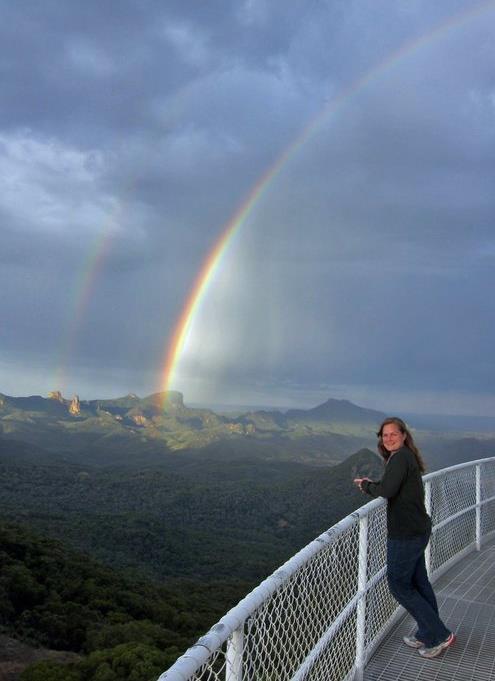 |
| double rainbow from the AAT catwalk |
 |
| from the top of the AAT dome |
 |
| Photo of AAT (from AAO and RFS) |
UPDATE (15:50): not how i was hoping the telescope would make front page news :(

UPDATE (16:00): brian schmidt remembers the devastating mt stromlo fires that hit canberra exactly ten years ago this week: link to article.
UPDATE (16:05): the MOPRA antenna does not appear to be damaged (visible at the top of the image below), but the support building (with the kitchen, bedrooms, bathroom and small office) is a pile of rubble. no CSIRO staff can access the site until tomorrow at the earliest.
UPDATE (17:00): the NSW Rural Fire Service confirmed 33 homes (and 50 sheds) lost due to the "wambelong" fire near coonabarabran and siding spring. some of these homes belong to people i consider friends. i'm very sad to report the news.
UPDATE (17:30): there are still some fires burning in the vicinity of coonabarabran, but the observatory is not under direct threat now. siding spring observatory is officially closed to everyone unless authorized by the rural fire service (including observatory staff). therefore all observing is suspended for two weeks (at least) and the full damage assessment is delayed until wednesday (it is currently monday late afternoon SSO local time). major telescope facilities appear to be ok and communication has been made with several of the computer systems from remote locations.
unless something major develops, i will not update this post anymore, because i have a major deadline tomorrow and i need to concentrate. THE SCIENCE WILL GO ON, despite the fact that i'm not getting the data from the AAT that i was scheduled to get over the next 4 nights :( i'll start another post about the situation when i have more info, and the AAO website will keep updated.
as a final reflection, please look at beautiful photos, taken by AAO's angel lopez-sanchez, of SSO between 2007 and 2012: link HERE.
and finally, a stunning panoramic image taken 4 months ago of the milky way over siding spring and the 4-meter anglo-australian telescope, by AAO's jamie gilbert.
 |
| the milky way over siding spring (credit: jamie gilbert) |
report of the second day after the fire: SSO - as the smoke clears.


