miriam & amadou are definitely a duo that i cannot wait to hear live!! the "blind couple from mali" create and intensely positive world music sound together. i was hooked the instant i heard their 2005 album dimanche a bamako. in combination with producer, manu chao, they created an album that feels as the name suggests.... like a lazy, happy, productive sunday afternoon. it's soft, but intricate, relaxed and intense!
here's a song called "senegal fast food"...
Sunday, March 23, 2008
Saturday, March 22, 2008
expelled from expelled!
this is the most hilariously ironic story i've heard in a long, long time.
from my perspective, it started this past wednesday, when i went to hear richard dawkins speak on UT's campus. i knew his general debate points before going in, but i appreciated that he raised my consciousness to concepts i hadn't considered.
during his talk he mentioned a movie i hadnt heard of... ben stein's expelled: no intelligence allowed. dawkins spoke of being tricked into being interviewed for the movie by people claiming they were sympathetic to his views on biology, evolution, religion and atheism. he also mentioned that biologist and blogger, pz myers, was similarly tricked into participating in this movie that apparently claims professors should be given tenure even if they throw out the massive amounts of evidence and scientific consensus for evolution, and instead believe in creationism.

so i just read on pharyngula, pz myers blog, a fabulously ironic story from last night. read his version for yourself, but i'll summarize here. he went to a ticket-less special screening of the movie last night with his family and a few guests. the producer of the film recognized him and sent over a policeman to escort him out of the line into the theatre with the threat of arrest! pz questioned the officer, then left without a fuss, leaving his family and guests to view the film. the irony? one of his guests was freaking richard dawkins!!! hahahaha!!
the producer recognized pz, but not his guest. way to be on top of things! here's another account from a witness last night. enjoy!!
from my perspective, it started this past wednesday, when i went to hear richard dawkins speak on UT's campus. i knew his general debate points before going in, but i appreciated that he raised my consciousness to concepts i hadn't considered.
during his talk he mentioned a movie i hadnt heard of... ben stein's expelled: no intelligence allowed. dawkins spoke of being tricked into being interviewed for the movie by people claiming they were sympathetic to his views on biology, evolution, religion and atheism. he also mentioned that biologist and blogger, pz myers, was similarly tricked into participating in this movie that apparently claims professors should be given tenure even if they throw out the massive amounts of evidence and scientific consensus for evolution, and instead believe in creationism.

so i just read on pharyngula, pz myers blog, a fabulously ironic story from last night. read his version for yourself, but i'll summarize here. he went to a ticket-less special screening of the movie last night with his family and a few guests. the producer of the film recognized him and sent over a policeman to escort him out of the line into the theatre with the threat of arrest! pz questioned the officer, then left without a fuss, leaving his family and guests to view the film. the irony? one of his guests was freaking richard dawkins!!! hahahaha!!
the producer recognized pz, but not his guest. way to be on top of things! here's another account from a witness last night. enjoy!!
Friday, March 21, 2008
looming defense

defense is looming
nerves peak in middle of night
less than two months left
now i have a job (!!!!!!!)
assurance relieves pressure
but tough times remain
much work still to do
prolific writing abound
concentration, please!
Thursday, March 20, 2008
a last message from sir arthur c. clarke
Sir Arthur C. Clarke shares reflections and preditions on his 90th birthday in this ~9 minute recording from december 2007.
the moon and saturn and regulus
it's the time of the month for the moon to swing past saturn again! look to the south-east to see the moon just below a white-yellow saturn!

this time last month when the moon passed by the 6th planet in our solar system, it also passed through the earth's shadow and shared with us a lovely lunar eclipse!

the above compilation image shows 12 lunar eclipses from 1996 to last month! it's interesting to see how the size of the moon changes in each image as the physical distance between the moon and the earth changes based on the moon's position in its elliptical orbit. enjoy!

this time last month when the moon passed by the 6th planet in our solar system, it also passed through the earth's shadow and shared with us a lovely lunar eclipse!

the above compilation image shows 12 lunar eclipses from 1996 to last month! it's interesting to see how the size of the moon changes in each image as the physical distance between the moon and the earth changes based on the moon's position in its elliptical orbit. enjoy!
Tuesday, March 18, 2008
what is intelligence, anyway?
this is a particularly interesting insight as i'm stuck in the depths of writing my dissertation and studying everything i think my committee members might ask me i should know to earn my doctoral degree. unfortunately, the insight isnt terribly useful for my current predicament, but it's interesting nonetheless.
What is intelligence, anyway?
By Isaac Asimov
What is intelligence, anyway?
By Isaac Asimov
When I was in the army, I received the kind of aptitude test that all soldiers took and, against a normal of 100, scored 160. No one at the base had ever seen a figure like that, and for two hours they made a big fuss over me.
(It didn't mean anything. The next day I was still a buck private with KP - kitchen police - as my highest duty.)
All my life I've been registering scores like that, so that I have the complacent feeling that I'm highly intelligent, and I expect other people to think so too.
Actually, though, don't such scores simply mean that I am very good at answering the type of academic questions that are considered worthy of answers by people who make up the intelligence tests - people with intellectual bents similar to mine?
For instance, I had an auto-repair man once, who, on these intelligence tests, could not possibly have scored more than 80, by my estimate. I always took it for granted that I was far more intelligent than he was.
Yet, when anything went wrong with my car I hastened to him with it, watched him anxiously as he explored its vitals, and listened to his pronouncements as though they were divine oracles - and he always fixed my car.
Well, then, suppose my auto-repair man devised questions for an intelligence test.
Or suppose a carpenter did, or a farmer, or, indeed, almost anyone but an academician. By every one of those tests, I'd prove myself a moron, and I'd be a moron, too.
In a world where I could not use my academic training and my verbal talents but had to do something intricate or hard, working with my hands, I would do poorly.
My intelligence, then, is not absolute but is a function of the society I live in and of the fact that a small subsection of that society has managed to foist itself on the rest as an arbiter of such matters.
Consider my auto-repair man, again.
He had a habit of telling me jokes whenever he saw me.
One time he raised his head from under the automobile hood to say: "Doc, a deaf-and-mute guy went into a hardware store to ask for some nails. He put two fingers together on the counter and made hammering motions with the other hand.
"The clerk brought him a hammer. He shook his head and pointed to the two fingers he was hammering. The clerk brought him nails. He picked out the sizes he wanted, and left. Well, doc, the next guy who came in was a blind man. He wanted scissors. How do you suppose he asked for them?"
Indulgently, I lifted by right hand and made scissoring motions with my first two fingers.
Whereupon my auto-repair man laughed raucously and said, "Why, you dumb jerk, He used his voice and asked for them."
Then he said smugly, "I've been trying that on all my customers today." "Did you catch many?" I asked. "Quite a few," he said, "but I knew for sure I'd catch you."
"Why is that?" I asked. "Because you're so goddamned educated, doc, I knew you couldn't be very smart."
And I have an uneasy feeling he had something there.
Monday, March 17, 2008
cape canaveral night launch
one day i hope to witness a shuttle night launch at cape canaveral. i want to watch the night sky glow like its daytime from the immense thrust created by humans to shoot rockets up so fast that they escape earth's gravity!! here's an image from APOD showing last week's night launch of the space shuttle endeavour.

many many years ago when vacationing with my family in florida (like every other family from ohio and the midwest at large it seemed!), we watched a daytime shuttle launch from many miles away. we stood on the beach, delaying our long ride home, to watch a tiny little streak of smoke rise quickly in the air. we saw it rise up and heard and felt the rumble afterwards. the sound delay was so long, that i almost forgot to expect it!
it's amazing to think that we (humans) are launching something into space almost every week now, even though we only started exploring space 50 years ago!!

many many years ago when vacationing with my family in florida (like every other family from ohio and the midwest at large it seemed!), we watched a daytime shuttle launch from many miles away. we stood on the beach, delaying our long ride home, to watch a tiny little streak of smoke rise quickly in the air. we saw it rise up and heard and felt the rumble afterwards. the sound delay was so long, that i almost forgot to expect it!
it's amazing to think that we (humans) are launching something into space almost every week now, even though we only started exploring space 50 years ago!!
Sunday, March 16, 2008
planetary nebula NGC 2371
there's a footprint in this big cloud of gas!

this image of planetary nebula, NCG 2371, just released from the hubble space telescope heritage collection. see the red left-footprint over on the left representing glowing nitrogen gas? perspective is grand, isn't it?!

as a title for this blog entry, i almost used: "caught red-footed!" while it caused me to sigh a big enough ... uuuuuuugh... that i ultimately chose a different title, i thought phit plait might appreciate it! :)
NGC 2371 lives about 4,300 light-years away in the constellation, gemini. in fact, tonight, there is a line up of the moon and mars, inside gemini, and NGC 2371 jumps right in between gemini's twin's , castor and pollux, and the moon!


now, NGC 2372 a very faint gas cloud at about 11 magnitudes, so you won't be able to pick it out with your eye, or even binoculars, but it'll be nice to know it's there!

this image of planetary nebula, NCG 2371, just released from the hubble space telescope heritage collection. see the red left-footprint over on the left representing glowing nitrogen gas? perspective is grand, isn't it?!

as a title for this blog entry, i almost used: "caught red-footed!" while it caused me to sigh a big enough ... uuuuuuugh... that i ultimately chose a different title, i thought phit plait might appreciate it! :)
NGC 2371 lives about 4,300 light-years away in the constellation, gemini. in fact, tonight, there is a line up of the moon and mars, inside gemini, and NGC 2371 jumps right in between gemini's twin's , castor and pollux, and the moon!


now, NGC 2372 a very faint gas cloud at about 11 magnitudes, so you won't be able to pick it out with your eye, or even binoculars, but it'll be nice to know it's there!
the moon, mars, and gemini
did anyone catch how gorgeously the moon lined up next to bright orange mars last night?
tonight the moon slides down and over a little to perch right between mars and the twins of gemini, pollux [PAUL-ux] and castor [CASS-ter]. the moon is bright and the alignment will occur practically overhead after sunset, but you'll be able to see the filling-up moon for most of the afternoon!
Saturday, March 15, 2008
carnival of space - #45
enjoy this week's round up of all spacey bloggy things at the 45th carnival of space hosted observations from missy's window.
Friday, March 14, 2008
her stroke of insight
in this video from TED, dr. jill bolte taylor mixes her knowledge of science with the poetry of her personal experience.
"Neuroanatomist Jill Bolte Taylor had an opportunity few brain scientists would wish for: One morning, she realized she was having a massive stroke. As it happened -- as she felt her brain functions slip away one by one, speech, movement, understanding -- she studied and remembered every moment. This is a powerful story about how our brains define us and connect us to the world and to one another."
Saturday, March 8, 2008
WMAP - "double-U map"
I remember the exact moment when the very first results were released from the wilkinson microwave anisotropy probe... WMAP... "double-U map."
it was my first year in grad school, february 2003, 8 months after i moved to austin, texas. many UT astronomers sat together in the main classroom watching an internet-fed NASA press-release projected on the front screen. with anticipation in the air and excitement lowly buzzing around the room, we informally drank from our coffee mugs and smiled at the faces on the screen and at each other!
these results were to revolutionize applied astronomy!
in my very first astronomy course ever, as a first-year undergraduate student (studying french), i learned that the value of the hubble constant was somewhere between 50 and 100 km/s/Mpc (astronomers refer to the hubble constant as H_o ["H-naught"]). this seemed like a pretty big spread in possible values for H_o, which especially didnt help my understanding a number with the units of velocity per unit distance... kilometers per second per megaparsec... km/s/Mpc...?? distance divided by time divided by distance. but the distances cancel out, right? so it's just a per second... (1/sec)... thats a rate! the hubble constant describes the rate at which the entire universe is expanding and we know that it lies somewhere between 50 and 100 km/s/Mpc? cool!
you can also discover the age of the universe from hubbles constant... the inverse of a rate (something per second) is a time. so if you take the inverse of the of expansion of the universe and change everything to the proper units (years), you discover that the age of the universe... is somewhere between 10 and 20 billion years, according to my freshman astronomy class! wow!
that was my thought process as an undergraduate anyway. jump forward to 2003 when the NASA spokesperson on the screen in the front of the classroom announced that the first results for the WMAP were tallied, and revealed that Hubble's Constant is 72 km/s/Mpc and the universe was 13.7 +/- 0.2 billion years old! how precise!?! goose bumps found my arms that day, when they told us this number and showed us the first image of the cosmic microwave background radiation (shown below). the updated 5-year results (revealed by NASA last week) show that hubble's constant is 70.1+/-1.3 km/s/Mpc and the universe is 13.73 +/- 0.12 billion years old! period.
how does the WMAP experiment reveal this information? by looking at the dying glow of the first light possible for us to "see" after the big bang. the colors show very tiny temperature differences.
here's the "map" of the universe revealed by the 2003 first-year results...

here's the equivalent map after collecting 5-years worth of data.

they look very similar. you can see the same general patterns in each... the dark blue spot near the center on both images, and there's another one towards the lower left (cosmic voids?). the new data more precisely isolates the orange "hot" spots from the blue "cold" spots in both space and difference in value.
to understand the oval shape of the WMAP image, i swiped this description and image from ned wright's cosmology tutorial...
"These ovals are all maps of the entire celestial sphere in an equal-area Mollweide projection. The image at right shows a topographical map of the Earth in this projection. Note that there is no part of the Earth that is not included in the oval, and thus there is nothing "outside" the WMAP map."

to read more in-depth introductions to cosmology, see ned wright's cosmology tutorial, or WMAP for dummies. phil plait, at badastronomy.com, gives a more brief, and to the point description of the dying glow of the big bang that WMAP actually sees. sean carroll at cosmic variance reflected on the third year WMAP results and introduces more of the physics-lingo involved in the discussion.
i wonder what will be the next big astronomy moment that will leave momentary details etched in my mind forever?
it was my first year in grad school, february 2003, 8 months after i moved to austin, texas. many UT astronomers sat together in the main classroom watching an internet-fed NASA press-release projected on the front screen. with anticipation in the air and excitement lowly buzzing around the room, we informally drank from our coffee mugs and smiled at the faces on the screen and at each other!
these results were to revolutionize applied astronomy!
in my very first astronomy course ever, as a first-year undergraduate student (studying french), i learned that the value of the hubble constant was somewhere between 50 and 100 km/s/Mpc (astronomers refer to the hubble constant as H_o ["H-naught"]). this seemed like a pretty big spread in possible values for H_o, which especially didnt help my understanding a number with the units of velocity per unit distance... kilometers per second per megaparsec... km/s/Mpc...?? distance divided by time divided by distance. but the distances cancel out, right? so it's just a per second... (1/sec)... thats a rate! the hubble constant describes the rate at which the entire universe is expanding and we know that it lies somewhere between 50 and 100 km/s/Mpc? cool!
you can also discover the age of the universe from hubbles constant... the inverse of a rate (something per second) is a time. so if you take the inverse of the of expansion of the universe and change everything to the proper units (years), you discover that the age of the universe... is somewhere between 10 and 20 billion years, according to my freshman astronomy class! wow!
that was my thought process as an undergraduate anyway. jump forward to 2003 when the NASA spokesperson on the screen in the front of the classroom announced that the first results for the WMAP were tallied, and revealed that Hubble's Constant is 72 km/s/Mpc and the universe was 13.7 +/- 0.2 billion years old! how precise!?! goose bumps found my arms that day, when they told us this number and showed us the first image of the cosmic microwave background radiation (shown below). the updated 5-year results (revealed by NASA last week) show that hubble's constant is 70.1+/-1.3 km/s/Mpc and the universe is 13.73 +/- 0.12 billion years old! period.
how does the WMAP experiment reveal this information? by looking at the dying glow of the first light possible for us to "see" after the big bang. the colors show very tiny temperature differences.
here's the "map" of the universe revealed by the 2003 first-year results...

here's the equivalent map after collecting 5-years worth of data.

they look very similar. you can see the same general patterns in each... the dark blue spot near the center on both images, and there's another one towards the lower left (cosmic voids?). the new data more precisely isolates the orange "hot" spots from the blue "cold" spots in both space and difference in value.
to understand the oval shape of the WMAP image, i swiped this description and image from ned wright's cosmology tutorial...
"These ovals are all maps of the entire celestial sphere in an equal-area Mollweide projection. The image at right shows a topographical map of the Earth in this projection. Note that there is no part of the Earth that is not included in the oval, and thus there is nothing "outside" the WMAP map."

to read more in-depth introductions to cosmology, see ned wright's cosmology tutorial, or WMAP for dummies. phil plait, at badastronomy.com, gives a more brief, and to the point description of the dying glow of the big bang that WMAP actually sees. sean carroll at cosmic variance reflected on the third year WMAP results and introduces more of the physics-lingo involved in the discussion.
i wonder what will be the next big astronomy moment that will leave momentary details etched in my mind forever?
human debut in astrophotography
more inspiring photographic fun from larry landolfi.


the background for the first image is a publicly available compilation image of "Cassiopeia A" [cass-ee-oh-PEA-uh] provided by NASA. the image of "Cas A" combines data from 3 space telescopes: infrared from the spitzer space telescope, visible light from the hubble space telescope, and x-ray emission from the chandra x-ray observatory. the supernova remnant, Cas A, shows us what is left behind after a star much more massive than our sun explodes to end its life! Cas A was first recorded to be seen by humans 300 years ago, after the light traveled 10,000 years to reach us!
i like how landolfi digitally adds a human perspective to these two wonderful snapshots of the universe!


the background for the first image is a publicly available compilation image of "Cassiopeia A" [cass-ee-oh-PEA-uh] provided by NASA. the image of "Cas A" combines data from 3 space telescopes: infrared from the spitzer space telescope, visible light from the hubble space telescope, and x-ray emission from the chandra x-ray observatory. the supernova remnant, Cas A, shows us what is left behind after a star much more massive than our sun explodes to end its life! Cas A was first recorded to be seen by humans 300 years ago, after the light traveled 10,000 years to reach us!
i like how landolfi digitally adds a human perspective to these two wonderful snapshots of the universe!
Friday, March 7, 2008
Thursday, March 6, 2008
space alone
this is a great little animated short movie. its a bit sad and made me think "woah!"
created by ilias sounas
enceladus: saturn's (water?) moon
the cassini spacecraft will be making a close fly-by of saturn's moon enceladus [en-SELL-ah-dus] in one week, next wednesday, march 12, 2008! it's surface features many craters, eventhough it is covered by fresh, clean ice! there are large geysers, like old faithful on earth, spouting out little ice crystals!

with the upcoming flyby, scientists hope to gain insight into a possible liquid layer beneath the ice surface. here's a quick video from JPL explaining the specifics of the mission!

with the upcoming flyby, scientists hope to gain insight into a possible liquid layer beneath the ice surface. here's a quick video from JPL explaining the specifics of the mission!
Tuesday, March 4, 2008
Sunday, March 2, 2008
neko case
neko case is my rock and roll crush. i am absolutely in awe of her musical mastery! she is a brilliantly unique songwriter and i've never heard a voice so powerful and pure. the best part about her is that she gets it... whatever that might mean to you! she dislikes auto-tuners "fixing" recorded voices, she doesnt want to be "too famous"... she just wants to be heard, and she's passionate about what she does. she has a lifelong fan in me!
"hold on hold on"
"favorite"

"hold on hold on"
"favorite"

moon covers venus this wednesday!
early-risers have quite a few interesting solar system alignments to entertain them for the next several mornings!
before the sun rises to outshine everything in the sky, three planets glow brightly toward the southeast: jupiter, venus, and mars. monday morning, march 3rd, the moon rises above the horizon just after jupiter, showing off its waning crescent to jupiter's lower left. the next morning, the sliver moon will shine between jupiter and the planet pair, venus and mercury! wednesday morning, the moon passes very close to mercury and venus... so close that the moon will pass in front of venus during the day!!

the lunar occultation of venus will be visible from many parts of north america (see map below). in austin, texas, we will be able to see the moon cover venus at 12:12pm (here's a table to determine times of occult for other locations - note that times are given in Universal Time so i subtracted 6 hours to get CST).

there are many times when venus is bright enough to be seen during the day, but it's a difficult (nearly impossible) task to see it when you don't know exactly where to look! this occultation will allow more of us to see venus during the day, because the much bigger target, the moon, will be so close! from texas, the crescent moon will be about 30 degrees up in the sky from the horizon, but still difficult to spot since only a tiny portion will be lit up by reflected sunlight. try to find the moon by looking southeast around noon, then look for venus just to the left of the moon.
i really enjoy seeing distant objects other than the sun in the sky during the day, so i'll be eating my lunch outside this wednesday!!
before the sun rises to outshine everything in the sky, three planets glow brightly toward the southeast: jupiter, venus, and mars. monday morning, march 3rd, the moon rises above the horizon just after jupiter, showing off its waning crescent to jupiter's lower left. the next morning, the sliver moon will shine between jupiter and the planet pair, venus and mercury! wednesday morning, the moon passes very close to mercury and venus... so close that the moon will pass in front of venus during the day!!

the lunar occultation of venus will be visible from many parts of north america (see map below). in austin, texas, we will be able to see the moon cover venus at 12:12pm (here's a table to determine times of occult for other locations - note that times are given in Universal Time so i subtracted 6 hours to get CST).

there are many times when venus is bright enough to be seen during the day, but it's a difficult (nearly impossible) task to see it when you don't know exactly where to look! this occultation will allow more of us to see venus during the day, because the much bigger target, the moon, will be so close! from texas, the crescent moon will be about 30 degrees up in the sky from the horizon, but still difficult to spot since only a tiny portion will be lit up by reflected sunlight. try to find the moon by looking southeast around noon, then look for venus just to the left of the moon.
i really enjoy seeing distant objects other than the sun in the sky during the day, so i'll be eating my lunch outside this wednesday!!
Saturday, March 1, 2008
box
great graphics in this video imply that boxes could take over the world. if not boxes, then what?
happy leap day!
for all the gory details about why we have leap years and which years are leap years (hint: there's a bit more to it than just "every four years"), go check out phil plait's thorough leap year explanation (complete with math!).

and happy birthday to my office mate, shay, who's about to get her phd at age 7! amazing!

and happy birthday to my office mate, shay, who's about to get her phd at age 7! amazing!
Friday, February 29, 2008
worldwide telescope
i'm super excited about the upcoming worldwide telescope (worldwidetelescope.org)!! apparently this interactive service will be better than google sky, starry night, or stellarium for allowing students and regular folks to pan thru space ad discover our real place in the universe with the eyes of nearly any telescope you choose! from my understanding, you will be able to download actual images from any astronomical archive data base that participates... like the prototype, openskyquery.net.
an announcement was made about the worldwide telescope at the TED conference, so i'll be looking for more news soon!

here's an abstract from a talk last year given by Jonathan Fay
an announcement was made about the worldwide telescope at the TED conference, so i'll be looking for more news soon!

here's an abstract from a talk last year given by Jonathan Fay
The WorldWide Telescope (WWT) project is designed to be an extensible learning and exploration environment which integrates hyperlinked rich media narrative with a seamless multiple survey virtual sky to enable guided and unguided exploration of the universe. WWT is a collaboration between Next Media Research (Principal Researcher and group manager Curtis Wong, Principal Research Software Design Engineer Jonathan Fay and Jina Suh Research Intern), Alex Szalay at Johns Hopkins University, Alyssa Goodman at Harvard's Center for Astrophysics, and Frank Summers at Space Telescope Science Institute.
The vision for WWT began in 1993 Curtis' production of a CD-ROM called "John Dobson's Universe" which was never completed but featured a number of narrated tours within a virtual sky and included a talk that John Dobson recorded at Table Mountain in 1993. Curtis worked closely with Jim Gray and Alex Szalay in 2002 to develop the SkyServer Website to facilitate public access to the images and data from the Sloan Digital Sky Survey. SkyServer was always conceived of as the foundation towards building the World Wide Telescope. In early 2005 Curtis developed the collaborations with Harvard and STSCI and hired Jonathan Fay in late 2005 to utilize his experience in astronomical imaging and building interactive visualizations for TeraServer to architect and build the technology for WWT.
norway sunset at midnight!
if youre a person who needs deep darkness to sleep, then take a sleeping eye mask if you visit norway!! photographer Thomas Laupstad captured some beautiful pictures of a norway sunset.... at midnight!!


northern norway seems not to be the best place to move if you enjoy stargazing ;)


northern norway seems not to be the best place to move if you enjoy stargazing ;)
Wednesday, February 27, 2008
mercury and venus - together!
Tuesday, February 26, 2008
50 years of space science
the US space studies board has put together an international public seminar series called "forging the future of space science: the next 50 years." this year marks the 50th anniversary of the international geophysical year which saw the launch of the first satellites: soviet union's sputnik, the US's explorer 1; the creation of NASA, and the beginning of the space science board! while reflecting on the last (first) 50 years of human space flight, this seminar series attempts to activate young minds to consider the possibilities for what the next 50 years of space science could bring!
austin, texas hosted one day of events last wednesday! the first event was an afternoon panel discussion.
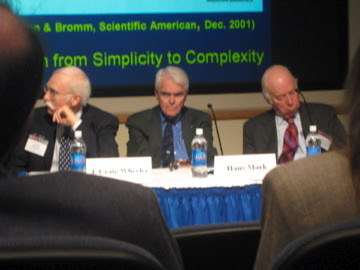
while the current generation of UT graduate students and postdocs were encouraged to participate in the panel discussion, the panelists definitely represented the previous 50 years of space science! here are three of the distinguishedold white men panelists:

(i couldnt stop giggling in my seat as i sat there watching some of them closing their eyes and bobbing their heads, so i took a picture :)
on the left is UT astronomy professor, president of the american astronomical society and consistent bearer of a rocking 'stache - j. craig wheeler. in the middle is former deputy administrator of NASA and current UT aerospace engineering professor - hans mark. on the right is nobel prize winning physicist and current UT physics professor - steven weinberg.
the panelists spoke briefly about how space technology has prominently affected their research over the years, but i was hoping to hear a bit more about their visions of the future of space science. weinberg didnt disappoint with his candid negativity towards manned space flight, specifically regarding the moon-mars initiative proposed by G. W. Bush in 2004!
i thought the best part of the discussion began when the audience joined in. i jumped up to say that i wanted to hear more benefits about the science resulting from manned space flight. i didn't initially support the moon-mars initiative because i did not trust the motives of the man who proposed it, but more importantly, i did not like the way NASA'a budget would have to transform itself to meet the demands of this new plan while not fundamentally increasing. the direct drawback to my particular science would be decreased funding for the james webb space telescope: the only planned successor to the hubble space telescope.
a couple graduate students from the aerospace engineering school pointed out that science would come from going to the moon and/or mars: properties of fluid dynamics, for example. it was also pointed out that while robots are useful technology, it takes the mars rovers 2 days to turn around and dig a shallow hole into a rock face, where it would only take a human a matter of minutes.
their major claim was that it is arrogant to discount manned space-flight as not scientifically useful just because one's own "science" might not be benefited. this is a point i take to heart as it is directly pertinent to my apparently selfish astronomer views!!
but i am not convinced that sending humans to deep space will teach us more than the effects of deep space on humans. let's send 100 robots to mars instead of a human, because ultimately, that would be cheaper. weinberg claimed that if we had built many hubble space telescopes to launch into space, in the event that things went awry, instead of sending astronauts on servicing missions to fix the telescope/instruments, we would have saved a lot of money for performing just as much science.
and let's not forget that exploring space is COOL!! exploration is an exhilarating experience for human beings and necessary to learn more about our local solar system and the universe beyond. focused questions pertaining to the existence of life, the origins of earth, etc... should be asked and answers should be sought!! but i dont think our best immediate move is to send humans. lets send lots of robots of increasing capability and when/if they find something excitingly unexplainable.... then lets send humans! weinberg makes the statement that exploration of space is a good, beneficial thing, but NASA shouldn't tout manned space flight as a misleadingly strict "scientific endeavor."
all this being said, if i was invited to be an astronaut, i would go up into space to experience weightlessness in a second - without hesitation!!! however, i think this statement supports independent spaceflight and not manned, NASA-funded missions.
austin, texas hosted one day of events last wednesday! the first event was an afternoon panel discussion.
while the current generation of UT graduate students and postdocs were encouraged to participate in the panel discussion, the panelists definitely represented the previous 50 years of space science! here are three of the distinguished

(i couldnt stop giggling in my seat as i sat there watching some of them closing their eyes and bobbing their heads, so i took a picture :)
on the left is UT astronomy professor, president of the american astronomical society and consistent bearer of a rocking 'stache - j. craig wheeler. in the middle is former deputy administrator of NASA and current UT aerospace engineering professor - hans mark. on the right is nobel prize winning physicist and current UT physics professor - steven weinberg.
the panelists spoke briefly about how space technology has prominently affected their research over the years, but i was hoping to hear a bit more about their visions of the future of space science. weinberg didnt disappoint with his candid negativity towards manned space flight, specifically regarding the moon-mars initiative proposed by G. W. Bush in 2004!
i thought the best part of the discussion began when the audience joined in. i jumped up to say that i wanted to hear more benefits about the science resulting from manned space flight. i didn't initially support the moon-mars initiative because i did not trust the motives of the man who proposed it, but more importantly, i did not like the way NASA'a budget would have to transform itself to meet the demands of this new plan while not fundamentally increasing. the direct drawback to my particular science would be decreased funding for the james webb space telescope: the only planned successor to the hubble space telescope.
a couple graduate students from the aerospace engineering school pointed out that science would come from going to the moon and/or mars: properties of fluid dynamics, for example. it was also pointed out that while robots are useful technology, it takes the mars rovers 2 days to turn around and dig a shallow hole into a rock face, where it would only take a human a matter of minutes.
their major claim was that it is arrogant to discount manned space-flight as not scientifically useful just because one's own "science" might not be benefited. this is a point i take to heart as it is directly pertinent to my apparently selfish astronomer views!!
but i am not convinced that sending humans to deep space will teach us more than the effects of deep space on humans. let's send 100 robots to mars instead of a human, because ultimately, that would be cheaper. weinberg claimed that if we had built many hubble space telescopes to launch into space, in the event that things went awry, instead of sending astronauts on servicing missions to fix the telescope/instruments, we would have saved a lot of money for performing just as much science.
and let's not forget that exploring space is COOL!! exploration is an exhilarating experience for human beings and necessary to learn more about our local solar system and the universe beyond. focused questions pertaining to the existence of life, the origins of earth, etc... should be asked and answers should be sought!! but i dont think our best immediate move is to send humans. lets send lots of robots of increasing capability and when/if they find something excitingly unexplainable.... then lets send humans! weinberg makes the statement that exploration of space is a good, beneficial thing, but NASA shouldn't tout manned space flight as a misleadingly strict "scientific endeavor."
all this being said, if i was invited to be an astronaut, i would go up into space to experience weightlessness in a second - without hesitation!!! however, i think this statement supports independent spaceflight and not manned, NASA-funded missions.
Subscribe to:
Posts (Atom)