Showing posts sorted by relevance for query cassini. Sort by date Show all posts

Wednesday, July 16, 2008

cassini continues...

the cassini space craft that is floating around saturn has finished its 4 year mission. many fantastic images have come from this mission, and luckily for us, cassini started an extended 2-year mission on july 1, 2008!!

here are a couple anniversary shots recently released....


in this picture you can see the moon, mimas, in the top left and you can see the shadow of the moon, enceladus, on the surface of saturn.


in both images you can see the shadows of the rings on the northern hemisphere of the planet. over the next year, we will see less and less of the ring shadows, both from cassini and from earth, as the plane of the rings lines up with the sun. the ring shadows line up exactly with saturn's horizon during saturns vernal equinox on august 11, 2009! afterwards, the shadows will appear on the southern hemisphere of the planet.

you can still see saturn in the western horizon at sunset, with mars nearby!

Monday, September 24, 2012

cassini and saturn

here is a lovely shot of saturn, its rings, their shadows and saturn's largest moon titan.  

Saturn and Titan.  Photo Credit: NASA


this photo was taken by cassini - a spacecraft that humans sent up to explore saturn and its moons 15 years ago!   cassini launched in 1997 and arrived at saturn in 2004.   it successfully completed it's original mission after 4 years, in 2008.  since the satellite has remained healthy, its missions have been extended, completing the equinox mission in 2010, and currently working on the solstice mission.

that's an impressive lifetime for a little machine flying around a distant planet!   


Friday, July 9, 2010

saturn's hexagon

here's a funny saturday morning breakfast cereal (SMBC) cartoon.


indeed ;)

the hexagonal patterns around saturn's north pole were discovered by the voyager spacecraft flybys in the 1980s and quickly became mysterious phenomena. images taken by the cassini spacecraft since 2006 have shown how long-lived the hexagonal patterns in the clouds are, further extending the mystery. this image from cassini shows the thermal infrared glow (at 5 microns) of saturn's north pole:


circles and a definite hexagon! strange.

since astronomical objects are so far away in space, it is rare that laboratory experiments on earth can test theories about the inexplicably strange aspects of the solar system we observe with our telescopes and spacecraft, because we can rarely recreate the conditions that exist elsewhere in the universe (temperature, size, density, etc...).

but, a recent study by physicists Ana Claudia Barbosa Aguiar and Peter Read of the University of Oxford in the United Kingdom, has produced hexagonal patterns similar to those observed around saturn's north pole by releasing dye into a 30-liter cylinder tank of water spinning on a table. inside the tank of water, they place a small ring that whirls more rapidly than the cylinder and produces a jet stream.

the video below shows their experiment (behold, actual science on youtube!!!):


the study deduces that the speed of the spin of the inner ring relative to the cylinder determines the number of sides of the polygon formed. the larger the difference between the speed of the inner ring and the cylinder, the fewer sides the polygon had; they can produce triangles, squares, or "anything you like."

awesome.

Tuesday, April 29, 2008

saturn and iapetus

here are some fantastic images of saturn that i received from a friend and/or from the jpl cassini website. these images were taken by the cassini space craft using red, green and blue spectral filters then combined to create natural-looking photographs.

i absolutely love the details of the atmosphere that you can see above the shadow of the rings!


the image below shows the moon, rhea (1,528 kilometers, or 949 miles across) in the foreground. the little moon shadow at the upper left in from the moon mimas, and the skewed shadow at the bottom right is from the moon, iapetus [eye-AP-i-tus].


the above image shows some cool seasonal features of saturn. the northern (upper) part of saturn is currently experiencing winter and is therefore cooler on average as it is turned away from the sun more than the southern part. in the northern hemisphere, above the ring shadow, you can see the detailed structure of the gas deep down into the atmosphere, whereas you cannot see such structure at the equator or in the southern hemisphere. this is likely due to two effects: the higher temperatures at the equator and the south, and also the reflection of sunlight. we can see some structure in the southern atmosphere, but it is mostly flushed out by scattered sunlight. photons that reach saturn from the sun are bounced around off the particles high up the atmosphere and reflected back out in all directions. this makes it harder to see the deeper layers....

like when you turn your bright lights on while driving thru fog: you quickly realize you can actually see less than if you just have dim lights on!


here are some great images of the saturn's moon, iapetus. iapetus has a crazy, unexplainable bulging waistline that hasnt been seen on any other planet or moon in our solar system.


iapetus is saturn's third largest moon and has a lot of craters. the big crater near the bottom is about 500 km across! this moon is locked in synchronous rotation with saturn, meaning the same side is always facing the planet (just like our moon - we always see the same side of the moon!). it's not really understood why iapetus has such a strongly 2-toned surface!


cool stuff!

Thursday, May 2, 2013

saturn's hurricane

thanks to the cassini spacecraft, that is in orbit around saturn, we've known for a while that saturn's north pole features a massive storm in the shape of a hexagon, instead of earth's common circle-hurricane-storms.  check this out from november 2012:

saturn's north pole hexagon (credit: NASA/JPL-Caltech/Space Science Institute)
now look at this infrared image taken by cassini late last year.  the red shows low clouds deep in the atmosphere, and green reveals high clouds floating above on the outskirts of the storm.  the depth of the image has a dizzying affect.... especially when you consider that the red storm covers an area of 2000 kilometers (1200 miles) across!

saturn's storm (credit: NASA/JPL-Caltech/Space Science Institute)
amazing.

if you have a telescope, or access to one, saturn is visible in the night sky right now.  it's always worth the effort to see it with your naked eye, enhanced by binoculars or a telescope, fluttering through our atmosphere.

Friday, October 13, 2006

beautiful saturn


just look at this picture!!!!! i think it's absolutely gorgeous. stepping back for a moment to think that this single photo is a mosaic of 165 individual images taken from the cassini space craft as it solely flew around saturn and then sent the files back to scientists on earth..... wow. its cool what we can do with little robots in space!

the sun was directly behind saturn when cassini took these shots, lighting up the rings from behind. notice all the subtle details in the structure that you can see, color differences... some red areas, some blue.... faint outer rings that are really hard to detect. amazing.

here's a link with the full-size pictures!

Saturday, May 22, 2010

saturn's aurora

the spacecraft cassini continues to explore saturn's environment and captured this lovely timelapse of saturn's aurora between october 5th and 8th, 2009.


auroras (aurori? aurorae?) occur because energetic particles coming from the sun react with a planet's magnetic field. magnetic fields naturally have directional field lines which act as "traffic lanes" that guide the electrically charged solar wind particles to the north and south magnetic poles.

once concentrated at the poles, the particles begin to react with the gas in the planet's upper atmosphere. the atoms and molecules of the atmospheric gas absorb some of the energy of the foreign particles and become "excited." when they get exhausted from being excited, they return to their relaxed state by sending off a photon of light which we see collectively as the glow of an aurora.

the type of gas in the atmosphere that reacts with the solar particles determines the color of the aurora we see. on earth, the gas is mostly atomic oxygen (which produces a red glow), molecular nitrogen (blue), and molecular oxygen (green).

the animated image of saturn's aurora is almost as mesmerizing as voyager's approaching view of jupiter in the late 1970s.

Wednesday, January 27, 2010

tethys plays peek-a-boo

saturn's moons play games with the space craft cassini in today's astronomy picture of the day. the tiny moon tethys pokes around the side of saturn's largest moon, titan.


you can see a huge crater on tethys in the image, and you can clearly see one of the most intriguing features of titan: the dense atmosphere that surrounds it! titan is the only satellite in our solar system known to have such a substantial atmosphere which places it on the top of the list of candidates to host some sort of microbial extraterrestrial life. there is currently discussion happening about future missions to explore titan more closely.

mike brown (aka - pluto killer!) wrote a great description of his team's discovery of some storms in titan's atmosphere.

you can watch a video of the entire occultation shown in the image above, or you can learn more about saturn from the sixty symbols video!

Friday, September 14, 2007

space reading

the 20th installment of the carnival of space is up at music of the spheres.

there are some neat articles... i ejoyed the contribution from the planetary society blog with some incredible new saturn photos from the spacecraft cassini.

my entry this week talks about some of the constellations up in the northern hemisphere and the stories behnd them from various cultures!

Thursday, March 6, 2008

enceladus: saturn's (water?) moon

the cassini spacecraft will be making a close fly-by of saturn's moon enceladus [en-SELL-ah-dus] in one week, next wednesday, march 12, 2008! it's surface features many craters, eventhough it is covered by fresh, clean ice! there are large geysers, like old faithful on earth, spouting out little ice crystals!


with the upcoming flyby, scientists hope to gain insight into a possible liquid layer beneath the ice surface. here's a quick video from JPL explaining the specifics of the mission!

Friday, November 15, 2013

the day the earth smiled

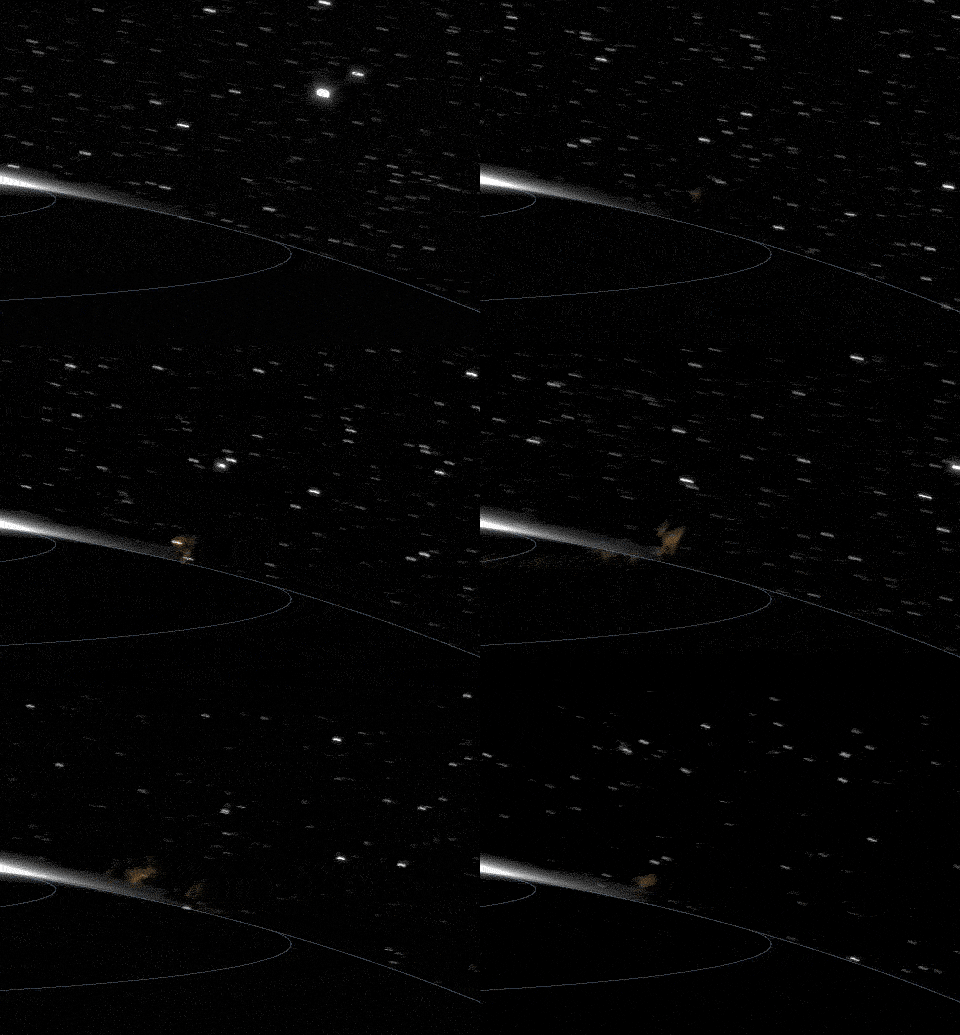
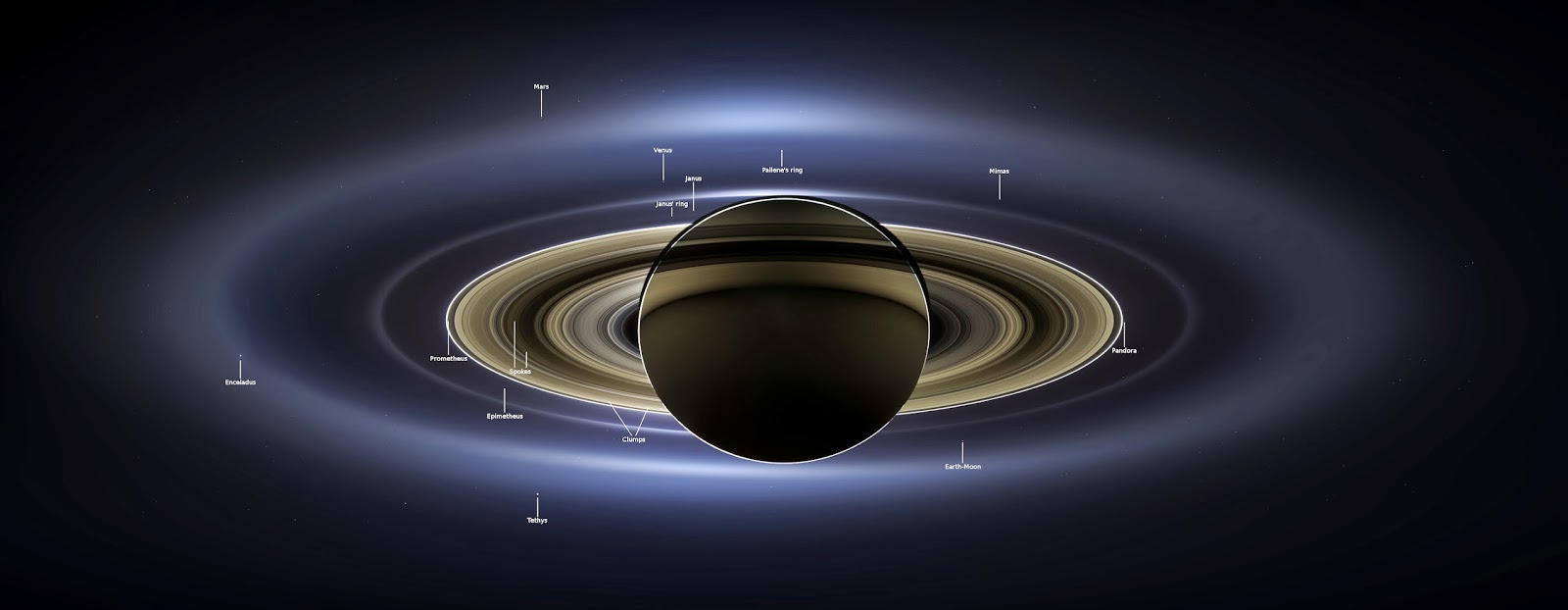
these images from the cassini space craft are just amazing.  many images taken in july this year were combined to create these fantastic panoramas.


the image below shows where planets and moons of saturn are located.


to understand all the details in this image, i share this video of emily lakdawalla describing all the fascinating subtleties.  very much worth the 10 minutes of your time.  enjoy!


Sunday, January 18, 2015

the sirens of titan

i recently finished reading Kurt Vonnegut's second novel, The Sirens of Titan.  overall, an enjoyable read. i like how vonnegut plays with words and patterns and patterns of words so nonchalantly.  it feels like an efficiently written story, deceivingly simple, yet so much happens throughout!

Saturn's largest moon, Titan (Image credit: NASA/JPL/University of Arizona) 
it seems fitting that just as i finish reading this book, NASA published a new video, Approaching Titan a Billion Times Closer, in honor of the Huygens probe touching down on Titan, ten years ago this month!

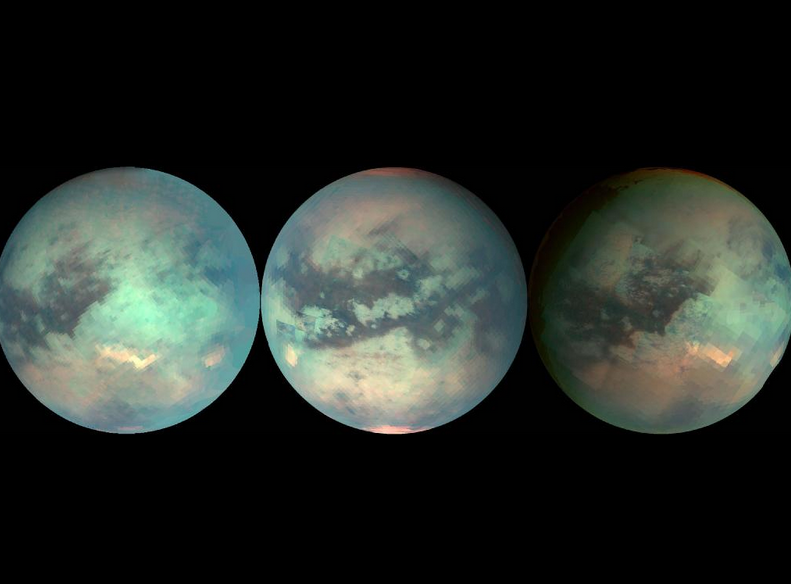
titan is saturn's largest moon and the only moon in the solar system with a dense atmosphere. the video shows a collection of images taken by the cassini spacecraft and then images from huygens, as it fell down to the surface of titan in 2005.

Saturday, July 10, 2010

how is saturn like an octopus?

NASA's cassini website shows saturn all decked out in world cup garb!


so... does saturn predict holland or spain to win? if you havent read about the "sucker for soccer" octpus who seemingly predicts the winner of late-stage WC matches, thats perfectly alright. it just means the title of this post makes no sense.

either way, a team from a country who has never won a world championship will be the new world cup winners, and i think thats great!!

although, i will be suffering some serious soccer withdrawal over the upcoming weeks :(

Thursday, November 29, 2007

sounds from saturn

NASA has released sounds of saturn recorded by the cassini-huygens mission. the radio emissions from saturn are closely related to the auroras near the poles of the planet so they are related to the planet's magnetic fields.


scientists did some messing around with the radio emissions recorded from saturn so that they are actually audible to the human ear. listen here

as space.com points out, saturn sounds an awful lot like the 1956 science fiction movie Forbidden Planet.

Sunday, December 10, 2006

science and religion

there was a comprehensive conference in california recently called "beyond belief" which brought together people to discuss... science and religion... and how they fit together, or not. if you do a quick youtube search, you'll find many video clips of various presenters.

my personal opinion is that spirituality is a good thing, and unique for each individual, but *religion* is not always a good thing in that most ask their followers to abide by certain rules and belief systems, teaching that all other religions are bad and wrong. this black and white picture has caused many many a war to be fought and lives to be lost. this is only one problem i have with "religion" but i will not write any further about my opinions now, and instead give an excerpt from an article i enjoyed about the conference!

"Maybe the pivotal moment came when Steven Weinberg, a Nobel laureate in physics, warned that ..the world needs to wake up from its long nightmare of religious belief,.. or when a Nobelist in chemistry, Sir Harold Kroto, called for the John Templeton Foundation to give its next $1.5 million prize for ..progress in spiritual discoveries.. to an atheist .. Richard Dawkins, the Oxford evolutionary biologist whose book ..The God Delusion.. is a national best-seller.

Or perhaps the turning point occurred at a more solemn moment, when Neil deGrasse Tyson, director of the Hayden Planetarium in New York City and an adviser to the Bush administration on space exploration, hushed the audience with heartbreaking photographs of newborns misshapen by birth defects .. testimony, he suggested, that blind nature, not an intelligent overseer, is in control.

Somewhere along the way, a forum this month at the Salk Institute for Biological Studies in La Jolla, Calif., which might have been one more polite dialogue between science and religion, began to resemble the founding convention for a political party built on a single plank: in a world dangerously charged with ideology, science needs to take on an evangelical role, vying with religion as teller of the greatest story ever told.

Carolyn Porco, a senior research scientist at the Space Science Institute in Boulder, Colo., called, half in jest, for the establishment of an alternative church, with Dr. Tyson, whose powerful celebration of scientific discovery had the force and cadence of a good sermon, as its first minister.

She was not entirely kidding. ..We should let the success of the religious formula guide us,.. Dr. Porco said. ..Let..s teach our children from a very young age about the story of the universe and its incredible richness and beauty. It is already so much more glorious and awesome .. and even comforting .. than anything offered by any scripture or God concept I know...

She displayed a picture taken by the Cassini spacecraft of Saturn and its glowing rings eclipsing the Sun, revealing in the shadow a barely noticeable speck called Earth."

read more ... a free-for-all on science and religion

Monday, March 9, 2009

night sky - march 2009

the moon continues to fill up with light over the next few nights as it passes by the constellation, leo. look to the east in the early evening to watch the moon slowly approach saturn. tonight, 8 march, 2009, saturn is at opposition - it sits opposite the sun in our sky, so it's up all night! if you have access to a small telescope (local astronomy clubs, friends, etc...) or binoculars, take a look! saturn's rings are edge-on right now from our perspective on earth, but its a nice treat to see saturn and the moon only 8 degrees apart in the sky... as they will be tuesday night, 10 march, 2009, when the moon is full!!


it makes sense that the full moon appears near saturn in our sky when saturn is at opposition. the moon shines because it reflects sunlight. when the moon is full, sun shine covers the entire surface of the moon that is visible to us. this happens when the earth sits between the sun and the moon so that the sun shining from behind us illuminates the moon.


tuesday night, both saturn and the moon sit exactly opposite of the sun in earths sky!


this image of saturn was taken by the cassini space craft.