notice anything unusual about this mozart piece?
check out more on igudesman and joo. they have some pretty funny performance pieces! i also like Rachmaninov had big hands.
Thursday, October 18, 2007


Tuesday, October 16, 2007
lacking responsibility
i just read a very interesting blog entry by effect measure, bush doctrine: no child travels ahead. young US students did not perform very well against students from around the world in math and science tests (Trends in International Mathematics and Science Study). so what is the department of education's solution to this challenge? they decided that US students wont take the tests anymore and therefore we won't look bad against the rest of the world!
ugh! what a horribly lazy way out! way to set an example for competitive improvement in the world forum!
i decided to test myself....
i wonder which one i missed.
ugh! what a horribly lazy way out! way to set an example for competitive improvement in the world forum!
i decided to test myself....
| You Passed 8th Grade Math |
 Congratulations, you got 9/10 correct! |
i wonder which one i missed.
left or right?
which direction is she spinning?

if you see her turning counterclockwise, the test claims you are left-brained, and if you see her spinning clockwise, you are right-brained. some people can see her spinning one way, then focus and switch directions.
i've always thought of myself as strongly left-brained with some right-brain capabilities, but i cannot at all see her spinning counterclockwise! i've spent (a bit too much) time trying to see her going the other way, but i cannot.
can you? if so, how??!
UPDATE: i just did it!! woohoo! i managed to switch directions while watching her bottom foot...
Monday, October 15, 2007
saturn, venus, and regulus together again?
last week i described the early morning alignment of venus, saturn and regulus, and dr lemming observantly commented that those exact three objects were close together in the evening sky just a few months ago! how did that happen?
the first thing to note about our solar system is that all the planets orbit around the sun in one flat plane... imagine the sun at the center of a thin pancake and the planets all moving around the sun in nearly circular orbits on the surface of this pancake. when you look at the pancake from above, you see a circle but from the side view... you see a very flat line. so from earth's point of view (inside the pancake), the planets all line up to follow a single line across the sky, called the "ecliptic" (say it out loud... it's a fun word to speak!). this name comes from eclipse, since the planets and sun will all pass very close to each other, and sometime pass in front of each other, causing eclipses from our perspective as they move across the sky.
the picture below (from 2003) shows a nice demonstration of the ecliptic. a picture was taken every 6 minutes and then superimposed together to show the paths of (left to right) the sun, venus, the moon and jupiter along the ecliptic plane. the "line" looks curved across our sky and you can see that all planets follow this path pretty closely.

so how is it that venus, saturn and regulus are together again in the morning sky now when just 3 months ago, they formed a similar triangle in the evening sky?? it all has to do with the movement of saturn, venus and earth around the sun, and the relatively stationary position of regulus far away from our solar system.
below is a picture of the locations of all the planets in their orbits around the sun on july 13, 2007 (created at solar system live) at the time that i reported the triangle alignment. the relevant planets for this discussion are earth (third rock from the sun), venus (the white planet so close to the earth that it looks like we're on top of it), and saturn (6th in line, with the rings, outside the gas giant jupiter's orbit).

the blue/green circles are the paths the planets follow as they orbit around the sun (the distances between each planet and the sun are shown in logarithmic scale). the planets orbit counterclockwise from this perspective, with the planets moving more slowly as you go out from the sun. it take venus 219 earth days to go once around the sun (its sidereal period). earth takes 365 days and saturn creeps along at about 11,000 earth days per orbit (once around the sun every 30 earth years!).
saturn moves along its orbit very slowly. in one earth year, the earth has progressed all the way around the sun and back to its location in the diagram while saturn has only move 1/30 of the way around its orbit, or 12 degrees.
now imagine you are standing on the left side of earth looking out towards the sun. the sun begins to set as the earth rotates (counterclockwise in this picture). when the sky darkens, you can see venus and saturn very near each other and close to the sun as it sets in the sky (on the left of the sun in the image). you also see the star regulus that happens to lie close to venus and saturn in our sky, even though it is very far away at a distance of nearly 80 light years!! you see a close grouping of venus, saturn and regulus in the sky.
3 months pass... it is october 14, 2007 and all the planets have moved for 90 days, counterclockwise, along their orbits. that means a quarter of the way around the sun for earth, not quite one half the full orbit for venus, very little movement for saturn and seemingly no movement for regulus as shown below....

now, looking out from earth's point of view in the pancake, venus and saturn are on the right side of the sun, but still very close together from our perspective. the two planets are on the opposite side of the sun, which means as earth rotates counterclockwise and the sun rises into view, venus and saturn are near it, rising just before the sun... in the early morning! cool stuff. everything is relative.
enjoy the very bright venus close to saturn and regulus for the next week!

the first thing to note about our solar system is that all the planets orbit around the sun in one flat plane... imagine the sun at the center of a thin pancake and the planets all moving around the sun in nearly circular orbits on the surface of this pancake. when you look at the pancake from above, you see a circle but from the side view... you see a very flat line. so from earth's point of view (inside the pancake), the planets all line up to follow a single line across the sky, called the "ecliptic" (say it out loud... it's a fun word to speak!). this name comes from eclipse, since the planets and sun will all pass very close to each other, and sometime pass in front of each other, causing eclipses from our perspective as they move across the sky.
the picture below (from 2003) shows a nice demonstration of the ecliptic. a picture was taken every 6 minutes and then superimposed together to show the paths of (left to right) the sun, venus, the moon and jupiter along the ecliptic plane. the "line" looks curved across our sky and you can see that all planets follow this path pretty closely.
so how is it that venus, saturn and regulus are together again in the morning sky now when just 3 months ago, they formed a similar triangle in the evening sky?? it all has to do with the movement of saturn, venus and earth around the sun, and the relatively stationary position of regulus far away from our solar system.
below is a picture of the locations of all the planets in their orbits around the sun on july 13, 2007 (created at solar system live) at the time that i reported the triangle alignment. the relevant planets for this discussion are earth (third rock from the sun), venus (the white planet so close to the earth that it looks like we're on top of it), and saturn (6th in line, with the rings, outside the gas giant jupiter's orbit).
the blue/green circles are the paths the planets follow as they orbit around the sun (the distances between each planet and the sun are shown in logarithmic scale). the planets orbit counterclockwise from this perspective, with the planets moving more slowly as you go out from the sun. it take venus 219 earth days to go once around the sun (its sidereal period). earth takes 365 days and saturn creeps along at about 11,000 earth days per orbit (once around the sun every 30 earth years!).
saturn moves along its orbit very slowly. in one earth year, the earth has progressed all the way around the sun and back to its location in the diagram while saturn has only move 1/30 of the way around its orbit, or 12 degrees.
now imagine you are standing on the left side of earth looking out towards the sun. the sun begins to set as the earth rotates (counterclockwise in this picture). when the sky darkens, you can see venus and saturn very near each other and close to the sun as it sets in the sky (on the left of the sun in the image). you also see the star regulus that happens to lie close to venus and saturn in our sky, even though it is very far away at a distance of nearly 80 light years!! you see a close grouping of venus, saturn and regulus in the sky.
3 months pass... it is october 14, 2007 and all the planets have moved for 90 days, counterclockwise, along their orbits. that means a quarter of the way around the sun for earth, not quite one half the full orbit for venus, very little movement for saturn and seemingly no movement for regulus as shown below....
now, looking out from earth's point of view in the pancake, venus and saturn are on the right side of the sun, but still very close together from our perspective. the two planets are on the opposite side of the sun, which means as earth rotates counterclockwise and the sun rises into view, venus and saturn are near it, rising just before the sun... in the early morning! cool stuff. everything is relative.
enjoy the very bright venus close to saturn and regulus for the next week!
tiny fingers

i miss areya already. spending time with a tiny baby is therapeutic... even more so when you dont have to change her diapers ;)
setting sun from space
this picture of the sun setting over the pacific ocean was captured in 2003 from the international space station.


Sunday, October 14, 2007
mmm... bananas
those of you who know me (or my email address) know how much a like a good banana. i want one of these awesome fruit vessels by helena schepens...


can you spot mercury?
jupiter keeps sinking lower and lower in the early evening sky, but it is still bright and clearly visible in the southwest for a few hours after sunset. tonight, the new moon is three days past new and is just visible above the horizon at dusk as it sets just after the sun. if you have a clear view of the horizon, look for the waxing crescent moon and see if you can spot mercury to its lower right.

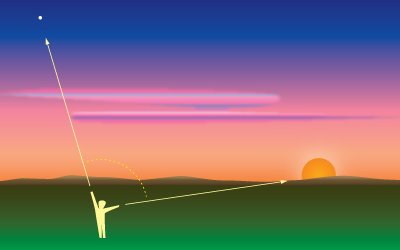
you'll need a pair of binoculars and a very clear view of the horizon, but its worth looking, because mercury is rarely visible to us on earth! mercury is the closest planet to the sun so from our perspective on earth, the little planet always remains very close to our bright star as it follows its orbit around the sun. in fact, in our sky, mercury never appears farther than 28 degrees from the sun, so it's only visible just as the sun sets or rises. the angle shown in the image below is about 90 degrees, but it gives you an idea of what i mean. mercury never moves in our sky farther from the sun than about a 3rd of the angle shown below.
in the image below (generated at solar system live), you can see the sun, mercury's orbit next, then venus, earth and mars. these 4 inner planets are also called "terrestrial planets" because they are solid and rocky. you can see that as earth orbits around its orbit, it always sees mercury close to the sun.

you'll need a pair of binoculars and a very clear view of the horizon, but its worth looking, because mercury is rarely visible to us on earth! mercury is the closest planet to the sun so from our perspective on earth, the little planet always remains very close to our bright star as it follows its orbit around the sun. in fact, in our sky, mercury never appears farther than 28 degrees from the sun, so it's only visible just as the sun sets or rises. the angle shown in the image below is about 90 degrees, but it gives you an idea of what i mean. mercury never moves in our sky farther from the sun than about a 3rd of the angle shown below.
in the image below (generated at solar system live), you can see the sun, mercury's orbit next, then venus, earth and mars. these 4 inner planets are also called "terrestrial planets" because they are solid and rocky. you can see that as earth orbits around its orbit, it always sees mercury close to the sun.
star gazing
"Rational and innocent entertainment of the highest kind."
- John Mills, 19th century amateur astronomer
- John Mills, 19th century amateur astronomer
Subscribe to:
Posts (Atom)