originating in sydney nearly 20 years ago, TropFest is the world's largest short film festival. last night was the screening of the finalists and the official voting for a winner of this year's competition. there were a lot of people in sydney's domain park, yet i was impressed by how quiet they were when the films were playing.
there were 16 finalists. the short films were not anywhere near the amateur quality i was expecting - they were impressively professional! here are my two favorites, neither of which won, unfortunately.
The Maestro
Directed by Adam Anthony
Den Sista Galaxonaut
Directed by Alexander George & Tyrone Lindqvist
Monday, February 21, 2011
Sunday, February 20, 2011
Saturday, February 19, 2011
Wednesday, February 16, 2011
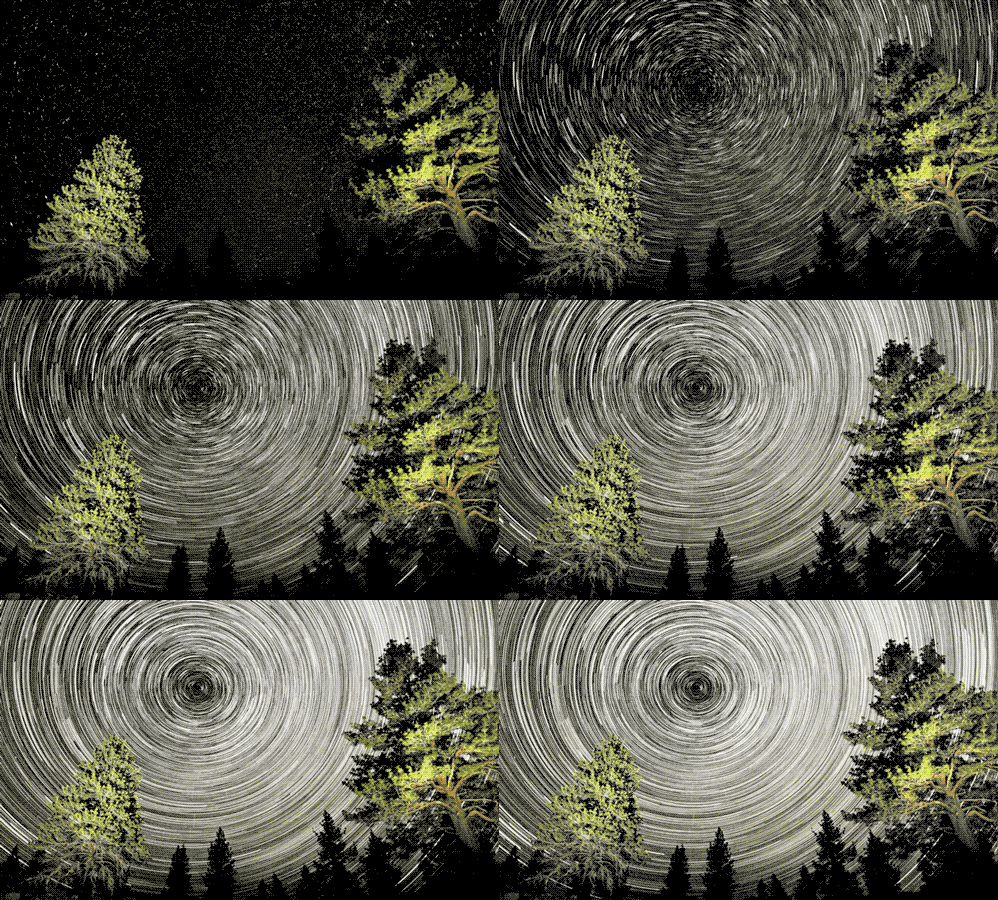
starry walk in the woods
(i saw this image though this link, but she doesnt give a link to the person who actually created the photo... i hate that about tumblr)
Tuesday, February 15, 2011
determining redshifts
determining how far away an object in the universe is from the earth is one of the most difficult tasks astronomers face, and also one of the most important. because the light from distant objects is the only signal we know how to receive from them with current technologies, we need to know how far away they are in order to determine how intrinsically bright they are. once we know that fundamental piece of information we can start to deduce all sorts of funky and interesting information about them!
there is a series of ways that astronomers use to determine distances to celestial objects, which is described as the "cosmic distance ladder." if an object is sufficiently far away (more than a few million light years - a criterion satisfied by all galaxies in the universe except andromeda and the little guys in our local group), we can measure its redshift. the cosmological redshift is a measure of how much a wavelength of light from a distant galaxy has stretched due to the expansion of the universe since the galaxy's stars emitted the light that is finally now reaching earth. whew! go read THIS for an explanation of redshift if you want...
in order to determine a solid redshift, you have to know how far light from a galaxy has shifted in wavelength. the best way to do this is to look at the galaxy's spectrum to identify specific spectral features (e.g. hydrogen, oxygen, etc...) whose patterns are all shifted to longer wavelengths. when i was at the telescope last week, we were observing spectra of 400 galaxies an hour (in clear weather) and then determining their redshifts as we went. here are some examples of the practice in action...
someone in the collaboration expanded a fancy little bit of code that shows the galaxy spectrum (in white) and allows one to display template spectra of well-known galaxy types (green) shifted to the potential redshift of the observed galaxy. (click image to enlarge). the X axis (horizontal) shows the wavelength scale (the discrete energies of the photons received by the telescope) and the Y axis (vertical) shows the amount of photons received at each of those discrete wavelengths.
to determine the exact redshift, you match as many features as you can, like the overall shape of the spectrum, the well-known dips (like calcium H and K that are very close to each other at about 4500 angstroms in the above spectrum), or the more obvious spikes ("emission lines"), if you happen to get strong ones like in the example below.
some galaxies have spectral features that are very strong and easy to identify, but others look noisy and its not obvious at all if there are any features. to be absolutely sure of a redshift, we can take a guess at the redshift and then look more closely at several regions where there should be spectral features if they are present in the galaxy and if the galaxy is at the guessed redshift.
its amazing to sit back and think that each one of these spectra are composite collections of light created by hundreds of billions of stars gravitationally bound together in a single swirling galaxy, probably not unlike our own milky way home. but i have to admit, when every singe hour of observations produces a collection of 400 galaxy spectra to determine redshifts for, my eyes feel exhausted and strained at the end of a long night at the telescope!
luckily during our recent observing run, we had quite a few people in the telescope dome (note the unusually high female to male ratio :)
and we could therefore be a bit more leisurely during our redshifting sessions!!
there is a series of ways that astronomers use to determine distances to celestial objects, which is described as the "cosmic distance ladder." if an object is sufficiently far away (more than a few million light years - a criterion satisfied by all galaxies in the universe except andromeda and the little guys in our local group), we can measure its redshift. the cosmological redshift is a measure of how much a wavelength of light from a distant galaxy has stretched due to the expansion of the universe since the galaxy's stars emitted the light that is finally now reaching earth. whew! go read THIS for an explanation of redshift if you want...
in order to determine a solid redshift, you have to know how far light from a galaxy has shifted in wavelength. the best way to do this is to look at the galaxy's spectrum to identify specific spectral features (e.g. hydrogen, oxygen, etc...) whose patterns are all shifted to longer wavelengths. when i was at the telescope last week, we were observing spectra of 400 galaxies an hour (in clear weather) and then determining their redshifts as we went. here are some examples of the practice in action...
someone in the collaboration expanded a fancy little bit of code that shows the galaxy spectrum (in white) and allows one to display template spectra of well-known galaxy types (green) shifted to the potential redshift of the observed galaxy. (click image to enlarge). the X axis (horizontal) shows the wavelength scale (the discrete energies of the photons received by the telescope) and the Y axis (vertical) shows the amount of photons received at each of those discrete wavelengths.
to determine the exact redshift, you match as many features as you can, like the overall shape of the spectrum, the well-known dips (like calcium H and K that are very close to each other at about 4500 angstroms in the above spectrum), or the more obvious spikes ("emission lines"), if you happen to get strong ones like in the example below.
some galaxies have spectral features that are very strong and easy to identify, but others look noisy and its not obvious at all if there are any features. to be absolutely sure of a redshift, we can take a guess at the redshift and then look more closely at several regions where there should be spectral features if they are present in the galaxy and if the galaxy is at the guessed redshift.
its amazing to sit back and think that each one of these spectra are composite collections of light created by hundreds of billions of stars gravitationally bound together in a single swirling galaxy, probably not unlike our own milky way home. but i have to admit, when every singe hour of observations produces a collection of 400 galaxy spectra to determine redshifts for, my eyes feel exhausted and strained at the end of a long night at the telescope!
luckily during our recent observing run, we had quite a few people in the telescope dome (note the unusually high female to male ratio :)
and we could therefore be a bit more leisurely during our redshifting sessions!!
Monday, February 14, 2011
valentine's forecast
via central illustration
but dont despair because...
if you need some nerdy valentine love, check out this video where the chemists of the period table of videos produce the "perfect perfume."
also, check out the cards produced by stephoodie or previous valentine's posts here and here. thats enough about the hallmark holiday for this year.
but dont despair because...
if you need some nerdy valentine love, check out this video where the chemists of the period table of videos produce the "perfect perfume."
also, check out the cards produced by stephoodie or previous valentine's posts here and here. thats enough about the hallmark holiday for this year.
Sunday, February 13, 2011
bioluminescence
photgrapher phil hart captured this incredible image of the gippsland lakes in victoria, australia in 2008.
the cause of the blue glow is bioluminescence: light produced by a chemical reaction which originates in an organism, and this case, it was an organism that lived in the lake for one summer only!
the whole, fascinating story is on his website, but i'll summarize here. fires and massive floods starting in 2006 caused nitrogen rich water with high salinity to concentrate in the gippsland lakes. after a summer of these conditions, a new species to the lake began to prosper, called noctiluca scintillans, or sea sparkle. whenever there is motion or agitation in the water, it glows more brightly!
what a strange and interesting world we live in!
the cause of the blue glow is bioluminescence: light produced by a chemical reaction which originates in an organism, and this case, it was an organism that lived in the lake for one summer only!
the whole, fascinating story is on his website, but i'll summarize here. fires and massive floods starting in 2006 caused nitrogen rich water with high salinity to concentrate in the gippsland lakes. after a summer of these conditions, a new species to the lake began to prosper, called noctiluca scintillans, or sea sparkle. whenever there is motion or agitation in the water, it glows more brightly!
what a strange and interesting world we live in!
Saturday, February 12, 2011
Friday, February 11, 2011
Thursday, February 10, 2011
are you kidding me?
yes, it actually can get this bad.
UPDATE: and as sarah rightly points out in the comments, i/we receive such questions from both men and women.
Wednesday, February 9, 2011
Tuesday, February 8, 2011
Sunday, February 6, 2011
intense observing
as you can see, i havent been able to post nearly as much as i was hoping during this observing run at the AAO. it turns out this telescope and observing project require a lot more attention than i had predicted. it takes three people to keep operations going: a "night assistant" to control the telescope (make sure it continues pointing in the right direction, monitor the weather), a "support astronomer" to operate the instrument (keep everything in focus, configure the 400 optical fiber positions before each observation, actually open the camera's shutter), and the "observer" to decide what targets to look at and make sure the data is top quality throughout the night.
i'm feeling fairly exhausted from the whole ordeal even though these are short summer nights! during this run i'm training to do both the support tasks and those of the observer and at the end of this month i will spend a few nights as the head support astronomer!
for now, here are some photos.
these mountains are littered with telescopes and i just found out there are plans to build about 14 more small-ish ones over the next several years!
butterflies love bottle brush.
the view from the catwalk of the AAT.
the AAT.
the control room setup is not quite as impressive as at UKIRT on mauna kea, but it certainly accomplishes the goals.
the night assistant in his rest state.
no matter how much i want to complain about brutal observing and not having as much time as i was hoping to work on science during the nights, i cannot complain at all about having time after i eat dinner to go out and watch kangaroos eat grass and bounce around. they are so freaking adorable... and when they hop away, i cant help but smile.
i'm feeling fairly exhausted from the whole ordeal even though these are short summer nights! during this run i'm training to do both the support tasks and those of the observer and at the end of this month i will spend a few nights as the head support astronomer!
for now, here are some photos.
these mountains are littered with telescopes and i just found out there are plans to build about 14 more small-ish ones over the next several years!
butterflies love bottle brush.
the view from the catwalk of the AAT.
the AAT.
the control room setup is not quite as impressive as at UKIRT on mauna kea, but it certainly accomplishes the goals.
the night assistant in his rest state.
no matter how much i want to complain about brutal observing and not having as much time as i was hoping to work on science during the nights, i cannot complain at all about having time after i eat dinner to go out and watch kangaroos eat grass and bounce around. they are so freaking adorable... and when they hop away, i cant help but smile.
Friday, February 4, 2011
telescope domes and kangaroos!
its one of those fantastic new moon, pitch black nights where you cant see your hand in front of your face. unfortunately, the sky is also covered in clouds so i cant see any stars :( but i managed to see some kangaroos and take some photos before the sun went down!
the anglo-australian telescope:
the Faulkes Telescope South:
the anglo-australian telescope:
the Faulkes Telescope South:
Thursday, February 3, 2011
the australian astronomical observatory
i've been working for the anglo australian observatory out of the sydney offices since november 2010 and today i finally get to drive out to the observatory and meet some new big telescopes! for the next four nights and several more later this month, i will be learning to use the anglo-australian telescope (AAT).
in this photo from 1979 you can see the AAT and star trails around the southern celestial pole. you can also see squiggly lines on the catwalk around the telescope created by the flashlight of an astronomer checking the weather during this long exposure...
with a 4 meter diameter primary mirror, the AAT is no longer one of the largest telescopes on the surface of the earth, but it has remained an astronomical work horse since the mid 1970s, when it was built as the first major telescope in the southern hemisphere.
for a nice little video summary of some of the most influential science discoveries produced by the AAT, CLICK HERE!! the project they mention near the end of the video, called GAMA, is the one i'm working on. hopefully, i'll get to write more this week about what i'm doing at the telescope and the research i'm doing in australia and with GAMA.
for now... its time to drive over 7 hours to the northwest to reach the observatory. we're currently sitting under heavy clouds, but even after driving 400 km north, we'll be decently far away from last night's intense cyclone yasi. as you can see on this map, yasi hit in northern queensland, while the observatory sits solidly in new south wales. sending out good thoughts to those suffering from yasi and other flooding around queensland!
in this photo from 1979 you can see the AAT and star trails around the southern celestial pole. you can also see squiggly lines on the catwalk around the telescope created by the flashlight of an astronomer checking the weather during this long exposure...
with a 4 meter diameter primary mirror, the AAT is no longer one of the largest telescopes on the surface of the earth, but it has remained an astronomical work horse since the mid 1970s, when it was built as the first major telescope in the southern hemisphere.
for a nice little video summary of some of the most influential science discoveries produced by the AAT, CLICK HERE!! the project they mention near the end of the video, called GAMA, is the one i'm working on. hopefully, i'll get to write more this week about what i'm doing at the telescope and the research i'm doing in australia and with GAMA.
for now... its time to drive over 7 hours to the northwest to reach the observatory. we're currently sitting under heavy clouds, but even after driving 400 km north, we'll be decently far away from last night's intense cyclone yasi. as you can see on this map, yasi hit in northern queensland, while the observatory sits solidly in new south wales. sending out good thoughts to those suffering from yasi and other flooding around queensland!
great britain? united kingdom? england?
c. g. p. grey attempts to control the world's confusion over the difference between the united kingdom, great britain, and england in this fairly successful video. he speaks quite quickly, but you can get the transcript here.
this video certainly clears up many mysteries, but opens up many more. why do so many countries on the opposite side of the world from "the empire" still recognize the monarchy as their head of state? this video also doesnt show you the different flags of england, scotland, ireland, etc... so you might still be confused during world cups or olympic games.
Wednesday, February 2, 2011
powers of ten
until now, there was no legal online access to the fabulous "powers of ten" short video by the architects ray & charles eames. yes, it looks dated, since it was produced in the 1960s, but i have such a vivid memory of seeing this for the first time at a young age (on an IMAX screen), that i wanted to share it here.
the video starts by showing a couple picnicking in chicago then zooms out into the universe by powers of ten (its still tough to grasp just how huge the universe even after studying it at such scales for so many years). then the video zooms back to the couple and further inside themselves to their atoms and blood cells and below. enjoy!
UPDATE: thanks to jad for leaving a comment... i was looking for the link to the site he mentions but couldnt find it at the time of writing this original post!
"I love that movie. This is a pretty cool flash(?) app that lets you zip through the powers of ten. Not zooming in and out on a single point like the movie, but with more time to look around: http://primaxstudio.com/stuff/scale_of_universe/"
the video starts by showing a couple picnicking in chicago then zooms out into the universe by powers of ten (its still tough to grasp just how huge the universe even after studying it at such scales for so many years). then the video zooms back to the couple and further inside themselves to their atoms and blood cells and below. enjoy!
UPDATE: thanks to jad for leaving a comment... i was looking for the link to the site he mentions but couldnt find it at the time of writing this original post!
"I love that movie. This is a pretty cool flash(?) app that lets you zip through the powers of ten. Not zooming in and out on a single point like the movie, but with more time to look around: http://primaxstudio.com/stuff/scale_of_universe/"
Tuesday, February 1, 2011
holy cactus!
Léon Diguet took this photo as part of his research in 1895 in the baja california peninsula. the cardón cactus is the world's largest type of cactus and can live for several hundred years. incredible...!
Monday, January 31, 2011
lessons from australia #1
always walk behind someone who is slightly taller than you (especially in the morning)...
comic from the oatmeal
Sunday, January 30, 2011
Saturday, January 29, 2011
adenocarcinoma
too bad adenocarcinoma is a cancer, because this photo of it splitting into two cells is gorgeous.
via fresh photons
via fresh photons
Friday, January 28, 2011
Thursday, January 27, 2011
Internet Stars: The Secret Life of Sixty Symbols
for anyone who happens to be near nottingham, UK thursday evening, the creator of sixty symbols and other interesting video projects at the university of nottingham, brady haran, will be giving a public lecture. i've been advised (warned?) that i should be "worried" about the potentially embarrassing out-takes he will be showing. oh dear. so if you go, please do let me know how silly i come across! thank you.
Internet Stars: The Secret Life of Sixty Symbols
Brady Haran
Thursday 27th January 2011
ABSTRACT: A small band of scientists from Nottingham have become minor celebrities on YouTube. But how did it happen? And were there problems along the way? Film-maker Brady Haran is the man behind Sixty Symbols (physics and astronomy) and the Periodic Table of Videos (chemistry). In this lecture he will take you behind the scenes on both projects. He'll discuss how the films are made and share some embarrassing 'out- takes' that prove scientists are only human!
6-7 pm
Maths & Physics Building (B1)
University of Nottingham
University Park Campus
Nottingham
Internet Stars: The Secret Life of Sixty Symbols
Brady Haran
Thursday 27th January 2011
ABSTRACT: A small band of scientists from Nottingham have become minor celebrities on YouTube. But how did it happen? And were there problems along the way? Film-maker Brady Haran is the man behind Sixty Symbols (physics and astronomy) and the Periodic Table of Videos (chemistry). In this lecture he will take you behind the scenes on both projects. He'll discuss how the films are made and share some embarrassing 'out- takes' that prove scientists are only human!
6-7 pm
Maths & Physics Building (B1)
University of Nottingham
University Park Campus
Nottingham
Wednesday, January 26, 2011
australia day 2011
there are so many events happening today around sydney in honor of australia day that i just cant keep up. i managed to walk to the harbour to watch the ferrython. there were a lot of boats of all sizes racing under the harbour bridge! this photo is a hint of the event before the real chaos began, but i like it...
then i returned home to eat lunch and decided that its too bad its not a holiday in the rest of the world, because i keep getting "urgent" work emails! hmph.
anyway, happy australia day!
then i returned home to eat lunch and decided that its too bad its not a holiday in the rest of the world, because i keep getting "urgent" work emails! hmph.
anyway, happy australia day!
Tuesday, January 25, 2011
Monday, January 24, 2011
Sunday, January 23, 2011
green eggs and cous cous
for my birthday last year, a very good friend gave me the flavour thesaurus by niki segnit as a gift. i have grown to really enjoy this random not-quite-a-cookbook! not only is it a lovely libro...
but it's fun to explore. there are 16 categories (mustardy, green & grassy, meaty, etc...) and 99 flavours that the book pairs together giving recipe ideas, anecdotes, historical information, and other unique bits about the chosen ingredients. if i have a craving for a particular food item, i look in the book to see possible pairings and generally find some obvious suggestions and some out of the ordinary and fun ideas too!
for instance, i had an abundance of basil that i needed to use, so i looked up basil in the book and found myself completely charmed after reading the entire entry under the heading Basil & Egg:
When in the mood to make eggs green
(To clarify just what I mean,
Not 'eco' green, like Prius cars
But coloured green, like men from Mars),
In your mental pan you should
Consider only what tastes good.
Rule out at once the croquet lawn,
The waistcoat of a leprechaun.
Green ink will only make you ill,
As would a mashed-up dollar bill.
Avocado'd be a waste:
In scrambled eggs it's hard to taste.
Green tea - a very current fad -
Would be presposterously bad.
Leeks and lettuces lack the might:
When cooked they'll be less green, more white.
Peas and peppers taste persuasive,
But their colour's not pervasive.
Broccoli all but makes the mark,
Except its green's a trifle dark;
Celery, okra, courgettes, kale
In hue and flavour mostly fail.
Of the green things that we tested
Basil simply can't be bested.
To scramble eggs you add pesto,
Stir it well, and then, hey presto -
Green eggs. Season. Serve with ham.
(Do not prepare for folk named Sam.)
i immediately made pesto! the green eggs on toast were not quite as green as i imagined while reading the poem, but i mixed the remaining pesto in with some cous cous and vegetables and the flavours all came together beautifully.
but it's fun to explore. there are 16 categories (mustardy, green & grassy, meaty, etc...) and 99 flavours that the book pairs together giving recipe ideas, anecdotes, historical information, and other unique bits about the chosen ingredients. if i have a craving for a particular food item, i look in the book to see possible pairings and generally find some obvious suggestions and some out of the ordinary and fun ideas too!
for instance, i had an abundance of basil that i needed to use, so i looked up basil in the book and found myself completely charmed after reading the entire entry under the heading Basil & Egg:
When in the mood to make eggs green
(To clarify just what I mean,
Not 'eco' green, like Prius cars
But coloured green, like men from Mars),
In your mental pan you should
Consider only what tastes good.
Rule out at once the croquet lawn,
The waistcoat of a leprechaun.
Green ink will only make you ill,
As would a mashed-up dollar bill.
Avocado'd be a waste:
In scrambled eggs it's hard to taste.
Green tea - a very current fad -
Would be presposterously bad.
Leeks and lettuces lack the might:
When cooked they'll be less green, more white.
Peas and peppers taste persuasive,
But their colour's not pervasive.
Broccoli all but makes the mark,
Except its green's a trifle dark;
Celery, okra, courgettes, kale
In hue and flavour mostly fail.
Of the green things that we tested
Basil simply can't be bested.
To scramble eggs you add pesto,
Stir it well, and then, hey presto -
Green eggs. Season. Serve with ham.
(Do not prepare for folk named Sam.)
i immediately made pesto! the green eggs on toast were not quite as green as i imagined while reading the poem, but i mixed the remaining pesto in with some cous cous and vegetables and the flavours all came together beautifully.
Subscribe to:
Posts (Atom)