Kseniya Simonova is a ukrainian sand artist who recently won "ukraine's got talent." she interprets germany's invasion and occupation of the ukraine during WWII. beautiful and haunting...
Sunday, August 30, 2009


Saturday, August 29, 2009
the big bang briefly
this little 2 minute video features the easily-understandable physicist janna levin.
you can read a bit more discussion about the big bang from the astronomist.
or watch more of janna levin during her appearance on the colbert report.
The Big Bang Briefly 1 from Keith Olwell on Vimeo.
you can read a bit more discussion about the big bang from the astronomist.
or watch more of janna levin during her appearance on the colbert report.
UKIRT - from 100 hours of astronomy
this video, created as part of the 100 hours of astronomy project for the international year of astronomy, describes the UKIRT telescope - where i'm spending my week.
Friday, August 28, 2009
twinkle twinkle little stars
while sitting inside the control room of a telescope, we are isolated from seeing exactly what's happening with the weather outside, except for when we venture out into the cold to check the sky. i like to go out and check fairly often, acclimate my eyes to the darkness, see the stars... but its cold and conditions can change rapidly enough, that its necessary to have weather monitoring devices working all the time (if possible!).
inside UKIRT's control room, there is a screen showing the realtime view from an all-sky camera! the image below shows that view... you can see the telescope on the left side and the milky way galaxy streaming across the sky!

the green plus sign is where our telescope is pointing and the little yellow crosshairs show the position of a companion telescope. at the upper left, above the white telescope, you can see a fainter silver dome with a big line shooting out of it! that is the laser used by the gemini telescope adaptive optics system. the laser is clearly visible when i go outside, and i think its great fun to watch it change positions!
so what are adaptive optics and why do we shoot lasers into the sky??
because photons of light from distant stars get shaken up as they pass thru the earth's atmosphere, causing them to "twinkle" to our eyes. the more the photons get shaken up, the bigger and "fuzzier" objects appear in a telescopic image (this is the major advantage of putting telescopes in space). if we can somehow determine the turbulence in the atmosphere as the photons pass thru it, we can correct for it and get sharper images of the stars!
adaptive optics is a fascinating technique that has recently come in to use by several major telescopes around the world to improve the image sharpness. to correct for atmospheric distortions, you use a specific guide star, a quick computer to measure how the star "twinkles", and a special deformable mirror that sits inside the optical path of the telescope.
the computer measures the changing light coming from the guide star every millisecond or less, then rapidly sends signals to adjust the shape of the special mirror in order to immediately correct for the "twinkle." if there is no natural guide star bright enough to use in the part of the sky that you happen to be observing, you can create an artificial guide star with a laser! a "laser guide star" it's called.
here's a nice example of how impressively the use of adaptive optics can improve image quality!
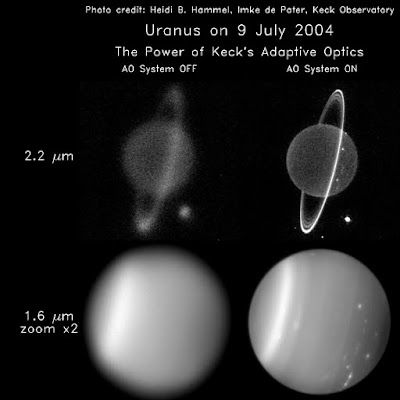
pretty amazing difference, no? adaptive optics systems are incredibly complicated to develop and produce, so not all telescopes use them, but they become more important as telescope mirror sizes increase.
now to go check the sky....
inside UKIRT's control room, there is a screen showing the realtime view from an all-sky camera! the image below shows that view... you can see the telescope on the left side and the milky way galaxy streaming across the sky!

the green plus sign is where our telescope is pointing and the little yellow crosshairs show the position of a companion telescope. at the upper left, above the white telescope, you can see a fainter silver dome with a big line shooting out of it! that is the laser used by the gemini telescope adaptive optics system. the laser is clearly visible when i go outside, and i think its great fun to watch it change positions!
so what are adaptive optics and why do we shoot lasers into the sky??
because photons of light from distant stars get shaken up as they pass thru the earth's atmosphere, causing them to "twinkle" to our eyes. the more the photons get shaken up, the bigger and "fuzzier" objects appear in a telescopic image (this is the major advantage of putting telescopes in space). if we can somehow determine the turbulence in the atmosphere as the photons pass thru it, we can correct for it and get sharper images of the stars!
adaptive optics is a fascinating technique that has recently come in to use by several major telescopes around the world to improve the image sharpness. to correct for atmospheric distortions, you use a specific guide star, a quick computer to measure how the star "twinkles", and a special deformable mirror that sits inside the optical path of the telescope.
the computer measures the changing light coming from the guide star every millisecond or less, then rapidly sends signals to adjust the shape of the special mirror in order to immediately correct for the "twinkle." if there is no natural guide star bright enough to use in the part of the sky that you happen to be observing, you can create an artificial guide star with a laser! a "laser guide star" it's called.
here's a nice example of how impressively the use of adaptive optics can improve image quality!

pretty amazing difference, no? adaptive optics systems are incredibly complicated to develop and produce, so not all telescopes use them, but they become more important as telescope mirror sizes increase.
now to go check the sky....
Thursday, August 27, 2009
height difference - star wars
here's a great, relaxed photo of most of our favorite star wars characters!

from left to right: Harrison Ford (Han Solo), David Prowse (Darth Vader), Peter Mayhew (Chewbacca), Carrie Fisher (Princess Leia), Kenny Baker (R2-D2), and Mark Hamill (Luke Skywalker). Undated. link

from left to right: Harrison Ford (Han Solo), David Prowse (Darth Vader), Peter Mayhew (Chewbacca), Carrie Fisher (Princess Leia), Kenny Baker (R2-D2), and Mark Hamill (Luke Skywalker). Undated. link
square root of minus one = i
super cute!

i love that they advertise this shirt in pink, although she's not going to get anywhere here counting with her fingers!!

i love that they advertise this shirt in pink, although she's not going to get anywhere here counting with her fingers!!
Tuesday, August 25, 2009
successful journey to the big island
i arrived on the big island with about a day and a half to enjoy before i had to start working. i stayed with a friend near the southeast coastline and certainly fulfilled the desire to have a quick island adventure holiday!
my confused body demanded sleep soon after i arrived, and awoke in time to admire the sunrise over the ocean!

we walked across a lava field...

saw beautiful flowers...

relaxed at a black sand (clothing-optional) beach...

enjoyed the company of a friendly dog named rufus...

went snorkeling... (last time i visited this part of the island, i didnt have the waterproof case for my camera!)...


saw lava trees...

and cooked some fresh ahi for dinner! very nice.
now i'm up at the 9000 ft astronomer's residence, called hale pohaku (HP). i have to stay here for the night to begin to acclimate to the altitude and night schedule. tomorrow evening i head up to the 14000 ft. summit!
my confused body demanded sleep soon after i arrived, and awoke in time to admire the sunrise over the ocean!

we walked across a lava field...

saw beautiful flowers...

relaxed at a black sand (clothing-optional) beach...

enjoyed the company of a friendly dog named rufus...

went snorkeling... (last time i visited this part of the island, i didnt have the waterproof case for my camera!)...


saw lava trees...

and cooked some fresh ahi for dinner! very nice.
now i'm up at the 9000 ft astronomer's residence, called hale pohaku (HP). i have to stay here for the night to begin to acclimate to the altitude and night schedule. tomorrow evening i head up to the 14000 ft. summit!
Monday, August 24, 2009
shine a light
here's an excellently produced little video about light and lightbulbs, created by clifford v. johnson who writes one of my favorite blogs, asymptotia.
Sunday, August 23, 2009
space day and moon watch
mark your calendars... we're putting on a "space day and moon watch" event at nottingham castle on october 31st (halloween!), 2009! i'm really excited for it, even though it's quite a complicated series of tasks to organize such a huge event!

thanks and props to mark hammonds (of supernova condensate) for designing the great poster.

thanks and props to mark hammonds (of supernova condensate) for designing the great poster.
Saturday, August 22, 2009
meeting a new telescope!
(a little too) bright and early tomorrow morning i leave for my first trip back to the states since i moved to england almost exactly one year ago!
the first stop is hawaii where i will have about 36 hours of free time before heading up the extinct volcano to meet a new telescope! i'm observing with the 3.8 meter united kingdom infra-red telescope (UKIRT) for the first time. i'll spend 7 nights awake at the summit of mauna kea observing targets for the UKIDSS project.

after the observing run, i'm going back to my hometown in ohio to see my family in person for the first time in over a year! woohoo! this is the longest stretch i've gone without seeing them and i'm really thrilled to get in some family time!

the first stop is hawaii where i will have about 36 hours of free time before heading up the extinct volcano to meet a new telescope! i'm observing with the 3.8 meter united kingdom infra-red telescope (UKIRT) for the first time. i'll spend 7 nights awake at the summit of mauna kea observing targets for the UKIDSS project.

after the observing run, i'm going back to my hometown in ohio to see my family in person for the first time in over a year! woohoo! this is the longest stretch i've gone without seeing them and i'm really thrilled to get in some family time!

Friday, August 21, 2009
shanghai, china
after viewing the total solar eclipse, and enjoying a brief stop in suzhou, i went to shanghai, china for a couple days.
i made it successfully from the train to the subway only to find this sign...

uh, where am i going?
this has always been the most intimidating thing about visiting countries whose written languages i cannot even make a guess at! luckily, my guide book listed the chinese characters and english language, so i found my way to the correct stop!

a mix of old and new.

simple and smooth jasmine tea.

shanghai is an architecturally interesting city.

parasols everywhere. i love parasols. i wish people in the western world wouldnt look at me like such a weirdo when i use one on a sunny day! there were people walking around campus moments before totality of the solar eclipse still holding their parasols over their heads!

deep fry and enjoy.

i have no idea why the broccoli in the picture is upside down! it made me laugh enough to buy the book!

one of the main tourist attractions in shanghai is the riverfront buildings of the bund. as i was walking thru the city to the bund, i noticed this crazy building off in the distance!

i was more interested in seeing this strange oriental pearl tower than the bund, so i decided to cross the river to the pearl tower side. instead of taking the metro under the river, i used the "bund sightseeing tunnel." the ride was ridiculous! i cannot really recommend taking the overpriced tunnel for anything more than a good laugh and 4 minutes of bright lights! i have to admit that i did enjoy it though, because all the excited chinese tourists rushed to the front of the little car, while i sat in back watching their reactions to all the lights.

the oriental pearl tower up close.

the view of the bund from the pudong side of the river.

(how adorable is her dress?)

i wasnt expecting shanghai to be lit up at night as much as it is! all the buildings with crazy architecture also have lights strewn all over them!

this dish tasted a lot better than it looks or sounds: eel and eggplant.

self-portrait while sitting on the maglev: the world's fastest train and the first commercial high-speed magnetic levitation line in the world. since i rode outside of peak hours, we only reached 301 km/hr (188 mph - as opposed to the normal operation speed of 431 km/h (268 mph)). we attained that speed in under 2 minutes, and were only able to enjoy the smooth ride for another 5 minutes before we arrived at the airport, 20 miles outside of the city. i wish i could take a maglev across the US!

more photos: here.
i made it successfully from the train to the subway only to find this sign...

uh, where am i going?
this has always been the most intimidating thing about visiting countries whose written languages i cannot even make a guess at! luckily, my guide book listed the chinese characters and english language, so i found my way to the correct stop!

a mix of old and new.

simple and smooth jasmine tea.

shanghai is an architecturally interesting city.

parasols everywhere. i love parasols. i wish people in the western world wouldnt look at me like such a weirdo when i use one on a sunny day! there were people walking around campus moments before totality of the solar eclipse still holding their parasols over their heads!

deep fry and enjoy.

i have no idea why the broccoli in the picture is upside down! it made me laugh enough to buy the book!

one of the main tourist attractions in shanghai is the riverfront buildings of the bund. as i was walking thru the city to the bund, i noticed this crazy building off in the distance!

i was more interested in seeing this strange oriental pearl tower than the bund, so i decided to cross the river to the pearl tower side. instead of taking the metro under the river, i used the "bund sightseeing tunnel." the ride was ridiculous! i cannot really recommend taking the overpriced tunnel for anything more than a good laugh and 4 minutes of bright lights! i have to admit that i did enjoy it though, because all the excited chinese tourists rushed to the front of the little car, while i sat in back watching their reactions to all the lights.

the oriental pearl tower up close.

the view of the bund from the pudong side of the river.

(how adorable is her dress?)

i wasnt expecting shanghai to be lit up at night as much as it is! all the buildings with crazy architecture also have lights strewn all over them!

this dish tasted a lot better than it looks or sounds: eel and eggplant.

self-portrait while sitting on the maglev: the world's fastest train and the first commercial high-speed magnetic levitation line in the world. since i rode outside of peak hours, we only reached 301 km/hr (188 mph - as opposed to the normal operation speed of 431 km/h (268 mph)). we attained that speed in under 2 minutes, and were only able to enjoy the smooth ride for another 5 minutes before we arrived at the airport, 20 miles outside of the city. i wish i could take a maglev across the US!

more photos: here.
Wednesday, August 19, 2009
some things i do not understand
- the song "a man needs a maid" by neil young.
- the point of linkedin.
- the ridiculousness of the current health care debate in the US.
- mint kit kat.
- this photo.
- the resurgence of neon-colored clothing.
- why so few people wear hats anymore.
- the laws of cricket.
- the accents spoken by some people in england.
- consciousness
- why i should bother spelling thru as through.
- the appeal of red bull.
- how to roll an "R" with my tongue.
UPDATE: how people believe the email (spam) that says that mars will look as big in the sky as the full moon in just over a week. (it wont... ever!)
- the point of linkedin.
- the ridiculousness of the current health care debate in the US.
- mint kit kat.
- this photo.
- the resurgence of neon-colored clothing.
- why so few people wear hats anymore.
- the laws of cricket.
- the accents spoken by some people in england.
- consciousness
- why i should bother spelling thru as through.
- the appeal of red bull.
- how to roll an "R" with my tongue.
UPDATE: how people believe the email (spam) that says that mars will look as big in the sky as the full moon in just over a week. (it wont... ever!)
Tuesday, August 18, 2009
astronomy public lecture series
if youre anywhere near nottingham this thursday, i'm giving a public lecture from 6-7pm. click on the image for more information!


Monday, August 17, 2009
the milky way and trees!
here's another gorgeous shot of the milky way by tom @ timescapes. cant wait to see the full timelaspe series from this shoot!


Sunday, August 16, 2009
influential books
a facebook meme went around recently challenging you to share 15 books that you've read that have stuck with you, without taking too long to think about it. i thought i'd share my list here and see if you would like to offer your list of 15.
the secret garden - frances hodgson burnett
lord of the rings (trilogy) - JRR tolkien
memoirs of a geisha - arthur golden
the world according to garp - john irving
flowers for algernon - daniel keyes
black holes and time warps - kip s thorne
the poisonwood bible - barbara kingsolver
pride and prejudice - jane austen
harry potter (series) - jk rowling
the origin of species - charles darwin
divine secrets of the ya ya sisterhood - callie khouri
enders game - orson scott card
the red tent - anita diamant
the dark tower (series) - stephen king
count of monte cristo - alexandre dumas
since i've had a little more time now to think about it now, i'll list some other books that been influential throughout different periods in my life:
bridge to terabithia - katherine paterson
where the red fern grows - wilson rawls
surely youre joking, mr feynman - richard feynman
the hitchhiker's guide to the galaxy - douglas adams
the secret garden - frances hodgson burnett
lord of the rings (trilogy) - JRR tolkien
memoirs of a geisha - arthur golden
the world according to garp - john irving
flowers for algernon - daniel keyes
black holes and time warps - kip s thorne
the poisonwood bible - barbara kingsolver
pride and prejudice - jane austen
harry potter (series) - jk rowling
the origin of species - charles darwin
divine secrets of the ya ya sisterhood - callie khouri
enders game - orson scott card
the red tent - anita diamant
the dark tower (series) - stephen king
count of monte cristo - alexandre dumas
since i've had a little more time now to think about it now, i'll list some other books that been influential throughout different periods in my life:
bridge to terabithia - katherine paterson
where the red fern grows - wilson rawls
surely youre joking, mr feynman - richard feynman
the hitchhiker's guide to the galaxy - douglas adams
Friday, August 14, 2009
carnival of space #115
this week's space reading is available at the 115th carnival of space hosted at new frontiers.
Thursday, August 13, 2009
science ladders
here's a nice photo from the found in the LIFE magazine archives showing scientists performing some classical mechanics coordinate transformations on a massive blackboard many decades ago!

notice that the big leaning ladder has a prop underneath one leg!! eek!
the calculations look impressive and all, but when scientists stand on precarious ladders, everything seems way more dramatic and important, no?! i wonder if they normally have 4 different ladder options close to this blackboard?

notice that the big leaning ladder has a prop underneath one leg!! eek!
the calculations look impressive and all, but when scientists stand on precarious ladders, everything seems way more dramatic and important, no?! i wonder if they normally have 4 different ladder options close to this blackboard?
Wednesday, August 12, 2009
paper transformer
this looks super fun! i'm definitely going to make one with my nephew when i see him next month! has anyone tried to make one before?
Tuesday, August 11, 2009
perseid meteor shower!
the perseid meteor shower peaks late tonight and early tomorrow night, august 12th. go out to see some burning bits of comet dust as the earth passes thru the debris left by comet swift-tuttle. if you have clear skies, look up to the northeast after 11 pm tonight!


enjoy!


enjoy!
the masochism tango
tom lehrer is a mathematician and musician who is most famous for a series of satirical songs he performed in the 50s and 60s. there are many great songs covering political and social topics, this one is my favorite!


Monday, August 10, 2009
suzhou, china
after viewing the total solar eclipse in ningbo, china, i headed to the city of suzhou which is located about an hour west of the massive shanghai. despite the torrential downpours of water from the sky that occurred during the majority of my time in suzhou, i really enjoyed exploring the gardens and the old city, the company of my hosts, and the loud, booming thunder!
one thing that surprised me about suzhou was the density of *electrically-powered* motorbikes!! when the chinese find a fad, it really takes hold because bikes with real motors were so rare that they seemed really loud and out of place. luckily, the people i stayed with had a couple electric bikes, so i got to ride around town on one! it was great and strange to have a whole conversation while riding on the back of a scooter!
suzhou is famous for the ancient gardens that exist throughout the city, and i explored several! the humble administrator's garden is a massive plot (52,000 sq. meters = 12.85 acres!) that was originally created in 1509. there are dozens of buildings, waterways, lotus gardens, bridges, and bonsai plants, etc... it's incredible.

peaceful lotus plants grew in the water.

this lady floating in her boat was selling the fruits of the lotus plant.

you peel away sections and eat the the pods inside. the pods can be as big as grapes, but taste more like edamame beans.

bamboo everywhere.


scenes from walking thru town....

ducks in a row on the side of a road...

ancient canals run throughout the city. they are nice to walk beside and have obviously been used for hundreds of years by the people of the city. there are many stairs leading down into the water and benches and pavilions all along in order to sit peacefully, relax, and take shelter from the regular rainstorms!


for lunch, i stopped in a little tea house and had rose tea and dim sum. yum! apparently, i didnt use all the little plates properly because they kept bringing more little empty plates, pointing to things, and leaving the plates on the table. i was confused, but nodded and smiled and thoroughly enjoyed the meal!

another garden i really enjoyed was the lion grove garden, built in 1342!

the strange rocks that decorate the garden represent lions doing their many activities. the limestone rocks were transformed into their odd shapes while sitting at the bottom of lake taihu, then they were transported to form such classical gardens.

the rocks are strategically placed around the gardens to form labyrinths! the whole place is like a giant playground to explore, and i had so much fun running around thru the tunnels and paths made of these crazy rock structures! they also use zigzag bridges, because evil spirits cant turn sharp corners!

i really enjoyed the final meal in suzhou which was at a vegetarian restaurant. this odd seaweed thing wasnt my favorite dish though!

so many yummy choices....

see the full set of pictures here.

one thing that surprised me about suzhou was the density of *electrically-powered* motorbikes!! when the chinese find a fad, it really takes hold because bikes with real motors were so rare that they seemed really loud and out of place. luckily, the people i stayed with had a couple electric bikes, so i got to ride around town on one! it was great and strange to have a whole conversation while riding on the back of a scooter!
suzhou is famous for the ancient gardens that exist throughout the city, and i explored several! the humble administrator's garden is a massive plot (52,000 sq. meters = 12.85 acres!) that was originally created in 1509. there are dozens of buildings, waterways, lotus gardens, bridges, and bonsai plants, etc... it's incredible.

peaceful lotus plants grew in the water.

this lady floating in her boat was selling the fruits of the lotus plant.

you peel away sections and eat the the pods inside. the pods can be as big as grapes, but taste more like edamame beans.

bamboo everywhere.


scenes from walking thru town....

ducks in a row on the side of a road...

ancient canals run throughout the city. they are nice to walk beside and have obviously been used for hundreds of years by the people of the city. there are many stairs leading down into the water and benches and pavilions all along in order to sit peacefully, relax, and take shelter from the regular rainstorms!


for lunch, i stopped in a little tea house and had rose tea and dim sum. yum! apparently, i didnt use all the little plates properly because they kept bringing more little empty plates, pointing to things, and leaving the plates on the table. i was confused, but nodded and smiled and thoroughly enjoyed the meal!

another garden i really enjoyed was the lion grove garden, built in 1342!

the strange rocks that decorate the garden represent lions doing their many activities. the limestone rocks were transformed into their odd shapes while sitting at the bottom of lake taihu, then they were transported to form such classical gardens.

the rocks are strategically placed around the gardens to form labyrinths! the whole place is like a giant playground to explore, and i had so much fun running around thru the tunnels and paths made of these crazy rock structures! they also use zigzag bridges, because evil spirits cant turn sharp corners!

i really enjoyed the final meal in suzhou which was at a vegetarian restaurant. this odd seaweed thing wasnt my favorite dish though!

so many yummy choices....

see the full set of pictures here.
Subscribe to:
Posts (Atom)