if you look up in the sky tonight as the sun sets, you'll be sure to notice the crescent moon floating next to the amazingly bright planet venus in the western sky (assuming there are no clouds blocking the view!).
while the moon has passed by venus in our evening sky during the last several months, this will be our last opportunity to see the evening alignment for a while. next month, venus will pass between the earth and the sun so that it will rise in the morning sky for the rest of the year! venus will not be our "evening star" again until 2010!
according to solar system live, here is the alignment of the planets around the sun tonight:
if you imagine the earth spinning counterclockwise, you see that venus is in the sky as the sun is setting.
here is the alignment of the planets on 30 march, 2009, showing venus passing between the earth and sun.
in this case, venus rises in earth's sky just before the sun and is therefore visible in the morning! you can also see from these images, how much more quickly the closest planet, mercury, moves around the sun than the 4th planet, mars.
so... look up tonight, take some pictures, and enjoy venus next to the moon!
predictably, my little part of the world was covered by thick clouds last night, so i didnt have the chance to view comet lulin or the quadruple saturn transit :(
luckily, other people in the world have taken lovely photos of comet lulin! one of the coolest things i've seen so far is this MOVIE! by patrick colestock.
these images were taken by francisco rodriguez 22 feb 2009, from the canary islands!
while it seems that in the UK, they mostly celebrate pancake day.... i have to say i'm highly partial to the more festive mardi gras carnival celebrations!! i'll still be eating (perfect) pancakes tomorrow, but i might have to dress up to do it!
i've been listening to some great new orleans music from NOLA radio all day to get in the mood! now i want to cook a gumbo or etouffee!
here are a few photos of the carnival floats in sao paulo, brasil that i saw in 2007.
*fine print: calendars most relevant for beings whose location in the universe is on a planet called earth, located 150 million kilometres (93 million miles) away from its g-type sun, 26,000 light years from the center of the in the milky way galaxy, of the local group, virgo supercluster. thank you.
there's a big cloud of atomic gas around the comet. when streams of particles from the sun, called solar wind, react with the comets extended gas, they emit x-ray light! as far as i know, this is the first view of a comet with such a range of wavelengths!
there are many organizations out there that offer people the option to "buy" a star. in my experience, these are mostly silly because the profit goes to the individual seller and nothing changes regarding the star's working name.
the good news is that i recently found out about an organization that allows one to "adopt" a star and gives all the money to support scientific research! welcome the pale blue dot project, which is hosted by a non-profit organization - the white dwarf research corporation (WDRC)!
as i was investigating the validity of this project, i discovered that i know most of the members of the board of directors of the WDRC!! of the 6 BoD members, i've met ed, observed with anjum, danced the samba with kepler, played bluegrass music and sand volleyball with mike, and enjoyed a few beers in austin with travis! that's travis on the right, and nairn on the left, who informed me of the pale blue dot project.
so what is it you ask?
the members of the WDRC will help detect planets revolving around distant suns from the data of NASA's kelper space telescope, scheduled to launch next month! since the WDRC is a non-profit group and not funded by NASA, support for their analysis of Kepler's data will come from donations the public makes to the pale blue dot project to adopt a star! you can search thru a catalog in google sky and adopt any star available! as a result, you will "receive a personalized certificate by email and will be acknowledged in both the text version of the catalog, and in the placemark for their adopted star in Google Sky." cool!
each star that you can choose to adopt has a designated string of numbers like "022009" to identify it. amusingly, travis noticed that the catalog number of a particular star - 47 53787 - spells "Is Jesus" on a telephone!! therefore, he is offering the opportunity for one lucky bidder to officially adopt the "jesus" star on ebay!! the bidding ends 26 february, 2009! :)
as of today, humans have detected evidence for 340 planets outside of our solar system! none of these planets are earth-like as no current systems have the sensitivity to detect earth-like planets around other stars! astronomers predict that with kepler, we should be able to find hundreds of planets the size of earth or bigger at various distances from their suns!
to hear more about the process of how the white dwarf research corporation will search thru kepler's data for new exosolar planets, here's travis (metcalfe) speaking for a google tech talk on january 13, 2009.
info on the video:
ABSTRACT: In February 2009 NASA will launch the Kepler satellite, a mission designed to discover habitable Earth-like planets around distant Sun-like stars. The method that Kepler will use to detect distant worlds will only reveal the size of the planet relative to the size of the host star, so part of the mission is devoted to characterizing distant Suns using a technique known as "asteroseismology". I have developed an automated approach to matching computer models of stars to such observations, based primarily on a parallel genetic algorithm. I will give a broad overview of how we can probe the insides of stars using seismology, and I will provide a general background on the operation of our model-fitting application. I will conclude with our first results on a nearby star: the Sun.
Speaker: Travis Metcalfe Travis Metcalfe is an astronomer at the National Center for Atmospheric Research in Boulder, Colorado. He started his career in the backyard of his childhood home in rural Oregon, and continued it in such places as Tucson, Austin, and Boston before landing in Boulder four years ago.
yes, of course i mean that abbey road, the one made famous by the name of my favorite beatles album. this music video shows people pausing throughout the day to have their picture taken...
you can even watch LIVE as people cross abbey road, and nearly get hit by cars and double-decker buses, while trying to take photos!! of course, one day i will be one of those silly people... where is abbey road, anyway?!
this also gives me an excuse to share some recent artwork of my friend, shay, of the wicked chickenz.
seriously excellent summary of film trilogies, by dan meth. of course, these are his opinions and we all have our own, but the visual representation is fantastic!
i think the third back to the future was better than the second. other than that, i mostly agree with his ratings for the movies i've seen!
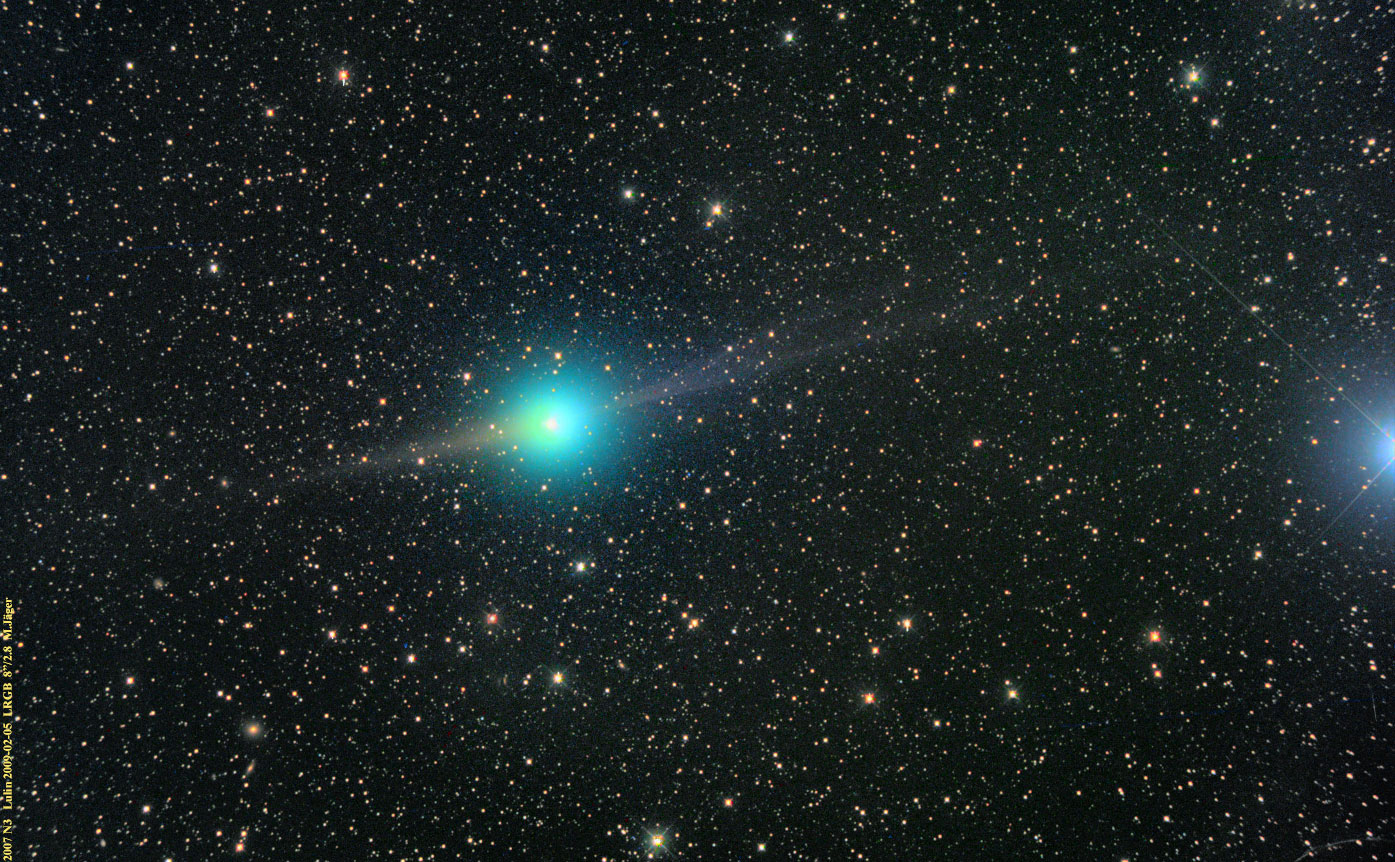
comet lulin passed around the sun last month and now approaches the earth, on its way back to the outer solar system. despite what my fingers keep typing, lulin was not named after a harry potter character, the comet was named after the lu-lin observatory in taiwan, where it was discovered in july 2007. lulin will reach its closest point to earth on february 24, 2009, passing at a distance of 0.41 AU (one astronomical unit (AU) is the distance between the earth and the sun). february 24th is an exciting date from our position in solar system because we'll also be able to see a quadruple transit of saturn!!
i've collected some images taken around the world, but check out space weather and caffeinated astronomy for other nice collections! jack newton took this image in arizona on 18 february 2009.
the green glow of the comet comes from the gases around the nucleus. cyanogen and diatomic carbon both glow green when illuminated by the sun's light. the tails of comet lupin change over time, innocently changing positions and brightness as they interact with the sun's energy output!
comet lulin will reach a brightness of 5th magnitude, which means some people might be able to see it with their eyes. you can definitely see it with a steady pair of binoculars, or even better, with a small telescope.
right now, saturn's rings sit in an edge-on position relative to earth... saturn is sideways. christopher go took advantage of this position to image the moon, titan, as it transited in front of the ringed planet on feb. 8, 2009. he used an 11-inch telescope to create this little movie:
go's movie shows a preview of the event happening on february 24th, 2009! not only will that date treat us to comet lulin's closest approach, we will also see *four* of saturn's moons pass directly in front of the planet at the same time: titan, mimas, dione and enceladus!!! a quadruple transit!
saturn will sit very close to comet lulin on feb 24, 2009, so get your telescopes ready and look to the southwest before dawn!!
six year old Madin Mohammed demonstrates some impressive futbol skills! he was born in algeria and is following in the footsteps of Zinedine Zidane. its amazing to watch MM's balance as he twists around and flicks the ball around his legs and other players!
i hope that MM stays healthy and uninjured over the next decade of his life, so all options are available to him when he's gets old enough to make big choices. i also hope that the big teams tracking him remember to give him enough space to be a kid and enjoy his life!
so the galaxy zoo 2 project has launched - ahead of schedule!!!?? does that ever happen with anything? nice job folks!
anyway, i'm completely mesmerized by the collection of preliminary classifications of galaxy data put together by steven bamford! just take a look at the amazing variety of galaxies that exist in our universe!
below, i show a small sample of galaxies categorized by the public as having five spiral arms...
awesome! to summarize my research in a sentence.... why do all those different types of galaxies have the different colors, shapes, features, and sizes that they do? fantastic.
if you have some extra time, go have fun with the galaxy zoo!
i'm in oxford today! i gave a seminar a few hours ago and now i'm thinking about the comments people made about the research. one of the most interesting parts of doing research is presenting the results to people who havent spent so much time thinking about the same details. oftentimes, they look at the situation from fresh perspectives and ignite new ideas with simple comments!
i also talked a bit with chris lintott who was bounding with excitement about the lift off of galaxy zoo 2!! later tonight, you can check out galaxy zoo 2 and sift thru gorgeous images of thousands and thousands of galaxies! by classifying their properties, you are helping us to classify more galaxies than we could possibly do ourselves and ultimately, contributing to great new science results! so - give it a go!
ps. i had to walk past so many beautiful old buildings in oxford thats its unfortunate the oxford astrophysics group lives in a much more modern (read: more ugly) building :( oh well.
APOD featured the heart-shaped, star-forming region, W5, last year. viewed below is the infrared image captured by the spitzer space telescope. i cropped the image to show the heart portion of the "heart and soul nebula"!
this star-forming complex sits 6,500 light years away in the cassiopeia constellation. the processes of all the gas condensing down to give birth to new stars leads me (loosely) into the next valentine's day feature: jay grandin's inanimate love:
some lovely images and art:
and i'll end with a simple valentine... like the ones we used to sign and embarrassingly hand out to each other kid in our elementary classes on valentine's day:
"We placed a camera on a conveyor at a Tokyo/Asakasa sushi bar named Maguro-bito(near the Nakamise Shopping Arcade). It was about 9pm and the place was packed with great people. "
this cool photo of an in-focus moon and out-of-focus firework comes from the big picture feature on china's lantern festival (that suffered an unfortunate ending).
i'm shocked to have just realized that i've never formally encouraged readers to check out the wonderful book by kip s. thorne: black holes and time warps. i first read this book one summer as an undergraduate, soon after i switched my major to physics. my summer research project was to find the simplest solution to einsteins field equations!! wow, was i thrilled, and scared!
my first assignment was to read black holes and time warps all the way thru, stopping by the professors office every other day to ask any questions that arose. to my pleasant surprise, the entire first chapter is a fun science-fiction story that tracks what happens to space travelers as they approach black holes of bigger and bigger masses! it took me about a month to get thru the book, and the last few chapters regarding worm holes and potential time warps completely boggled my noggin - but i was intrigued, and it was a good thing, because i spent the rest of that summer learning to solve tensor equations!
the final solution that i acquired (with the help of mathematica) wasnt the memory that stuck with me of my summer project. it was the imagery from thorne's book that has sunk into my soul. a couple years ago i met thorne while he visited UT-austin. i attended a lunch with him where he discussed the potential for detecting gravitational waves with spaced-based instrumentation. he signed my copy of him book and seemed pleased to hear that it greatly influenced my early career.
anyway, all this is leading up to the fact that kip thorne wrote a guest post at cosmic variance about stephen hawking, who is giving a public lecture at the pasadena convention center on march 9, 2009. report back if you get to attend! enjoy!
now if only i could get a translation of all the acronyms my teenage cousins use on myspace, facebook, and in emails!
i feel moderately illiterate to the internet language of the youth, and i keep up with technology at a reasonable pace. i can't imagine the natural smoothness with which technology upgrades integrate into the lives of young people. will the steady rate at which older generations passed down practical knowledge to younger generations be unrecognizable to my children - considering their technologically modern world will require new and different skills every couple years?
i didnt use a computer in school until i was a teenager. teaching would be less fun if i couldnt prepare power point presentations with pretty pictures - but there's a lot to be said for the old "chalk and blackboard" method as well.
am i just getting crabby and old and tired of relearning old skills with new software?
carmina burana is a fantastically powerful piece of music for a full orchestra and chorus, composed by carl orff in 1935 and 1936. you hear the last movement often in dramatic cinematic scenes, as you might recognize from this video clip:
the video above shows that exact chorus and orchestra performing the memorable movement in 2000, just a few years after i left the group! the director, james conlon, was an intimidating man to a high school student. we were able to rehearse with the adult choir several times before we performed the piece on stage. i sat among the sopranos, continuously amazed by the powerful vibration of their collective voices. most of the rehearsals were directed by the adult choir conductor, but i distinctly remember the first rehearsal with mr. conlon.
during a quiet moment is the rehearsal, when mr. conlon was explaining an important point, my watch started beeping to tell the hour - completely mortifying my fragile young self after it took me a couple seconds to realize i was the cause of the terrible sounds!! oh NO! he stopped cold. he turned to me furiously, pointed directly at me with his director's wand, and declared that such a scene should never interrupt him again! *gasp* ... yes, sir. sorry, sir.
needless to say, i never wore that silly watch to rehearsal again, and still have nasty flashbacks sometimes when i hear cell phones ringing at inopportune times. in fact, seeing him in the above video reminded me of the incident (obviously) just after i remembered the thrill of actually performing carmina burana on stage!
anyway, the thing that reminded me of all these events, was this little video of alternative lyrics to carmina burana, that i just found on neat-o-rama. this made me cry from laughing! enjoy!
last week saw the 2009 session of the TED conference with the theme "the great unveiling." several videos of talks are available to view already on the website, but i'm intrigued by TED prize winner, jill tartar. she is the director of the SETI (Search for Extraterrestrial Intelligence) Institute’s Center for SETI Research and as a TED prize winner, she can share her vision ("wish") to change the world. she states:
"I wish that you would empower Earthlings everywhere to become active participants in the ultimate search for cosmic company.”
her ideas gone much beyond the public flashing SETI related graphics on our screen savers hoping to receive signals from distant planets! read more about her ideas: here.
in other TED news, xkcd identifies a critical question facing participants of all modern social networks:
IC 1101 the biggest galaxy we've found in the universe! it lives 1 billion light years away (at z = 0.0767) in the massive abell 2029 galaxy cluster. the unromantic name comes from the index catalogue which was created at the end of the 19th century.
IC 1101 floats with a girth of 6 million light years, making it 60 times larger than our milky way with its mere 100,000 light year diameter. how many stars does the most massive elliptical galaxy contain? 100,000,000,000,000 = 100 trillion = 10^14 stars. how does the number of stars in the largest galaxy in the universe compare to the number of cells in the human body? see starts with a bang to find out!
the above right image shows the entire abell 2029 cluster in optical light from the digitized sky survey. IC 1101 is the big bright one living right at the center. the left image shows what the cluster looks like in x-ray light, as seen by the chandra telescope. the optical views shows lots of individual galaxies floating around the biggest concentration of mass that sits right at the center. the x-ray light is created by very very hot gas. the image shows a smooth distribution of multi-million degree gas, concentrated at the center of the cluster, but extending far out into the outer regions! here's another optical image...
one thing i wonder... why is this the most massive galaxy in the universe? why dont galaxies get bigger? there are several galaxies at the centers of different clusters that are close to this big, but what creates an upper limit on the mass of a galaxy? (and the dark matter halo that it lives in?) basically, the limits are set by the initial distribution of matter after the big bang, time, and the expansion of the universe, but... i still wonder.